
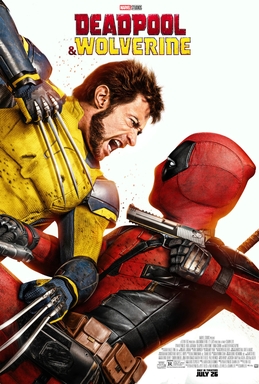
Behind the film
- Year
- 2024
- Director
- Shawn Levy
- Writers
- Rhett Reese, Shawn Levy, Paul Wernick, Zeb Wells, Ryan Reynolds
- Genres
- Superhero, Action, Black comedy, Science fiction
- Production
- Marvel Studios, Maximum Effort, 21 Laps Entertainment
- Country
- United States
- Cast
- Ryan Reynolds, Hugh Jackman, Emma Corrin, Matthew Macfadyen, Morena Baccarin, Rob Delaney, Dafne Keen, Jennifer Garner
About the film
Contains story spoilers.
Wade Wilson has traded superhero work for an ordinary job when the Time Variance Authority offers him a place in another universe. His own world is dying because its anchor figure, Logan, is dead. Wade recruits a different Wolverine, a disgraced survivor, but Paradox sends both men to the Void. There they encounter Cassandra Nova and discarded heroes. With help from a resistance group, they escape, only to discover Cassandra intends to use Paradox's Time Ripper to destroy other timelines. Wade and Logan share its otherwise fatal energy, defeating her and surviving. The TVA arrests Paradox, their world recovers, and this Wolverine finds a place among Wade's friends. His past remains tragic; the resolution gives him a future rather than undoing everything he regrets.
Deadpool & Wolverine turns belonging into a question of franchise membership. Wade wants to matter, but the organisation offering him significance treats an entire world as disposable. That contradiction gives his jokes a more uncomfortable setting than a straightforward promotion into a bigger superhero team. A supposedly superior institution can recognise his commercial usefulness without recognising the value of the people around him. The film's emotional argument grows from that difference. Being invited into a prestigious universe means little if admission requires accepting that everyone who made life meaningful can be erased. Its enormous fictional machinery therefore has an unusually domestic stake: preserving a circle of friends.
Ryan Reynolds and Hugh Jackman organise the central pairing around incompatible ways of handling shame. Wade fills silence before anyone can challenge him, turning embarrassment into verbal aggression. Logan makes silence itself aggressive. His physical presence appears to promise certainty, while his reluctance to engage suggests how little confidence he has in the person behind it. Put together, these habits create comedy through friction rather than simple agreement. Wade needs an audience, and Logan is particularly unwilling to become one. Their partnership becomes interesting when attention stops being something one man steals and begins to become something each can offer without immediately mocking or rejecting it.
The multiverse has a useful function beyond providing recognisable faces. It allows an identity to be recognisable while its history is different. A costume and a name can carry enormous expectations, yet they cannot tell Wade what this particular man has endured. That gap gives the film room to separate a beloved public image from an individual's worth. The idea also applies to its crowded supporting world. Characters who appear to have been left behind by the machinery of entertainment still have desires inside the story. Recognition supplies the first laugh, but the larger question is whether being forgotten makes someone expendable.
Emma Corrin's Cassandra offers a different kind of threat from the loud collision of the leading men. Her ease around power contrasts with their defensive performance. Matthew Macfadyen's Paradox makes institutional cruelty sound like a practical scheduling matter, giving the cosmic danger the manners of an office decision. These contrasting registers matter because Deadpool's irreverence could otherwise flatten everyone into the same comic rhythm. A calm antagonist and an administrator who talks through disaster create space for his interruptions to have targets. The scene can be funny because a frightening attitude is being exposed, even while the consequences of that attitude remain serious.
The action treats bodily damage as elastic comic material, with the protagonists' extraordinary resilience supporting prolonged, excessive confrontations. That affects how the violence reads. Injury can become an insult delivered through choreography, a physical continuation of an argument that refuses to finish. The film's adult language and graphic spectacle are therefore central to its temperament rather than incidental flourishes on a children's adventure. Its musical choices can also position familiar superhero imagery against an incongruous emotional register. The pleasure often lies in the difference between how grandly a confrontation is presented and how petty the men conducting it can be.
Its references work on two levels. A viewer familiar with earlier screen versions of these characters can read the encounters as an affectionate, sometimes abrasive conversation with superhero cinema's recent history. Someone with less background can still follow the basic arrangement of outsiders seeking a second chance. The film does ask for an appetite for self-reference: a remark may concern the fictional situation, the actor's public persona and the business of making these films at once. Those layers make Wade an unstable guide. He can puncture an illusion that the emotional story must then persuade the audience to enter again.
Shawn Levy's film finally depends on whether that movement between ridicule and sincerity can hold. Its most substantial idea is that redemption need not be a complete restoration of an earlier self. A person can carry failure into a new relationship without being magically cleared of it. Friendship becomes an alternative to measuring worth through a perfect heroic record or an institution's approval. Under the crowd of costumes, jokes and spectacular collisions sits an argument about remaining answerable to particular people. The scale is cosmic, but the destination is the possibility of sharing an ordinary life after the spectacle has ended.