
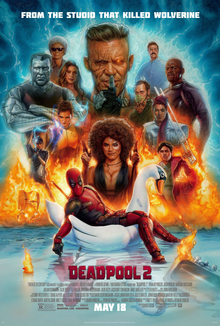
Behind the film
- Year
- 2018
- Director
- David Leitch
- Writers
- Rhett Reese, Paul Wernick, Ryan Reynolds
- Runtime
- 1h 59m
- Genres
- Black comedy, Superhero, Lgbtq-related, Time-travel
- Production
- 20th Century Studios, Marvel Entertainment, The Donners' Company
- Country
- United States
- Cast
- Ryan Reynolds, Josh Brolin, Morena Baccarin, Julian Dennison, Zazie Beetz, T. J. Miller, Brianna Hildebrand, Jack Kesy
About the film
Contains story spoilers.
Deadpool 2 takes a character who can survive almost any physical injury and gives him a problem that regeneration cannot fix. Wade Wilson's body keeps repairing itself, but that does not tell him what to do with grief or how to be useful to someone else. The contradiction supplies the film with both its emotional story and its comic machinery. Ryan Reynolds's Wade talks through danger, punctures heroic poses and acknowledges the entertainment around him. The second film places those habits beside people whose needs cannot be met by another joke. Its world remains one of costumed mutants and exaggerated violence, but its central relationship is between a directionless adult and a child who has been taught to expect cruelty.
Vanessa dies after one of Wade's targets follows him home. Colossus brings the grieving Wade into the X-Men, whose intervention at a mutant orphanage introduces Russell, a boy abused by its staff. Wade kills a staff member, and both he and Russell are imprisoned with collars suppressing their powers. Cable arrives from the future to kill Russell before he becomes the murderer of Cable's family. Wade's rescue team largely dies during its first mission, leaving Domino beside him. Russell escapes with Juggernaut and returns to kill the orphanage headmaster. Wade finally shields him from Cable's bullet while wearing a collar, and the sacrifice changes Russell's decision. Cable rewinds events to save Wade. A repaired time device later lets Wade rescue Vanessa as well.
The collars matter because they briefly remove the protection that makes Wade's usual recklessness possible. His healing ability often turns injury into an outrageous visual gag: destruction does not have the permanence it has for other people. Suppressing it changes the meaning of placing himself in danger. The story can then distinguish between a mercenary who takes risks because he expects to recover and somebody who accepts a cost for another person's sake. It also places him nearer Russell's vulnerability. Wade cannot simply defeat the boy's future with superior fighting ability. He needs Russell to believe that another relationship is possible, and that is a harder task than surviving a prison fight or growing back damaged limbs.
Cable, played by Josh Brolin, approaches the same child from the opposite direction. His knowledge of a possible future turns Russell into a threat before the boy has committed the act in question. The logic is efficient, severe and personal: preventing one death might protect the family Cable has lost. Wade's resistance introduces a different understanding of prevention. Rather than treating Russell's eventual violence as an essential part of him, he recognises the abuse and abandonment surrounding it. This does not make Russell harmless, or make the people nearby safe while he is furious. It makes the future a result that may still change. Cable's seriousness also supplies a steady surface against which Wade's evasions and improvisations can bounce.
Domino brings another kind of confidence into that partnership. Her power is luck, which creates a useful contrast with characters who visibly strain, plan or shout their way through a crisis. Action can unfold around her as a chain of fortunate outcomes rather than a demonstration of superior strength. The effect is comic, but it also changes the team's balance: Wade does not have to be the only person whose relationship with danger seems unusual. X-Force's disastrous introduction pushes the opposite idea. A name, a recruitment process and a collection of powers are insufficient foundations for a functioning group. The elaborate promise of a new superhero team collapses into a grotesque joke, leaving the smaller relationships to do the actual work of the story.
That combination of grotesquerie and affection shapes how the film handles family. Colossus represents a disciplined community Wade repeatedly tests; Vanessa is a connection he struggles to imagine living beyond; Russell needs protection that does not disappear when he becomes difficult. None of these relationships requires Wade to turn into a decorous traditional hero. They do require him to look past his own pain. The film repeatedly places his enormous capacity for physical recovery beside a much less automatic capacity for emotional change. Russell's fire and Cable's weaponry make that problem spectacular, but their conflict has an ordinary underlying structure: adults decide whether to define a child by the worst thing he might do, or help interrupt the conditions leading there.
David Leitch directs the 2018 sequel, with a screenplay by Rhett Reese, Paul Wernick and Reynolds. Its action comedy uses the mismatch between superhero grandeur and bodily embarrassment, while Wade's commentary keeps reminding us that a movie is arranging these events. The later time-travel jokes extend that freedom beyond the immediate plot and into the character's screen history. They also complicate the permanence of the loss that began the story. The account here follows the theatrical film, whose ending leaves a makeshift group together after an attempted rescue has become an act of care. Beneath the jokes about teams and costumes, its change is straightforward: Wade learns that belonging involves protecting someone who cannot repay him with the life he originally wanted back.