
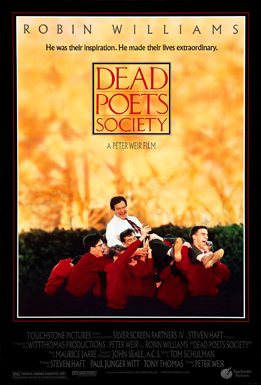
Behind the film
- Year
- 1989
- Director
- Peter Weir
- Writers
- Tom Schulman
- Runtime
- 2h 9m
- Genres
- Coming-of-age, Drama, Teen
- Production
- Touchstone Pictures
- Country
- United States
- Cast
- Robin Williams, Robert Sean Leonard, Ethan Hawke, Josh Charles, Gale Hansen, Dylan Kussman
About the film
Contains story spoilers.
Welton Academy presents itself through four ideals—tradition, honour, discipline and excellence—and expects its boys to accept a tightly mapped route toward status. The arrival of English teacher John Keating brings a different kind of lesson. He asks students to consider poetry as something lived rather than a set of lines to memorize, and his classroom practices make interpretation physical and personal. Todd Anderson, a shy new student, shares a room with Neil Perry, whose confidence and curiosity conceal the pressure he feels from his demanding father. Their friendship gives the film a close view of how the same school rules land differently on each boy. Welton’s opening ceremony reinforces the sense that students inherit a structure before they have the vocabulary to question it.
Keating’s methods unsettle the orderly curriculum. He has the class stand on desks to change their perspective, and he encourages them to seize the day while remaining alert to the brevity of life. When the students discover that he belonged to a secret club called the Dead Poets Society, Neil persuades the others to revive it. They meet in a cave to read poems, joke, and try out versions of themselves that have little space in the school’s formal halls. The gatherings are not a simple escape from responsibility; they give the boys a private language for desires that they have barely learned to express. The cave meetings let the boys experiment with poetry and friendship without turning the club into an organized plan to overthrow the school.
Neil’s central conflict emerges when he finds a part in a local production of A Midsummer Night’s Dream. Acting gives him a chance to explore a creative ambition, but his father has already decided that he will become a doctor and treats the play as a distraction. Neil forges the required permission for the play and pursues the role despite his father's opposition. At the same time, Todd works through his fear of speaking in class. Keating invites him to improvise a poem, turning an awkward moment into evidence that Todd has an imaginative voice of his own. The two arcs show different costs of self-expression: Todd has to risk embarrassment, while Neil risks open conflict at home.
As opening night approaches, Neil confides in Keating about his father’s refusal to let him perform. The immediate problem is permission, but behind it sits a much larger argument about who will decide the course of his life. Keating encourages Neil to speak honestly with his father, making clear that a teacher cannot grant the parental permission Neil needs. Neil instead tells Keating that he has discussed it and his father approved. The performance succeeds, and Neil’s classmates see a side of him the school hierarchy has not made room for. His father attends, takes him home afterward, and announces Neil will leave Welton for military school, with medicine still fixed as his future. That night, unable to see a way to claim the future he wants, Neil dies by suicide. His death devastates his parents and friends. The film leaves the force of those competing expectations visible without presenting his death as a romantic victory or a resolution to the conflict.
Welton responds by protecting its authority. The headmaster, Gale Nolan, investigates the forbidden society and frames Keating as responsible for Neil’s death. Cameron, facing pressure from the school, names his former friends and signs a statement that helps shift blame onto the teacher. The boys are made to sign as well, with the threat that refusal could jeopardize their futures. Todd resists the account at first but is eventually coerced into signing. Keating is dismissed, and the institution appears to have restored order by identifying one convenient cause for a tragedy shaped by much broader expectations.
The final classroom scene gives a different measure of what the students have taken from Keating. As he returns to collect his belongings, Todd speaks up about the pressure used to secure the statements. Nolan tries to restore the ordinary lesson, but Todd stands on his desk and addresses Keating with the class’s salute. Other students follow, while some remain seated. Their gesture cannot undo what happened to Neil or immediately reform Welton, but it makes the boys’ choice visible. The film ends on a divided room rather than a clean triumph, leaving courage as a beginning that carries consequences. The inquiry converts a complicated chain of adult failures into a disciplinary problem the headmaster believes he can close.
Peter Weir frames the school as an imposing world of wood, stone, ritual, and carefully managed movement, then lets Keating’s classes loosen that visual order. The contrast gives the poetry lessons their energy without pretending the students can step outside their social context. The film’s central question is not whether rules are always wrong; it is whether adults will listen when a young person says that the approved future does not fit. Neil’s story makes the stakes painfully concrete, while Todd’s quieter development shows the value of finding words and solidarity. The final salute is moving because it is incomplete: it acknowledges a teacher, but also exposes a system that has already failed one of its students.