
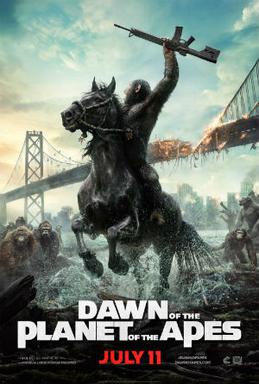
Behind the film
- Year
- 2014
- Director
- Matt Reeves
- Writers
- Mark Bomback, Rick Jaffa, Amanda Silver
- Runtime
- 2h 10m
- Genres
- Science fiction, Action, Drama, Thriller
- Production
- 20th Century Studios
- Country
- United States
- Cast
- Andy Serkis, Jason Clarke, Gary Oldman, Keri Russell, Toby Kebbell, Kodi Smit-McPhee, Judy Greer, Karin Konoval
About the film
Contains story spoilers.
Matt Reeves’s Dawn of the Planet of the Apes begins with a world changed by the simian flu. Human society has collapsed, and Caesar leads an ape community in Muir Woods, where families, rules and a shared sign language give the colony a recognizable civic life. The forest is not an empty refuge: it is territory with boundaries, memories and a history of human abuse. Caesar’s authority depends on a fragile idea that the apes can build a society different from the one that mistreated them, even as survival keeps placing them near the humans they fear.
Malcolm leads a small group from San Francisco into the apes’ territory to reach a hydroelectric dam that might restore power to the human settlement. Carver’s frightened gunshot injures a young ape and threatens to turn the encounter into violence, but Malcolm manages to prevent escalation. Caesar orders the people away, then visits their community to make clear that the apes will defend their land. The negotiation that follows is practical and personal: Malcolm asks to work on the generator, while Caesar agrees only if the humans surrender their guns. The dam offers a shared purpose, but neither side can ignore how quickly trust could collapse.
The human group includes Malcolm’s wife Ellie, a former nurse, and his son Alexander; the apes include Caesar’s wife Cornelia, their son Blue Eyes, and his adviser Maurice. These family relationships keep the political conflict from becoming a simple contest between species. Malcolm and Caesar recognize in one another the burden of leadership, while Koba sees compromise as an invitation to repeat old domination. Koba’s hatred comes from the abuse he endured in human laboratories, but his history does not excuse the choices he makes. His grievance becomes the language through which he persuades others to accept a war they had not wanted.
Reeves builds much of the film’s world through posture, gaze and sign. The apes communicate across group settings without relying on a human voice-over to translate every feeling, and the camera often holds long enough for gestures to function as decisions. Andy Serkis’s Caesar is not defined only by facial expression: stance, hesitation and movement signal when he is speaking as a father, leader or former human-raised outsider. The digital image has to preserve that performance inside a believable body, so the effects work serves social interaction rather than merely showing off visual detail.
The truce is tested when one human, Carver, secretly keeps a gun despite the agreement. Ellie helps save Cornelia, and the two communities continue working, but human leader Dreyfus arms his settlement in preparation for a possible attack. Koba discovers the weapons and confronts Caesar, accusing him of caring more for Malcolm’s group than for his own people. Caesar beats him but refuses to kill him. Koba then takes a rifle, kills Carver after the generator is repaired, and shoots Caesar while framing humans for the attack. The lie gives him control of the ape army and turns fear into invasion.
Koba’s assault on San Francisco is followed by imprisonment and violence within the ape community. He kills Ash for refusing to kill humans and confines Caesar’s loyal companions. Malcolm’s family finds Caesar badly wounded and hides him in his former home; Blue Eyes learns his father is alive and helps free the prisoners. In the tower, Malcolm confronts Dreyfus, who has rigged the base with explosives after contacting a military force. Caesar faces Koba above the city and defeats him, letting him fall. When Malcolm warns that human troops are coming, Caesar sends the family away and prepares his people for war.
The story does not end by proving either community wholly right. Caesar condemns Koba’s betrayal, yet understands from the conflict that apes can be as violent as humans. Malcolm’s people have a legitimate need for electricity, but their weapons and Dreyfus’s militarization help make cooperation precarious. The film’s political tension comes from the gap between what leaders intend and what their communities fear. A single secret gun, a misinterpreted injury or a deliberately staged attack can outweigh a period of shared work, especially when earlier violence has taught each side to expect the worst.
The visual design gives this argument scale without losing the characters. The forest is dense and vertical, while the ruined city and power infrastructure expose the remains of human systems; the dam creates a shared point of contact between communities, but also a resource neither can easily spare. The final tower sequence gathers both conflicts in one structure, with Caesar and Koba fighting above Malcolm and Dreyfus’s standoff below. The ending’s approaching military force belongs to this film’s unresolved threat, not a later chapter’s outcome. Caesar’s final address returns the focus to leadership: he must prepare his people for danger even after resisting the logic that brought it.