
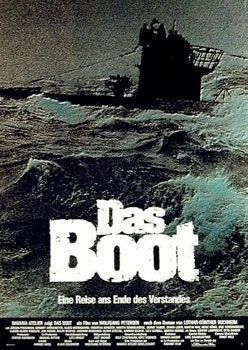
Behind the film
- Year
- 1981
- Director
- Wolfgang Petersen
- Writers
- Wolfgang Petersen
- Genres
- Drama, Historical, War, Submarine
- Production
- Bavaria Film, Producers Sales Organization
- Country
- West Germany
- Cast
- Jürgen Prochnow, Herbert Grönemeyer, Klaus Wennemann, Hubertus Bengsch, Martin Semmelrogge, Uwe Ochsenknecht, Heinz Hoenig, Jan Fedder
About the film
Contains story spoilers.
War correspondent Werner joins U-96 for an Atlantic patrol. The crew's boredom gives way to attacks, storms and desperate dives as they pursue shipping and evade escorts. After torpedoing a tanker, they witness sailors trying to escape it, confronting the human consequences of their success. Hoping to return, they instead receive orders to pass Gibraltar. An attack damages the submarine, which sinks onto a deep sea shelf. With air running short, the crew repairs it and manages to surface. They limp back to La Rochelle, where arrival seems to offer safety. An air raid devastates the harbour, kills crew members and sinks the boat. Werner emerges to find the wounded captain watching it disappear; the captain collapses and dies, leaving survival without the resolution a homecoming promised.
The submarine gives Das Boot an unusually concentrated world. A ship can be a workplace, a shelter and a weapon at once, with no easy separation between those functions. The conditions which make the crew effective also keep them enclosed together. Privacy becomes limited, movement has practical constraints and another person's ability to perform a task can decide whether everyone survives. That makes solidarity more than an attractive wartime idea. It is built into the physical situation. The story's intimacy comes from allowing the audience to understand how closely ordinary habits and mortal danger can coexist when there is nowhere else to go.
Waiting matters as much as action to that situation. A crew organised around possible danger cannot spend every moment confronting an identifiable enemy. Anticipation can become wearying precisely because it offers so little useful information. The transition from routine to crisis then feels less like a change of genre than an exposure of the risk which was already present. Petersen's premise gives the ordinary interval a purpose: it establishes people as inhabitants of a continuing life rather than figures who exist only when a battle begins. Knowing how they occupy the boat makes later urgency legible, because the emergency interrupts a world the film has allowed us to recognise.
Werner's presence creates a distinction between recording war and undergoing it. A correspondent arrives with the prospect of turning experience into an account for others, but the experience itself can dismantle the categories he expected to use. The role invites questions about what an image or report can adequately convey. Competence, fear and exhaustion do not necessarily combine into a heroic story simply because someone has been assigned to document them. The film's perspective becomes useful when the observer's distance narrows. He has to depend on the people he came to describe, making spectatorship a position with limits rather than a secure place outside events.
The captain's authority also depends on more than rank. In an enclosed system, command must operate through judgement that others can trust under pressure. A confident order is useful only if it recognises what the boat and its crew can actually do. That tension makes leadership a practical responsibility rather than a permanent aura of strength. The man giving instructions faces the same physical dangers as those obeying them, yet the unequal burden of deciding remains. The drama asks us to notice the gap between having the power to direct people and being able to promise them safety. The first can exist even when the second has become impossible.
Understanding the crew's human relationships does not require treating their mission or government as justified. A war film can bring viewers close to people serving a destructive order while leaving that order morally unresolved. Das Boot's perspective is demanding because technical admiration and ethical judgement need not move together. An effective attack can be a professional achievement and a human catastrophe at the same time. That distinction prevents identification with the enclosed crew from becoming a complete explanation of the conflict around them. Their fear is real within the drama, but so is the danger their work creates for people outside the boat.
The rescue work deep below the surface makes expertise tangible. Mechanical knowledge is valuable because it can create a possibility where hope alone cannot. At the same time, the environment supplies limits no individual can negotiate away through bravery. Pressure and available air do not recognise a person's determination or deservingness. This gives the submarine story its particular suspense: a solution has to be materially possible, and the people attempting it have to remain capable long enough to carry it out. The film can honour that effort without claiming the surrounding war rewards it fairly. Survival is an outcome of work and circumstance, not evidence of moral entitlement.
The final return denies the familiar promise that reaching a home port will make the preceding danger coherent. A boundary which looked like the end of the ordeal cannot stop the wider conflict. That makes the boat's concentrated world both essential and incomplete: it has contained the men's immediate responsibilities, but has never contained everything capable of destroying them. The story's force comes from that disparity. People can accomplish something extraordinary together and still find that their achievement offers no protection from the next event. Das Boot leaves the audience with the value of their effort and the waste surrounding it, refusing to turn one into an explanation which cancels the other.