
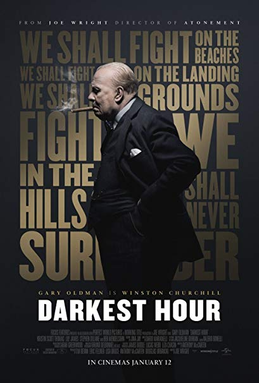
Behind the film
- Year
- 2017
- Director
- Joe Wright
- Writers
- Anthony McCarten
- Runtime
- 2h 5m
- Genres
- Biographical, War, Drama
- Production
- Working Title Films, Perfect World Pictures
- Country
- United Kingdom
- Cast
- Gary Oldman, Kristin Scott Thomas, Lily James, Stephen Dillane, Ronald Pickup, Ben Mendelsohn
About the film
Contains story spoilers.
In May 1940, Churchill becomes prime minister after Chamberlain is pushed out, though parts of his party and King George VI distrust him. As German forces advance, Churchill resists Halifax and Chamberlain's effort to negotiate through Italy, while the evacuation at Dunkirk becomes urgent. His stance strains his cabinet, king and family; an early public speech does not immediately secure support, and Halifax and Chamberlain prepare a political challenge. George later offers his backing, and Churchill visits ordinary Londoners before addressing his colleagues. Parliament backs his call to continue fighting. The film ends with a brief account of Dunkirk's evacuation and the later fates of Churchill, Chamberlain and Halifax.
Joe Wright frames political pressure through rooms and corridors rather than through battlefield spectacle. Cabinet meetings, private offices and passageways make government feel like a physical maze in which a decision has to pass through several forms of resistance before it can become national policy. Churchill is often placed among people who disagree with him, not isolated as a lone hero, and the cramped interiors give arguments a bodily closeness. The film's movement between public chambers and quieter spaces reminds us that a political position is formed through negotiation, fatigue and relationships as much as through a speech delivered to a crowd.
Gary Oldman's performance builds Churchill through rhythm and physical presence: a voice that can be forceful, hesitant or playful, and a body whose effort is visible beneath the prosthetic transformation. The role is not presented as a collection of famous phrases. Its dramatic interest lies in the gap between a commanding public identity and a man uncertain whether his judgment will hold under immediate pressure. The performance allows the character's appetite, temper and humour to coexist with fear, making the private indecision part of the film's central conflict instead of an embarrassing detail to be hidden before the next oration.
Clementine and Elizabeth Layton offer distinct responses to Churchill's authority. Clementine can challenge him as someone who knows the habits behind his public image, while Layton is professionally close enough to see how brusqueness affects the people around him. Neither relationship exists only to praise his leadership. Their corrections place the cost of his personality beside the scale of his responsibility and make the household an intimate counterpart to the cabinet. The film gives those women a role in interpreting Churchill rather than merely documenting him, so that political confidence is shown as something tested in private as well as in public.
King George VI is another necessary counterweight. His skepticism is rooted in the history the film gives their relationship, and his eventual support does not make him a passive instrument of Churchill's will. Their meetings turn constitutional authority into a personal encounter: both men carry public roles into a small room, but neither can rely on ceremony alone to settle the question of trust. The shifting alliance also helps show that Churchill's position is not secured simply by his appointment. He must persuade colleagues and institutions while accepting that confidence has to be earned from people whose judgment matters.
The film's historical drama is compressed into a short period of crisis, with events arranged around Churchill's choice between negotiation and continued resistance. That compression produces urgency, but it also means that the film should be understood as a dramatic rendering rather than a complete account of the wartime government or a neutral record of every participant's motives. Its focus is the experience of uncertainty inside leadership: bad news arrives, allies disagree, and the next decision must still be made. The polished structure lets the audience follow those pressures while leaving broader history larger than the individual story on screen.
The Underground sequence changes scale by moving Churchill outside the formal rooms of government and into a public space where he meets passengers. This encounter was invented for the film; it is a cinematic expression of civilian resolve, rather than a recorded meeting or a survey of what Londoners believed. That distinction matters because the scene functions symbolically: it gives him a way to imagine the public's resolve at a moment when elite debate has narrowed his options. The film's choice to visualise this encounter turns an internal political question into a face-to-face scene, but it also simplifies how national consent is formed.
The story ends on the threshold of a larger war rather than resolving the historical struggle itself. Its focus remains the moment Churchill chooses the words and political stance with which he will ask the country to endure danger. The final movement draws force from performance and audience response, but the film has already made clear that words cannot move troops or guarantee an outcome by themselves. They can, however, give a divided government a common public position. That gap between rhetoric and material reality is the film's most useful tension: a speech matters because of what it enables, not because eloquence alone defeats an army.