
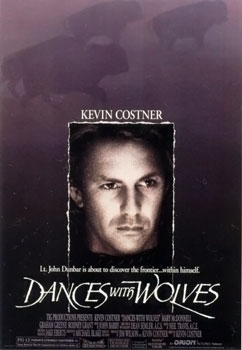
Behind the film
- Year
- 1990
- Director
- Kevin Costner
- Writers
- Michael Blake
- Runtime
- 3h 1m (theatrical version)
- Genres
- Drama, War, Western, Adventure
- Production
- Tig Productions, Majestic Films International, Allied Filmmakers
- Country
- United States
- Cast
- Kevin Costner, Mary McDonnell, Graham Greene, Rodney A. Grant, Floyd Red Crow Westerman, Tantoo Cardinal, Wes Studi, Maury Chaykin
About the film
Contains story spoilers.
Dances with Wolves begins in the American Civil War with an act that looks heroic only from a distance. Lieutenant John Dunbar, wounded and facing the loss of his foot, rides across the Confederate line hoping to be killed. He survives, his charge helps break the stalemate, and the army rewards him with treatment, his horse Cisco and a choice of posting. He asks to see the western frontier before it disappears. That decision takes him to Fort Sedgwick, where there is no garrison to greet him and no orderly system waiting to explain what has happened. Alone in a deteriorating outpost, he starts keeping a journal and putting the place back into working condition.
The empty fort gives the film time to establish a relationship with the landscape before it becomes a contested territory. Dunbar watches the grasslands, tends his horse and names a visiting wolf Two Socks after its white paws. The animal approaches cautiously, much as his future neighbours will. His first encounter with Kicking Bird, a Lakota holy man, is awkward and frightening for both men. Wind in His Hair is far less willing to trust the soldier. Dunbar eventually rides toward their village and finds Stands With a Fist, a white woman raised among the Lakota, injured while mourning her dead husband. Bringing her back creates an opening that neither side can yet explain in the other’s language.
Communication grows through visits, gifts and the help of Stands With a Fist, whose childhood English returns unevenly as she translates. Coffee and sugar at the fort become occasions for observation rather than grand speeches about understanding. Kicking Bird asks questions, Wind in His Hair tests his suspicions, and Dunbar discovers that the people described to him as enemies have individual obligations, humour and judgement. When he sees a buffalo herd and alerts the village, he joins a hunt that draws him further into its daily life. The sight of animals slaughtered for their hides gives that abundance a harsher context. A successful hunt means food and shared celebration; waste left by commercial hunters means a threat to the community’s future.
The bond becomes more personal as Dunbar spends longer in the village and grows close to Stands With a Fist. She is still in mourning, and Kicking Bird’s household has a say in when that period can end. Their romance therefore develops within relationships that already exist, rather than in a private world detached from the people around them. Dunbar receives the name Dances With Wolves after villagers see him playing with Two Socks. When a Pawnee attack threatens the village, he retrieves rifles from the fort to help defend it. He and Stands With a Fist eventually marry, while his friendships with Kicking Bird and Wind in His Hair deepen into commitments that his old military identity cannot comfortably contain.
The film also makes Dunbar’s knowledge uncomfortable. He knows more settlers and soldiers are coming, but hesitates to tell Kicking Bird how many. Friendship cannot alter the scale of the movement across the frontier. When the village moves to its winter camp, Dunbar returns to the fort for his journal, fearing that its contents could reveal where they have gone. Soldiers now occupy the outpost and treat the man in Lakota clothing as a deserter and traitor. His attempts to identify himself do not restore the authority his uniform once supplied. He is beaten and taken away under guard. Cisco and Two Socks are killed, so the return of the army destroys living connections established during his isolation.
Lakota friends rescue Dunbar during the journey to another fort, but the escape does not settle the danger. He now believes the army will keep pursuing him and that remaining with the winter camp would put everyone at risk. Stands With a Fist leaves with him. The farewell is full of objects and gestures that carry the history of their time together: Kicking Bird’s gift, the recovered journal and Wind in His Hair’s declaration of friendship as the couple rides away. Dunbar has gained a home and must leave it to protect it. The closing historical notice places that personal separation against the later loss of Lakota freedom, preventing the farewell from becoming a claim that mutual affection has solved the wider conflict.
Kevin Costner directs and plays Dunbar, with Michael Blake adapting his own novel. The film gives large stretches of conversation to Lakota dialogue and subtitles, so the village has a social life beyond the soldier’s ability to understand it. Graham Greene’s Kicking Bird and Rodney A. Grant’s Wind in His Hair offer different responses to his arrival, while Mary McDonnell’s Stands With a Fist carries a history of bereavement and displacement of her own. Dunbar’s journal supplies a close personal perspective; the expansive photography and John Barry’s music give that perspective room to grow. This remains a fictional Western arranged around one outsider’s transformation, but its strongest relationships are built through the time spent eating, speaking, working and making decisions together.