
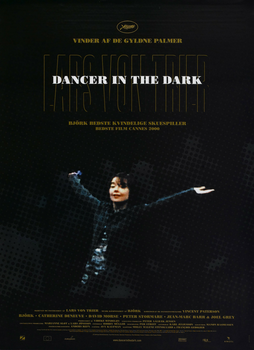
Behind the film
- Year
- 2000
- Director
- Lars von Trier
- Writers
- Lars von Trier
- Runtime
- 2h 19m
- Genres
- Musical, Drama, Trial
- Production
- Canal+, Film4, France 3
- Country
- Denmark, Sweden, Germany, United States, United Kingdom, Italy
- Cast
- Björk, Catherine Deneuve, David Morse, Peter Stormare, Joel Grey, Jean-Marc Barr, Udo Kier, Željko Ivanek
About the film
Contains story spoilers.
Dancer in the Dark places musical imagination inside a life where imagination cannot settle the material problems that keep arriving. Selma can transform the rhythms around her into another kind of experience, but those moments do not change what she earns, what she owes or how quickly her sight is deteriorating. The film's movement between daily life and musical fantasy keeps both conditions visible. Her inner world gives her a form of freedom that the surrounding circumstances do not offer, while the return from it makes clear that the circumstances have continued to exist during the song.
Lars von Trier wrote and directed the 2000 film, with Björk as Selma and Catherine Deneuve as her friend Kathy. David Morse plays Bill and Peter Stormare plays Jeff; Björk also composed the film's music. Selma is a Czech immigrant working in an American factory in the 1960s. Her hope centres on saving enough money for her son Gene's eye operation. The medical premise belongs to the fictional story, whose interest is the pressure created by a parent's effort to protect a child. Work and saving become purposeful acts, but they also leave her little room to absorb a setback without threatening the entire future she is trying to secure.
Selma confides her worsening vision to Bill, who has financial troubles of his own. He steals her savings and later accuses her of trying to rob him. Their confrontation ends with Selma killing him. She recovers the money and pays towards Gene's operation, but is arrested and convicted. Her refusal to reveal Bill's secret damages her defence. When friends try to use the money for a lawyer, she rejects a course that would endanger the operation. Before her execution, Kathy tells her that Gene's sight has been saved. The ending gives Selma that knowledge without saving her own life.
Selma's secrecy begins as a way of keeping her purpose intact. If other people understood how badly she could see, the employment supporting her savings might disappear, so acknowledging difficulty seems capable of producing another difficulty she cannot afford. That pressure makes her position precarious before the theft occurs. The work through which she is trying to secure a future for Gene also requires her to continue presenting herself as able to perform it. The film builds its tragedy around the narrowing space between what she needs and what she can admit to needing.
Bill's betrayal changes the meaning of a confidence. What Selma reveals in a moment of trust supplies him with an opportunity to exploit her, while his own disclosure becomes something she feels bound to protect. Their secrets therefore do not carry equal consequences. He uses knowledge of her vulnerability for his benefit; she treats knowledge of his vulnerability as a promise that still binds her. That imbalance persists after his death, because the story presented against her can make use of her silence. Loyalty becomes damaging when it survives in a relationship whose other participant has already violated it.
Kathy and Jeff offer concern from outside the private arrangement Selma has made around her son. Their help matters, but it does not automatically produce a solution she can accept. What they understand as a means of saving her can appear to her as a threat to the purpose for which she has worked. That conflict gives the later efforts to intervene their painful character. The people trying to support her are confronted with a choice organised by priorities they cannot simply replace, and the story allows care to remain real even when it cannot make her accept the course they want.
The musical passages make Selma's imagined relationships different from the relationships governing the plot. In fantasy, the world can move with her and answer her feelings through a shared rhythm. Daily life repeatedly restores inequalities that such movement seems able to suspend. That contrast gives the songs a dramatic function beyond providing breaks between events. They let the audience encounter how Selma experiences possibility, making the collapse of those possibilities more than a sequence of external misfortunes. The music has its own vitality, but the film never permits vitality alone to undo the decisions and institutions closing around her.
The final confirmation of Gene's successful operation gives the ending a narrowly defined achievement inside an overwhelming loss. It does not prove that Selma's death was an acceptable price or that her choices supply an example other people should follow. The tragedy depends on recognising how restricted the alternatives have become and how much remains beyond the reach of her imagination. Von Trier brings the fantasy and the surrounding reality to their most painful point of contact: Selma receives the news she has organised her life around, yet the world in which her son can see continues without allowing her to remain in it.