
Behind the film
- Year
- 2021
- Director
- Craig Gillespie
- Writers
- Dana Fox, Tony McNamara
- Runtime
- 2h 14m
- Genres
- Comedy, Adventure, Crime
- Production
- Walt Disney Pictures
- Country
- United States, United Kingdom
- Cast
- Emma Stone, Emma Thompson, Joel Fry, Paul Walter Hauser, Emily Beecham, Mark Strong, Kirby Howell-Baptiste
About the film
Contains story spoilers.
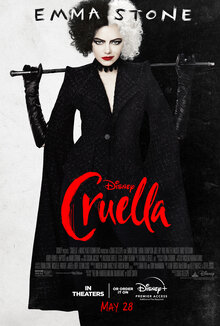
Young Estella moves to London after Catherine dies at the Baroness's estate, then grows up with thieves Jasper and Horace. A Liberty shop-window stunt wins her a job at the Baroness's fashion house, where she recognises her mother's necklace. Disguised as Cruella, she retrieves it and learns the Baroness's dogs caused Catherine's death. Her public fashion stunts become a revenge campaign that strains her friendship with the boys. When the Baroness tries to kill her, valet John saves her and reveals she is the Baron's daughter, secretly raised by Catherine after her birth mother ordered her killed. Estella confronts the Baroness at a gala; the Baroness pushes her from a balcony, but a hidden parachute lets her survive. Presumed dead, she inherits the estate and claims Cruella de Vil as her new identity, sending puppies to Roger and Anita.
The film treats fashion as a public language: clothes can declare status, disguise a person, or force attention onto someone whom a workplace has tried to make invisible. Estella's talent is first expressed through the display window, where she can transform the space that the store has assigned her to clean. The Baroness understands fashion as authorship and control; she commands a house whose workers make her visions visible. Cruella's style borrows the tools of that world while turning the public event into a challenge to the person who controls it. The rivalry is therefore not simply over a necklace or a job, but over who gets to author an image and who is expected to remain behind it.
Estella and Cruella are presented as two names for a tension she has not resolved. Estella wants recognition for her craft and loyalty to the friends who gave her a place in the city; Cruella is an invented performance that can take risks Estella would hesitate to take. The disguise gives her freedom, but it also offers a way to avoid responsibility for the damage that ambition can cause. As the persona becomes more successful, the gap between the two selves narrows, and Jasper and Horace notice that the person they grew up with is becoming harder to reach. The film makes identity a choice acted out in public, not merely a secret buried in a family record.
Jasper and Horace provide continuity with the street life that precedes the fashion-house spectacle. Their criminal skills and friendship with Estella are practical, based on shared work and trust, while the Baroness's world demands polished presentation and hierarchical obedience. When the trio moves between those worlds, their partnership changes but does not instantly disappear. The story gives the friends a stake in the feud beyond helping the title character execute plans: they have their own idea of what loyalty means and their own limit for being treated as supporting pieces in someone else's rise. Their relationship keeps the transformation emotionally grounded.
The Baroness is constructed as an antagonist whose discipline is both professional and personal. She can recognise talent and recruit it, but recognition does not mean that she is willing to share authority. Her composure, tailored appearance and controlled environment make the moments when her temper breaks feel like another form of performance slipping. Emma Thompson's stillness contrasts with Emma Stone's volatile changes of expression and movement, creating a visible difference between inherited command and self-fashioned audacity. Their scenes become contests of display, with the designer's polished world challenged by a rival who turns disruption into a signature.
The period setting uses London's fashion culture and punk energy as more than decoration. A shop window, a runway, a charity gathering and a street performance each provide a different audience, and Estella learns to adjust the scale of her appearance to each one. The film's costume design makes those shifts readable without needing every outfit to carry a plot clue: silhouette and colour communicate mood before a character speaks. Music and montage give the public spectacles a pop-theatrical rush, while quieter scenes among the friends remind us that the performance has a cost when the audience is not applauding.
This origin story has to approach a character already known as a villain, and it chooses to make the transformation into Cruella an achievement of style rather than a complete moral redemption. Estella's grievance is understandable, but the film also shows how revenge makes her increasingly willing to use people and disguise herself from them. The story grants her wit, skill and agency without pretending those traits cancel her cruelty. That tension matters to the ending: the name she claims carries confidence and menace together, leaving the film between the sympathetic childhood backstory it has created and the notorious figure it knows its audience recognises.
The film's design frequently turns a private object or memory into a public contest, linking personal identity with performance. But the most important shift is relational: Estella's friends cannot be treated as accessories to the Cruella persona indefinitely, and the Baroness sees any apparent intimacy as another arena for domination. The closing image of the estate and the puppies points toward familiar franchise material, but the story stops with Cruella's chosen identity established. It leaves the viewer with the uneasy question of whether creating an unforgettable image is a form of liberation when it also means accepting the harm built into the character's legend.