
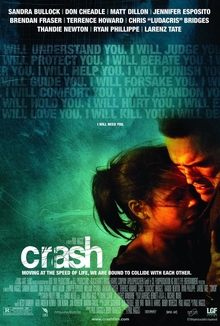
Behind the film
- Year
- 2004
- Director
- Paul Haggis
- Writers
- Paul Haggis, Robert Moresco
- Genres
- Drama, Crime
- Production
- Starz Entertainment, Yari Film Group, DEJ Productions
- Country
- Germany, United States
- Cast
- Don Cheadle, Sandra Bullock, Matt Dillon, Thandiwe Newton, Terrence Howard, Michael Peña, Ryan Phillippe, Larenz Tate
About the film
Contains story spoilers.
Crash uses Los Angeles as a network of encounters rather than following one person's journey across it. People meet in cars, shops, homes and workplaces, often bringing assumptions that shape the conversation before either side understands what is happening. The opening collision establishes the title's double meaning: bodies and vehicles can strike one another, but so can the stories people carry about race, safety and belonging. Paul Haggis builds the film through those crossings, returning to characters after an initial judgment has formed. The method makes later actions complicate earlier ones without necessarily cancelling the harm already done.
A carjacking introduces district attorney Rick Cabot and his wife Jean to Anthony and Peter, two men whose argument about racial suspicion sits beside their own criminal conduct. Jean's fear afterward spreads toward Daniel, the locksmith replacing the locks at their home, whom she judges through appearance rather than his work. Rick views the crime partly through its political consequences, turning a frightening personal experience into another calculation about public image. Daniel leaves with knowledge of what has been said about him, then returns to a daughter whose fear of violence has a different history. The film allows those households to sit beside one another without pretending they carry the same risks.
The police stop involving television director Cameron Thayer and his wife Christine places state authority at the centre of another encounter. Officer John Ryan humiliates the couple and sexually assaults Christine under cover of a search, while his younger partner Tom Hansen watches. Cameron's restraint helps prevent an immediate escalation but leaves his wife feeling abandoned, giving the stop consequences inside their marriage after the officers leave. Matt Dillon's Ryan is also shown caring for his ill father and struggling with medical bureaucracy. That private vulnerability provides context for his anger without making it a defence of what he does to someone over whom he holds power.
A later collision places Christine in a burning vehicle, where Ryan becomes the person attempting to save her. The reversal makes the rescue difficult before it becomes dangerous: she recognizes him and has a reason to fear his touch. His determination to get her out demonstrates real courage without undoing the earlier abuse. Thandiwe Newton gives Christine's response both physical urgency and the memory of the stop, keeping the two encounters connected rather than allowing the second to replace the first. Their sequence is one of the film's clearest examples of its structure, placing conflicting actions within the same person and leaving the audience with the discomfort of holding both.
Farhad's shop and Daniel's work produce another chain of misread intentions. Daniel explains that the damaged door needs more than a new lock, but the conversation ends with Farhad treating the warning as an attempt to take his money. When the shop is vandalized and insurance will not cover the loss, frustration becomes a plan for revenge against the wrong person. Daniel has reassured his daughter with a story about an invisible protective cloak, and her belief draws her into the confrontation. The gunshot seems to destroy that reassurance before the discovery of blank ammunition changes the outcome. A child's trust and a daughter's earlier ammunition choice interrupt violence the adults could not adequately communicate their way out of.
Hansen's wish to separate himself from Ryan does not guarantee he understands his own reactions. He intervenes when Cameron faces another armed confrontation, but a later encounter with Peter inside his car ends in a fatal misreading. A gesture Hansen interprets as reaching for a weapon is revealed through a small object he has also kept himself. The connection makes his earlier moral confidence painfully insufficient. Anthony, meanwhile, faces a different opportunity when he discovers people being transported for exploitation and chooses to release them rather than sell them. The parallel decisions move the film away from a stable distinction between the respectable officer and the criminal he would expect to distrust.
Detective Graham Waters' investigation links the public handling of a shooting with his family's private losses. The pressure to accept a politically useful version of events makes professional advancement part of the film's account of compromised judgment. His mother's concern for his missing brother becomes more devastating when the dead man is identified as Peter. That discovery reconnects a story the film has allowed to unfold elsewhere, making the network personal rather than merely an exercise in coincidence. Don Cheadle's restrained performance gives Graham's choices a tired practicality that sits uneasily beside the costs other people carry from them.
The closing returns to further crossings rather than suggesting that the city's conflicts have been solved. Mark Isham's score and the alternating moments of danger and quiet encourage the sense of shared emotional pressure, while the editing lets information arrive too late to prevent the actions it might have changed. The film's people do not all possess equal power, even when several experience fear or humiliation, and its most useful distinctions remain in the consequences of what they can do to others. Crash follows how quickly an encounter can become a judgment, then spends the rest of its story revealing the lives those judgments have failed to contain.