
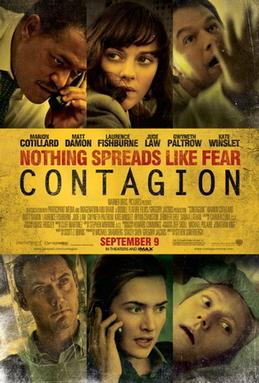
Behind the film
- Year
- 2011
- Director
- Steven Soderbergh
- Writers
- Scott Z. Burns
- Genres
- Drama, Thriller, Disaster, Action
- Production
- Warner Bros. Entertainment, Participant, Image Nation
- Country
- United States
- Cast
- Marion Cotillard, Matt Damon, Laurence Fishburne, Jude Law, Gwyneth Paltrow, Kate Winslet, Bryan Cranston, Jennifer Ehle
About the film
Contains story spoilers.
Beth Emhoff returns from Asia, then dies from a new infection; her son also dies. Immune husband Mitch protects daughter Jory. CDC investigator Erin Mears traces contacts but becomes infected and dies. Scientists identify fictional virus MEV-1, and Ally Hextall develops a vaccine after another researcher establishes a usable culture. Blogger Alan Krumwiede promotes a false cure and profits from panic. WHO investigator Leonora Orantes is kidnapped to secure vaccines for a village; after release, she discovers its doses were fake and returns to warn them. A birthdate lottery distributes vaccine as life begins recovering. The final flashback reveals the origin: displaced bats, an infected pig, food preparation and a casino handshake connect to Beth. The audience learns how the outbreak began after watching people struggle without that complete picture.
Steven Soderbergh organises the film around connections people cannot immediately perceive. A familiar movement through public space may carry consequences elsewhere, and the camera gives ordinary contact a significance that the characters do not yet understand. The suspense therefore begins before anyone can offer a coherent account of the threat. Scott Z. Burns's screenplay follows several lives rather than giving one protagonist command of the whole emergency. That structure is important to the film's world. No person experiences the outbreak in its entirety, even when a professional role permits a wider view. What looks like a connected pattern to the audience can remain a confusing series of local problems to the people trying to respond.
Matt Damon's Mitch supplies the private scale of that confusion. His responsibility is immediate and particular: a parent must make choices for a household whose safety cannot be guaranteed through ordinary routines. His lack of specialist knowledge does not make his experience marginal to the story. It makes visible the gap between receiving a public instruction and finding a way to live under it. Fear can become a constant condition without supplying a useful next step, while grief continues beside practical obligations. Damon gives the character a restraint suited to that pressure. Mitch does not need to articulate every aspect of the crisis for the audience to understand how radically it has changed the assumptions behind his daily life.
Kate Winslet's Mears approaches the same uncertainty through professional responsibility. The role involves persuading people to act before they have the reassuring completeness of an explanation. That makes communication part of the practical work, rather than something added once the scientific problem has been solved. Her presence also brings institutions down to the scale of an individual person carrying out a task. A public response depends on workers who have bodies, limits and exposure of their own. The film allows competence to matter without making it an invulnerability. Its professional characters can be serious about their obligations while remaining caught inside the emergency they are trying to organise, complicating the fantasy that someone managing a crisis necessarily stands outside its consequences.
Laurence Fishburne's Cheever has a wider field of responsibility and a different kind of pressure. Public leadership demands decisions about scarce resources, confidence and timing, while personal attachments can make impartiality difficult to inhabit. The film does not assume that holding an official position removes ordinary loyalties. It asks what happens when those loyalties become relevant to decisions other people must trust. That tension gives the institutional story human substance without reducing the entire response to personal motives. Authority has to operate through fallible people, and its credibility depends partly on whether those people can explain what is known, acknowledge what remains uncertain and distinguish a shared obligation from the wish to protect someone close to them.
Jude Law's Krumwiede offers a rival way of organising uncertainty. Where careful investigation can produce provisional answers, a persuasive outsider can offer a story whose confidence feels more immediately satisfying. The character's influence depends on attention and suspicion, making public fear an opportunity as well as an emotion. That is a different kind of danger from the biological one, yet it can affect how people move, spend and respond to help. The film places competing claims beside each other without treating all claims as equivalent merely because each has an audience. A convincing performance of independence may conceal an interest of its own. The question becomes how trust is earned when apparent certainty can travel more easily than the work required to establish it.
Marion Cotillard's Orantes brings unequal access into the international story. The crisis does not reach a world whose resources and security are evenly distributed, so expectations about fairness can differ sharply depending on who is waiting for help. That conflict makes the global response more than a matter of increasing geographic scale. The film asks how a common threat can produce competition between people whose chances of protection were unequal before it arrived. Its dramatic situations put moral pressure on both local loyalty and institutional procedure. An individual may act from an urgent desire to protect a community while using methods that compromise someone else's freedom, leaving care and coercion uncomfortably entangled inside the same action.
The research thread gives a different rhythm to these struggles. Progress requires enough information to make a useful next move, while the surrounding emergency makes the time spent finding that information feel painfully slow. Jennifer Ehle's Hextall embodies the tension between disciplined work and an appetite for a decisive breakthrough. Soderbergh's measured style permits the audience to see both immediate personal consequences and systems whose significance emerges across separate scenes. The ending provides an explanatory view the characters lacked, but that knowledge does not reverse their losses. Contagion uses a fictional outbreak to explore dependency, uncertainty and trust, keeping the ordinary world's connections visible precisely when people discover how much their lives had depended on taking those connections for granted.