
Behind the film
- Year
- 1997
- Director
- Robert Zemeckis
- Writers
- James V. Hart, Michael Goldenberg
- Genres
- Science fiction, Drama
- Production
- Warner Bros. Entertainment, Warner Bros. Pictures
- Country
- United States
- Cast
- Jodie Foster, Matthew McConaughey, James Woods, Tom Skerritt, William Fichtner, John Hurt, Angela Bassett, David Morse
About the film
Contains story spoilers.
Contact begins by making distance imaginable through the fading reach of Earth's own broadcasts. Radio is also Ellie Arroway's childhood means of reaching beyond the place where she lives. Her father encourages that curiosity, and his death leaves a loss that the adult scientist cannot entirely separate from her desire to listen. Robert Zemeckis's film gives the search for extraterrestrial intelligence both a professional method and a private emotional history. Ellie is not simply waiting for a visitor to arrive. She is spending time, money and attention on a question that other people consider too uncertain to justify those resources.
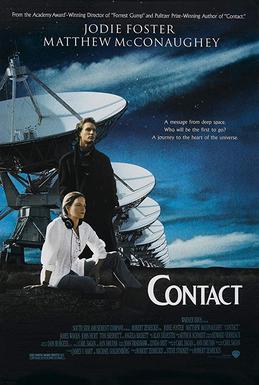
At Arecibo, Ellie meets Palmer Joss, whose interest in belief intersects with hers without producing agreement. Their attraction does not remove the difference between a scientist asking for testable evidence and a religious thinker who accepts other grounds for conviction. When institutional funding disappears, Ellie continues the search with support from the reclusive industrialist S. R. Hadden. The Very Large Array in New Mexico becomes the center of that work. The huge dishes make the enterprise visually impressive, but the drama repeatedly returns to people reading signals and arguing over what they mean. Scale does not eliminate the practical possibility of finding nothing, nor the threat of being told to stop looking.
A pattern of prime numbers from Vega changes the status of the project almost immediately. The discovery attracts government representatives, security concerns and a contest over who gets to announce it. Another layer of the transmission contains an old television image of Hitler, a disturbing reminder that a civilization's first visible trace may not represent what it would prefer to say about itself. Hadden helps decode further information by recognizing how the pages fit together in three dimensions. They contain plans for a machine. Now the uncertainty is no longer only whether somebody exists elsewhere: people must decide what an unknown design will do and whether building it is a reasonable risk.
Ellie expects the journey to belong to somebody who can investigate it carefully. The selection process instead asks who can represent humanity, placing her lack of religious belief under scrutiny. Palmer's participation makes that judgment personally painful as well as professionally consequential. David Drumlin is chosen, but a fanatic destroys the first machine and kills him during preparations. Hadden then reveals a second machine in Japan, and Ellie is offered the chance to use it. A voyage that once seemed to depend on an orderly public decision has become possible through arrangements she did not know existed. Her scientific commitment must now coexist with fear and incomplete knowledge.
Ellie's passage opens into extraordinary spaces before bringing her to a beach resembling an image connected with her childhood. The intelligence she meets adopts her father's appearance, explaining that a familiar form can make the encounter easier. Back on Earth, however, the observers believe the pod simply dropped through the machine. Ellie remembers an extended journey but cannot supply the visual record she expected to bring home. A hearing gives her the uncomfortable position of asking others to accept an experience they cannot reproduce. The audience also learns of eighteen hours of recorded static, information kept from public view. The discrepancy leaves evidence in the story without converting her experience into an uncomplicated public proof.
Jodie Foster's performance makes Ellie's intensity useful in scenes where scientific conviction can easily become a speech. She listens with her whole attention, and an interruption can feel like a physical intrusion into that concentration. Later, the same directness makes it difficult for her to package the journey into the kind of answer the hearing wants. Matthew McConaughey's Palmer has a more socially adaptable manner, but his confidence becomes uncomfortable when belief supplies a criterion that excludes her. Their conversations give the film more texture than a contest between an enlightened scientist and an ignorant believer would allow. Ellie can understand his affection and still feel the damage of his judgment. Palmer can believe her final account without suddenly acquiring her methods.
The institutional characters shape the discovery through different kinds of authority. Tom Skerritt's Drumlin understands professional credibility and the advantages of being near an important announcement. James Woods's Michael Kitz approaches the signal through suspicion, looking for danger and later an explanation he can contain. Angela Bassett's Rachel Constantine has to deal with the political consequences of decisions others describe as purely scientific or spiritual. John Hurt's Hadden exercises power from a distance, supplying an interpretation or an opportunity at moments when Ellie cannot obtain either through ordinary channels. William Fichtner's Kent belongs to the working team, where another way of noticing a pattern can matter more than public status. The crowded response to the signal therefore never becomes a single human reaction; it is a collection of competing responsibilities and ambitions.
James V. Hart and Michael Goldenberg's screenplay adapts Carl Sagan's story into a drama in which communication keeps changing form: radio contact, encoded pages, public announcements, private arguments and remembered experience. Zemeckis uses the size of the observatories and the machine to make the possibility of contact tangible, then places the encounter in a setting associated with a child's wish to speak to somebody lost. The resemblance is meaningful without establishing that grief has merely invented everything Ellie sees. The film allows scientific work, longing and uncertainty to remain together. Its final return to education and continued listening offers a practical continuation rather than a complete solution. There are still observations to make, questions to test and people to teach, even after the most extraordinary claim in Ellie's life resists the proof she had expected to provide.