
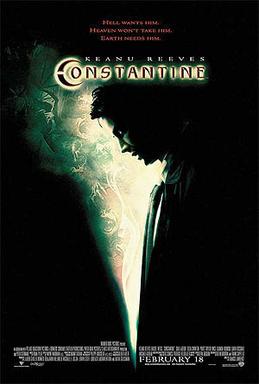
Behind the film
- Year
- 2005
- Director
- Francis Lawrence
- Writers
- Kevin Brodbin, Frank Cappello
- Genres
- Superhero, Horror, Fantasy, Drama
- Production
- Village Roadshow Pictures, Vertigo, Weed Road Pictures
- Country
- United States, Australia, Germany
- Cast
- Keanu Reeves, Rachel Weisz, Shia LaBeouf, Tilda Swinton, Pruitt Taylor Vince, Djimon Hounsou, Gavin Rossdale, Peter Stormare
About the film
Contains story spoilers.
John Constantine is an occult investigator who can see half-angels and half-demons in their true forms. He is also dying of lung cancer and fears the Hell awaiting him after an earlier suicide attempt. Police detective Angela Dodson asks him to examine the apparent suicide of her twin sister Isabel, and their investigation leads to the Spear of Destiny and a plan to bring Lucifer’s son Mammon to Earth. Angela becomes the host for the ritual. Constantine and his apprentice Chas seek help from the nightclub owner Papa Midnite, but the angel Gabriel is also working for Mammon. Chas is killed and Constantine cannot stop Gabriel directly, so he cuts his wrists to summon Lucifer. Lucifer banishes Mammon, strips Gabriel of angelic power and receives Constantine’s plea to save Isabel. He revives Constantine, removes his cancer and leaves him alive.
The film turns Los Angeles into a threshold landscape. Ordinary spaces can feel spiritually compromised, and the city’s familiar surfaces become possible hiding places for forces most people cannot see. This is a useful setting for a detective story because it makes perception itself part of the investigation. Constantine does not merely gather clues; he looks for signs that reality is behaving incorrectly. The result is a world where a street, hospital or apartment may carry a second meaning. The supernatural is not far away in a separate kingdom. It presses against daily life and sometimes wears a human face. That proximity gives the urban setting a persistent unease without requiring every scene to announce its mythology.
Constantine’s character is organized around a bargain with consequences. He knows the rules of the afterlife well enough to treat them as a system, but that knowledge has not made him morally peaceful. Keanu Reeves plays him with a dry reserve that suggests a man who has spent too long using cynicism as protection. The central question is not whether Constantine believes in good and evil; he already inhabits a universe where they are concrete forces. It is whether a person who expects punishment can still choose an action for someone else’s sake.
Angela gives the mystery a human reason to begin. Her work as a detective encourages her to look for evidence, while her bond with Isabel makes the question personal. Rachel Weisz gives Angela a guarded intelligence that lets her remain more than a guide into Constantine’s supernatural expertise. The two characters approach uncertainty differently: one has built habits around visible proof, while the other has survived by reading a world most people deny. Their partnership puts faith and scepticism into conversation without treating either as a simple virtue. The film’s spiritual framework becomes most accessible when it is attached to grief, responsibility and the desire to understand what happened to someone you loved.
Gabriel and Lucifer complicate the expected moral map. Tilda Swinton presents Gabriel with controlled severity, while Peter Stormare’s Lucifer is theatrical, intimate and unsettlingly amused. Their presence turns theology into character conflict: celestial beings can possess motives and resentments, and their status does not automatically settle the moral question. The story’s notion of justice is similarly personal. Lucifer’s intervention is tied to his interest in Hell’s own order, while Constantine’s plea reveals a willingness to make a sacrifice that he had not been willing to make for himself. The film does not offer a detailed doctrine. It uses familiar religious figures to dramatize power, envy, mercy and the uncomfortable possibility that virtue may appear in unexpected places.
The visual effects and production design make the supernatural concrete through texture. Constantine’s tools feel handled and practical, from cigarettes and lighters to weapons and relics. Hell is rendered as a blasted distortion of the city rather than a remote, abstract realm, suggesting that damnation grows out of recognisable places and human actions. The contrast between dark city interiors and scorched otherworldly expanses lets the film shift scale while remaining visually coherent. This material approach suits the protagonist: his work is less like pure magic than an ugly trade with equipment, rules and physical danger. The imagery supports the detective structure, making spiritual conflict something a character must navigate rather than merely discuss.
Francis Lawrence’s film debut mixes occult horror, action and comic dryness, producing a tone that is often deliberately hard-edged. The genre shifts reflect Constantine’s own way of moving through the world: he treats extraordinary dangers as professional problems, even when his self-assurance is visibly strained. Chas’s admiration provides a contrast to this guarded expertise, representing the desire to inherit a heroic role before understanding its cost. Their partnership gives the supernatural adventure an ordinary human measure. Competence may impress, but mentorship also carries responsibility. The film’s darker jokes and sudden visual grotesquerie work best when they expose the limits of Constantine’s control, keeping the spectacle tied to a character who cannot fully master the system he knows.
The conclusion leaves the struggle over Constantine’s future open. Constantine is given more time, but the reprieve does not erase mortality or promise a settled peace. That choice fits a film built around negotiation: even survival arrives with ambiguity, and the characters live inside a universe where motives rarely align neatly. The final image of Chas suggests that transformation remains possible, though grief is not simply cancelled by a supernatural reveal. The film ends on an uneasy note of continuation rather than a comprehensive answer about faith. Its appeal lies partly in this unresolved balance: Heaven and Hell are real in its world, yet the most consequential moral decision still belongs to a human being who believes he has already lost his chance to choose well.