
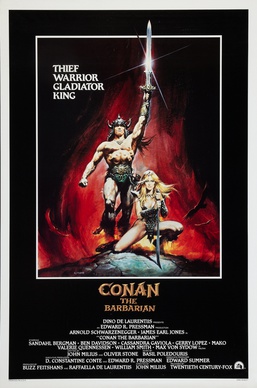
Behind the film
- Year
- 1982
- Director
- John Milius
- Writers
- John Milius, Oliver Stone
- Genres
- Action, Fantasy, Adventure, Sword-and-sandal
- Production
- 20th Century Studios, Dino De Laurentiis Corporation, Universal Pictures
- Country
- United States
- Cast
- Arnold Schwarzenegger, James Earl Jones, Max von Sydow, Sandahl Bergman, Ben Davidson, Mako, Gerry Lopez, Valérie Quennessen
About the film
Contains story spoilers.
Conan's childhood ends when Thulsa Doom's raiders destroy his village, kill his parents and take the family's sword. Sold into slavery, he grows into a fighter at the wheel and in the arena, then gains his freedom. He meets Subotai and Valeria, and their thefts draw them into conflict with Doom's cult. King Osric hires them to retrieve his daughter, who has joined the cult. Conan enters Doom's stronghold, is captured and crucified at the Tree of Woe; his companions rescue him. During a later assault, Valeria is killed by a supernatural arrow. Conan leads an ambush against Doom's forces and confronts the cult leader, who claims fatherhood over his followers. Conan kills Doom, leaves to return the princess to Osric, and is eventually described as a king.
The film's sword-and-sorcery world gives objects a weight that exceeds their practical use. Steel can suggest inheritance, identity and the promise of a strength a person hopes will make him secure. John Milius's imagined past is not a historical reconstruction; it is a place where beliefs about power are made tangible through bodies, weapons and ritual. The solidity matters because a mythic question might otherwise remain only dialogue. Conan has to carry, use and depend on material things, bringing ideas about endurance into the visible effort of moving through the world. The fantasy can consequently feel worked by human hands even when supernatural forces intervene, with meaning attached to objects that have been damaged, taken or preserved.
Arnold Schwarzenegger gives the hero a physical presence that can communicate endurance before any explanation arrives. Sparse speech does not make the character empty; it changes where the audience looks for decisions and responses. James Earl Jones's Doom offers a contrasting centre of authority, using stillness and assurance to make other people's attention gather around him. Their opposition is therefore more than a comparison of bodily strength. One kind of power can be demonstrated through direct effort, while another depends on persuading people to surrender their own judgment. The film gives both forms a visible appeal. Its conflict asks what that appeal costs the person who submits to it, particularly when reassurance comes from someone who wants obedience to feel like belonging.
John Milius frames the tale as a series of trials with a mythic, almost oral quality. A narrator introduces the setting and returns to ideas of steel and fate, while the episodes move through distinct environments: the wheel, the arena, the city of thieves, the temple and Doom's mountain stronghold. Rather than using these stops only as scenery, the film gives each a different social logic. The wheel reduces labour to repetition; the arena turns skill into entertainment; the temple organizes its followers around ritual and food; the fortress transforms wealth into an instrument of power. Repeated images of iron, stone and fire make this fantasy feel worked by human hands. Conan learns how people survive within each space before he can challenge it.
Basil Poledouris's score is one of the film's central narrative voices. Choral writing, brass and percussion give the landscape an ancient scale, while recurring musical ideas help connect widely separated stages of Conan's life. The music can make a journey feel ceremonial even when the images show physical work or rough travel. Its size also complements the production design: stone, timber, handmade weapons and textured costumes give the fantasy world a material weight. The effect is not documentary realism; it is a carefully built legend whose objects feel used, carried and inherited. The visual and musical choices make the film's imagined past tangible without claiming that it represents actual history.
Valeria changes the emotional direction of Conan's quest. She is not simply a companion who assists the hero; she has her own confidence as a fighter and her own understanding of risk. Their partnership grows from shared work and mutual recognition, and its brevity affects how the later struggle feels. Subotai brings a different kind of loyalty, often using humor and practical judgment to temper Conan's solitary focus. The film lets these companions create a temporary community around him. When that community is threatened, Conan's revenge is no longer only about reclaiming an object from his childhood; it is also about refusing Doom's power to decide which lives matter.
Doom's promise of belonging gives the fantasy an enemy whose power depends on more than the ability to defeat an opponent. A community can be organised around assurance, ceremony and the relief of no longer having to decide alone. That attraction makes domination more troubling than a simple external attack. Conan's independence may appear harsh, but it permits a refusal the leader's followers have been encouraged to surrender. The film does not suggest that self-reliance removes every need for others; the companions around its hero make the opposite visible. Its distinction is between relationships that sustain a person's agency and those that demand the agency be given away. The story's violence resolves an immediate conflict while leaving that larger question about strength and dependence available.