
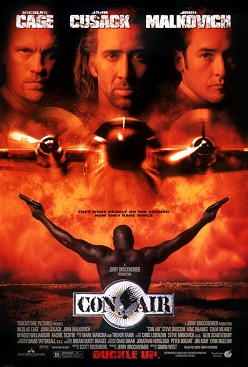
Behind the film
- Year
- 1997
- Director
- Simon West
- Writers
- Scott Rosenberg
- Runtime
- 1h 55m
- Genres
- Action, Thriller, Prison, Lgbtq-related
- Production
- Touchstone Pictures
- Country
- United States
- Cast
- Nicolas Cage, John Cusack, John Malkovich, Steve Buscemi, Ving Rhames, Colm Meaney, Mykelti Williamson, Rachel Ticotin
About the film
Contains story spoilers.
Con Air takes a journey towards freedom and places its passenger inside another person’s escape attempt. Nicolas Cage plays Cameron Poe, whose release from prison should allow him to meet the daughter born during his sentence. Simon West directs Scott Rosenberg’s screenplay, with John Malkovich as the criminal organising the hijacking and John Cusack as the marshal trying to understand it from the ground. The transport aircraft brings together people whose immediate destination is similar but whose future is not. Poe is supposed to leave custody; the others are being moved into it. When the flight changes hands, those different aims become a conflict he cannot explain openly without endangering himself.
Poe boards the prison transport after parole, but Cyrus Grissom’s group seizes it. He remains with his friend Baby-O, who needs insulin, and tries to protect guard Sally Bishop while communicating with marshal Vince Larkin. The escape plan leads through a desert airfield confrontation before the damaged aircraft reaches Las Vegas and crashes along the Strip. Poe and Larkin pursue Grissom and other escaping leaders, who are killed. Poe finally reunites with his wife and daughter, while Baby-O receives treatment. The ending also leaves Garland Greene outside the general arrests, gambling in a casino, rather than implying that every inmate has been returned to custody.
Poe’s military background makes him capable of acting inside the crisis, but his emotional aim remains deliberately ordinary. He wants to get home. That gives the extravagant action a simple line of attention the viewer can follow through a large cast and a changing escape plan. His choices become difficult because a purely private understanding of that aim would favour any opportunity to leave the danger behind. Staying aboard turns homecoming into something he refuses to purchase through abandoning another person. Cage’s character therefore has to balance a long-awaited personal future with immediate obligations to people beside him, none of whom can guarantee that taking the risk will be rewarded.
Baby-O’s need for medicine introduces a kind of urgency the hijackers’ control cannot accommodate comfortably. The body still has requirements when plans become violent, and those requirements do not pause while someone negotiates a new destination. Poe’s loyalty is expressed through a practical effort to meet a need rather than through a promise alone. The film uses that vulnerability to make the aircraft more than a moving collection of threats. It also contains a person whose survival depends on care at a particular time. That changes the meaning of staying: Poe is not simply remaining close to the villains, but remaining available to someone whose safety would otherwise be overlooked.
Grissom’s control works through a different model of cooperation. The prisoners have a shared interest in escape, yet shared interest does not make them trustworthy partners. Malkovich’s character has to direct people capable of violence and betrayal, so authority becomes a performance backed by threat. Their plan can succeed only while enough competing impulses remain temporarily aligned. The film’s ensemble lets that instability become part of the entertainment, with individual temperaments putting pressure on the apparent collective purpose. A hijacked plane is a confined space in which everyone needs movement, but the agreement about where and how to move can fail at any point.
Larkin’s role creates a second route through the problem. From outside, Poe may appear to be participating in the escape, and the distinction between apparent involvement and actual intention requires interpretation. Cusack’s marshal has to judge fragments while other officials favour a more immediate display of force. The thriller gains tension from those incompatible approaches. Destroying a threat can sound decisive without adequately accounting for the people inside it. Larkin’s effort is directed towards a more specific understanding of who is doing what aboard the plane, giving communication and analysis a place within a film otherwise full of forceful physical solutions.
The aircraft’s changing surroundings allow the action to expand without abandoning the central constraint. In the air, enclosure limits the choices; on the ground, the prisoners’ plan opens into larger confrontations while their transport still determines whether they can continue. The desert airfield and Las Vegas offer sharply different environments, but both become places where an intended route breaks down. That escalation makes the flight feel increasingly detached from the orderly system that was supposed to govern it. Machinery designed to deliver prisoners safely becomes a source of danger for people far beyond its original passengers, turning a controlled transfer into a public spectacle of damage.
The reunion gives Poe’s journey its emotional destination after a sequence of increasingly improbable obstacles. Its satisfaction comes from seeing the personal purpose survive the scale of the action surrounding it. At the same time, the final appearance of Greene retains a deliberately unsettling loose end within the celebratory finish. Con Air combines an earnest homecoming with heightened villains, explosive logistics and competing ideas about how authority should respond to a crisis. Poe’s defining quality is that release from responsibility to the prison system does not become release from responsibility to other people. The freedom he wants remains connected to the care he chooses to provide before he reaches it.