
Behind the film
- Year
- 1985
- Director
- Mark L. Lester
- Writers
- Steven E. de Souza
- Runtime
- 1h 30m
- Genres
- Action, Thriller, War
- Production
- Silver Pictures
- Country
- United States
- Cast
- Arnold Schwarzenegger, Rae Dawn Chong, Dan Hedaya, Vernon Wells, David Patrick Kelly, Alyssa Milano, Bill Duke, Bill Paxton
About the film
Contains story spoilers.
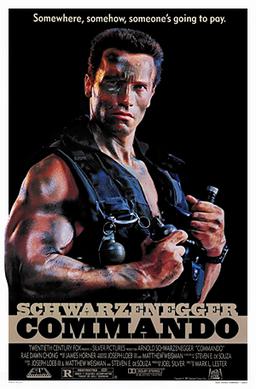
Commando gives its action an unusually direct purpose: a father wants his daughter back, and nearly everything between them becomes something he must get through. Mark L. Lester's film uses that clarity to support an extravagantly confident version of the rescue thriller. Arnold Schwarzenegger's John Matrix is not presented as an ordinary person improvising under pressure. His body and assurance establish a scale against which obstacles can seem both dangerous and absurdly temporary. The film's pleasure grows from watching that scale expand, with the emotional simplicity of the objective keeping the exaggeration easy to follow even when practical plausibility is left far behind.
Mercenaries kidnap Jenny Matrix and force her father to undertake an assassination for Arius, a deposed dictator seeking power. Matrix escapes the flight carrying him toward the assignment, leaving himself a limited window before his absence is discovered. He tracks associates of the kidnappers with help from Cindy, a flight attendant initially alarmed by his behaviour. Their search leads through violent confrontations to the location of Arius's island base. Matrix obtains weapons, reaches the island and fights through the men holding Jenny. Bennett, a former colleague, becomes the final personal threat; Matrix kills him and rescues his daughter. The reunion completes the mission that has driven the film, while his refusal to return to military service preserves the wish for a different life.
Schwarzenegger makes strength part of the film's comic timing. An intimidating gesture can double as an announcement that the scene's apparent problem is about to change ownership. Matrix's confidence also means that a verbal response need not compete with the action around it; it can arrive as a brief punctuation after an outcome has become clear. The humour depends on recognising the construction. This is a fantasy of exceptional capability, not a practical account of what one person can survive. Treating it as such makes the relationship between tension and comedy intelligible: danger is established so that the hero's disproportionate response can become the spectacle.
Rae Dawn Chong's Cindy provides a different measure of that spectacle. Her alarm gives the audience permission to recognise how unreasonable Matrix's conduct would appear outside the terms of an action film. The contrast also keeps the partnership active. She has to respond to him as a person encountered in the world, while he behaves as though his purpose should make the situation immediately understandable. That mismatch creates humour and friction before cooperation can settle into place. Her presence supplies a civilian perspective that the film's military rivalries would otherwise lack, allowing the rescue to move through ordinary spaces with someone still capable of noticing how extraordinary it has become.
Alyssa Milano's Jenny gives the objective a person rather than leaving it as a password for violence. The relationship establishes what Matrix's force is supposed to protect, bringing a domestic scale into a film eager to exceed normal physical limits. That connection is essential to the exaggeration. Without it, the escalating destruction would merely be a demonstration of available power. With it, movement has a direction that remains emotionally clear. The film makes the wish for safety easy to understand while using methods that belong to its imagined world. The distinction allows the family bond to matter without turning the surrounding combat into an endorsement of real-world behaviour.
Vernon Wells's Bennett makes the opposition personal in a way Dan Hedaya's Arius does not. Political ambition supplies an operation, but rivalry supplies the desire to confront this particular man. The film sets those motives beside one another without requiring a complicated account of either. Bennett's antagonism belongs to the theatrical contest between an assured hero and someone determined to make that assurance fail. His menace consequently works through proximity and challenge, bringing the confrontation back to bodies after the rescue has acquired a much larger scale. The spectacle keeps contracting toward the relationship that makes the final obstacle feel individual rather than interchangeable.
The progression through public and private spaces gives the action a practical rhythm. Information produces a destination; the destination produces resistance; resistance produces another opportunity to move. Lester's directness makes that chain legible even when the means of moving become excessive. The film rarely asks the audience to pause over an ambiguous intention. Its characters' purposes are plainly expressed through pursuit, obstruction and escape, allowing the energy to come from how an obstacle is handled. This clarity is part of the design rather than a claim to realism. It gives an outrageous performance enough structure for each escalation to feel like the next step in a recognisable chase.
Commando's appeal finally rests on the compatibility of a simple emotional demand and a deliberately outsized response. The rescue has a clear end, while the route toward it allows strength, hostility and humour to become increasingly theatrical. The film does not offer a sober picture of geopolitics or military practice, and its invented enemy setting should not be treated as information about an actual country. It offers the concentrated experience of an action hero refusing to accept that another person has control over his family. Its extravagance remains easy to read because the question beneath the destruction never changes: can he reach the person he is trying to protect?