
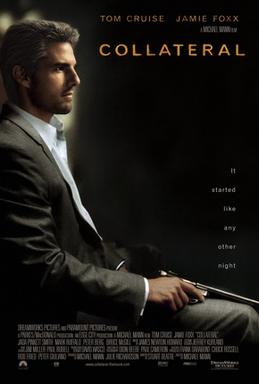
Behind the film
- Year
- 2004
- Director
- Michael Mann
- Writers
- Stuart Beattie
- Runtime
- 2h 00m
- Genres
- Neo-noir, Thriller, Crime, Drama
- Production
- Paramount Pictures, DreamWorks
- Country
- United States
- Cast
- Tom Cruise, Jamie Foxx, Jada Pinkett Smith, Mark Ruffalo, Peter Berg, Bruce McGill, Javier Bardem, Irma P. Hall
About the film
Contains story spoilers.
Michael Mann's Collateral makes Los Angeles visible through a man whose work requires him to remain in motion. Max's cab connects people and places while keeping the driver slightly apart from the lives he briefly encounters. A passenger can reveal something intimate and then leave, allowing Max to imagine opportunities without committing himself to them. Vincent interrupts that arrangement by staying. The hired route becomes a structure Max cannot leave, turning the usual separation between workplace and private life into a dangerous illusion. His knowledge of the city remains useful, but knowing a road does not determine what the person in the back seat will require him to do there.
Max meets prosecutor Annie on an evening fare, then accepts Vincent's overnight booking. A body falls onto the cab at the first stop, exposing Vincent as a hitman targeting people in a federal case. Forced to drive, Max destroys Vincent's briefcase after visiting his mother; the killer sends him to crime boss Felix to replace the missing information. Max impersonates Vincent and obtains the remaining targets. Detective Fanning follows the killings to a nightclub, where Vincent murders another target and then Fanning. After Max crashes the cab, Vincent escapes and Max discovers that Annie is the final target. He overpowers an officer, takes a gun and warns her. Max rescues Annie from her office, and Vincent pursues them onto a Metro train. In the shootout, Max fatally wounds him. Max and Annie leave together, while Vincent's body continues alone, turning the killer's account of urban indifference back toward himself.
The investigation adds another way of reading the same streets. Fanning tries to identify a pattern among deaths, while other officers encounter evidence arranged by a job they have not yet understood. That difference makes the cab's public appearance dangerous for its driver. Max is the visible person connecting the stops, and visibility can be mistaken for control. His attempt to imitate Vincent introduces the reverse problem: somebody can appear to command an operation while acting under another person's threat. Mann sets those readings beside each other, making identity depend on what an observer has been allowed to see rather than simply on whether the observer is paying attention.
Vincent's final seated body gives the film a still image after a night organized around urgent movement. The train can continue its route without understanding what has happened inside it, matching the impersonal city he has used to justify his work. Max's connection to Annie creates a different result. Their encounter has become something he acts upon rather than files away as another passing possibility. The ending joins that action to his survival without treating the night's losses as an ordinary route to personal improvement. A transport system continues, a killer becomes another unattended presence within it, and two people leave with a relationship their first conversation could only suggest.
Mann’s city is built from the cab’s windows and the streets that slide past them. Downtown towers, freeways, bars and office buildings appear not as a postcard but as a route with different social temperatures. The taxi binds these places together while keeping Max physically enclosed. His back seat is a narrow stage on which people reveal themselves briefly, then disappear into the city. That ordinary job gives the thriller its unusual scale: Max’s knowledge of routes and traffic matters, yet Vincent’s violence keeps turning familiarity into risk.
The film’s digital night photography gives Los Angeles a distinctive look, with city lights and distant movement visible in the darkness rather than swallowed by it. The image can hold the cab and the city at once, preserving the sense that a vast urban life continues just beyond the immediate danger. The contrast between street-level driving and distant office towers also mirrors Max’s hopes. He can see the city’s possibilities from his cab, but his savings and plans keep those possibilities at a remove. Max’s profession makes him unusually sensitive to how a street changes from one block to the next. At the same time, his cab is a controlled little room where Vincent can issue orders and Max can study him without openly challenging him. The windshield frames the world as both route and image, while the rear-view mirror lets Max observe the passenger whose intentions he cannot trust. Those details give the taxi a formal purpose beyond transportation.
Max and Vincent are written as opposing but not simplistic figures. Max has spent years polishing the dream of a limousine service instead of testing it, and his lie to his mother reveals how a modest ambition has become a shelter from action. Vincent’s detached competence appears at first like the opposite of Max’s hesitation, but the killer’s nihilism is another kind of confinement. He treats other people as incidental and claims the city’s indifference proves that nothing matters. The night repeatedly tests whether Max will accept that argument or act on the ties he has tried to postpone.
Jamie Foxx gives Max a careful, increasingly strained alertness, while Tom Cruise’s Vincent moves with an unnerving economy that makes sudden violence feel like an extension of routine. Their relationship changes through tiny shifts in who chooses the destination, who controls the conversation and who must respond. Jada Pinkett Smith’s Annie begins as a brief encounter but becomes the person Max must protect, bringing his distant professional dream into the present tense. By the time the cab ride ends, the film has made the night itself a character: a stretch of time in which Max’s old excuses are no longer available.