
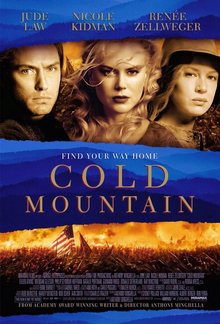
Behind the film
- Year
- 2003
- Director
- Anthony Minghella
- Writers
- Anthony Minghella
- Genres
- War, Romance, Drama
- Production
- Mirage Enterprises
- Country
- Italy, United States
- Cast
- Jude Law, Nicole Kidman, Renée Zellweger, Eileen Atkins, Kathy Baker, Brendan Gleeson, Philip Seymour Hoffman, James Gammon
About the film
Contains story spoilers.
Cold Mountain follows two journeys toward a home that neither person can assume has remained unchanged. Inman must cross a country damaged by war, while Ada has to learn how to live in the place to which he hopes to return. Anthony Minghella's adaptation of Charles Frazier's novel gives those undertakings different kinds of difficulty. One is measured through distance, encounters and danger; the other through the work needed to keep an ordinary life possible. Jude Law and Nicole Kidman spend much of the film apart, so their relationship exists through memory and expectation before it can be tested again in shared space.
Inman leaves Cold Mountain for the Confederate army after beginning a romance with Ada. Wounded and disillusioned, he deserts and starts home, encountering helpers, opportunists and violent pursuers. Ada's father has died, leaving her unable to manage the family farm until experienced Ruby Thewes joins her. The local Home Guard terrorises neighbours and later shoots Ruby's father Stobrod, who survives. While the women shelter him, Ada and Inman reunite and spend a night together. Further pursuit ends in a gunfight; Inman kills Bosie but is fatally wounded himself. Years later, Ada raises their daughter alongside the surviving household. Ruby has married Georgia, making the closing family gathering an image of life continuing after the hoped-for reunion has been lost.
Law's Inman carries the journey through a body that has already been damaged. His effort is less a triumphant march than an attempt to preserve enough strength and purpose to keep moving. The people he meets complicate any simple distinction between a safe civilian world and a dangerous military one. Need can draw strangers together, but it can also make them vulnerable to exploitation. His attention to Ada gives the road a direction without making that direction a guarantee. The film allows longing to sustain him while showing how little control longing provides over the next encounter or the conditions through which he must pass.
Kidman's Ada begins with forms of education and refinement that offer limited help in maintaining the farm. Her problem is not that she lacks feeling or determination, but that the demands of her circumstances require skills she has not developed. Renée Zellweger's Ruby changes the household by bringing practical knowledge and refusing to organise the relationship around Ada's former expectations of status. Their partnership makes competence visible through work. It also gives Ada a connection in the present, alongside the romance she preserves through letters and memory. Learning how to sustain the farm becomes part of making a future rather than merely waiting for someone else to return.
The contrast between the two women supplies energy without reducing them to a polished lady and a comic helper. Ruby's directness can challenge the habits Ada brings with her, while Ada's willingness to learn allows their arrangement to become more than an exchange of service. Each has a life beyond the immediate task of repairing the household. Their relationship can therefore develop through mutual dependence, with affection growing alongside the work rather than replacing it. The film's account of survival becomes collective here. Food, shelter and care must be made available repeatedly, and that continuity depends on people agreeing to contribute in different ways.
The Home Guard brings organised violence into spaces that might otherwise seem distant from combat. Ray Winstone's Teague turns local authority into a means of coercion, making neighbours vulnerable within the places they know best. That changes the meaning of home: familiarity cannot make a household secure when someone claims the power to enter it, punish its occupants or take what he wants. The Confederate setting also belongs to a society structured by slavery, rather than an abstract lost country detached from the people it oppressed. Treating its suffering as dramatically significant does not require turning its cause into an innocent ideal. The film's violence reaches civilians as well as soldiers.
Brendan Gleeson's Stobrod adds music and a difficult family history to the household's changing shape. Ruby's relationship with her father is not automatically repaired by his presence, and the film allows care to coexist with grievances that have not disappeared. Music gives these characters a way to gather without requiring every disagreement to be spoken away. Its place among hunger, pursuit and labour also changes the texture of endurance. Maintaining a life includes more than keeping a body moving; it can involve preserving a practice that gives an evening another meaning. The household becomes recognisable through what its members do together as well as through what they have survived.
The ending denies the romance a future that effort alone could secure. Inman's return matters, but reaching the destination does not place him outside the war's remaining violence. Ada's later life consequently gives the conclusion a wider shape than the loss of the couple. Their daughter exists within relationships maintained by other survivors, where new partnerships and old attachments continue together. Cold Mountain allows grief and domestic continuity to occupy the same image. The home toward which the story has moved is finally present, but it belongs to people who must inhabit it after profound changes. What lasts is a household capable of caring for its members, even though the future imagined at the beginning cannot be restored intact.