
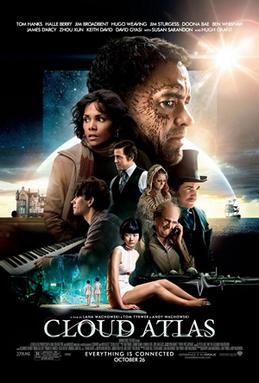
Behind the film
- Year
- 2012
- Director
- Tom Tykwer, Lana Wachowski, Lilly Wachowski
- Writers
- Tom Tykwer, Lana Wachowski, Lilly Wachowski
- Genres
- Science fiction, Fantasy, Drama, Mystery
- Production
- X-Filme Creative Pool
- Country
- Germany, United States, Hong Kong, Singapore, People's Republic of China, Spain
- Cast
- Tom Hanks, Halle Berry, Jim Broadbent, Hugo Weaving, Jim Sturgess, Doona Bae, Ben Whishaw, James D'Arcy
About the film
Contains story spoilers.
The film moves among six eras. In 1849, lawyer Adam Ewing helps stowaway Autua and escapes a doctor’s plot. In 1936, composer Robert Frobisher writes to physicist Rufus Sixsmith while completing a sextet. In 1973, journalist Luisa Rey investigates a dangerous reactor cover-up. In 2012, publisher Timothy Cavendish is confined in a care home and plots an escape. In 2144, clone Sonmi-451 becomes involved in a rebellion in Neo Seoul and leaves a recorded account before execution. Centuries later, Zachry lives in a post-apocalyptic community threatened by outsiders; Meronym, from a technologically advanced group, asks him to guide her. Their journey links the survival of his people to the past. Across the eras, characters encounter traces of earlier lives, while the film leaves the meaning of their connection suggestive rather than settled.
Cloud Atlas is organised less like a chain of episodes than a piece of music whose themes keep returning in altered forms. The six periods have distinct genres and rhythms, yet the editing often moves between them at moments of emotional or visual rhyme. A letter, an image or a repeated gesture can carry the viewer into another story before one narrative has fully finished. This structure asks for active comparison: not simply “what happens next?” but “what does this echo make newly visible?” The film’s form makes connection an experience the audience assembles, not a fact explained from outside the stories.
The ensemble’s multiple roles make the idea of recurrence concrete while also complicating it. Familiar actors appear in new bodies, social positions and moral circumstances, so recognition arrives before certainty. The casting creates a visual game, but it has a deeper function: it unsettles the assumption that identity is exhausted by a single face or lifetime. Doona Bae’s presence across different social worlds, for example, helps the film shift between intimacy and political scale without relying on one stable character arc. The transformations ask viewers to attend to how performance can preserve a quality while changing its meaning.
Because the same actors return, the film must negotiate an obvious risk: that its pattern could become a puzzle whose mechanism matters more than the people inside it. The individual eras keep the design grounded in different kinds of human conflict. A relationship can be shaped by ownership, creative labour, institutional secrecy, confinement or social hierarchy without those situations becoming interchangeable. The structure invites comparison, but the details resist a single formula. That balance is what lets the movie explore likeness without claiming that every life repeats in the same way.
The genre shifts are part of the storytelling rather than a decorative tour. The nineteenth-century section has the quality of a historical adventure; the composer’s story turns toward artistic ambition and intimate correspondence; the journalist’s investigation becomes a conspiracy thriller. Cavendish’s confinement brings comic farce, while Sonmi’s world uses science-fiction images to ask how a society controls people it treats as products. Zachry’s future begins as a survival tale. These changes let the film test its ideas under different emotional conditions, so the audience feels how power works differently in a salon, an office, a care home or a threatened settlement.
Objects and records give the movie a practical language for memory. Stories survive because someone writes them down, preserves them, hears them or risks passing them along. Yet documents do not travel unchanged: they can be private, misunderstood, repurposed or turned into evidence by someone living much later. This emphasis makes the film’s timelines feel connected without requiring a literal explanation for every resemblance. People inherit more than direct knowledge; they inherit unfinished arguments about who deserves freedom, who may speak and whose experiences count as history.
The political thread is not limited to one villain or one era. Again and again, individuals encounter systems that make exploitation sound ordinary: a hierarchy is presented as natural, a dangerous decision as necessary, or a person’s value as something measurable by usefulness. The film’s intercutting lets small acts of refusal accumulate across centuries. That can make the story feel emphatic, but it also clarifies its moral scale. Courage is not one grand event reserved for exceptional people; it can be a decision to help, tell the truth or refuse an assigned role when the costs are real.
Tom Tykwer, Lana Wachowski and Lilly Wachowski treat scale as both a production challenge and a philosophical question. The shifts from crowded cities to isolated landscapes make history feel immense, while repeated faces keep it intimate. The viewer moves between spectacle and close human choices, watching one frame of reference give way to another. The form may ask more patience than a linear adventure, because emotional consequences can pause while another century comes forward. But that interruption is part of its purpose: meaning accumulates in the spaces between the stories, where one life changes how another is understood. The film does not need its recurring patterns to prove a literal theory about reincarnation or destiny. It leaves that question open and puts more weight on the ethical similarities viewers can observe. A person’s act can matter beyond the immediate moment, not because the universe guarantees a neat reward, but because other people may carry the story forward. That distinction keeps the film’s broad spiritual language tied to material choices. Its central concern is the reach of responsibility: how a private decision can become part of a larger record, and how later people may use that record to imagine a different future.