
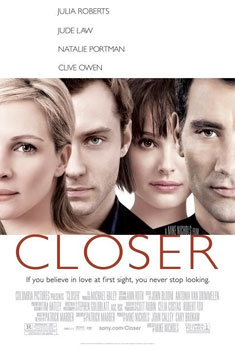
Behind the film
- Year
- 2004
- Director
- Mike Nichols
- Writers
- Patrick Marber
- Runtime
- 1h 44m
- Genres
- Romance, Drama
- Production
- Columbia Pictures
- Country
- United States
- Cast
- Julia Roberts, Jude Law, Natalie Portman, Clive Owen
About the film
Contains story spoilers.
London writer Dan meets Alice after she is hit by a car, and they become a couple. While promoting a novel inspired by her, he flirts with photographer Anna; after Dan's online impersonation draws dermatologist Larry to the aquarium, Anna and Larry meet and start dating. Dan and Anna later begin an affair, confess to their partners, and leave them. Alice resumes stripping; Larry meets her and asks her real name, which she gives as Jane Jones. Anna and Larry's marriage collapses, and Dan's relationship with Anna is tested when she sleeps with Larry to secure divorce papers. Dan returns to Alice, but during their Gatwick reconciliation he asks about Larry and she confirms the affair; she ends things and Dan slaps her. Later, New York shows Alice living under her real name, while Anna and Larry remain together.
The film adapts Patrick Marber’s play, and its theatrical roots remain visible in the way scenes are built around verbal contests. Characters enter a room with one account of what has happened, then use questions, jokes or accusations to make the other person concede a different version. The dialogue is not merely a delivery system for plot. It is where each person tests what another knows and whether a confession can be made without surrendering power. Mike Nichols keeps the exchanges clear and sharply staged, letting the performers’ timing carry shifts from flirtation to hostility. This gives the film a compact, almost chamber-like quality even as it moves across years and locations.
Names and identities matter because the characters treat self-description as something they can edit. Alice gives Dan a name drawn from a memorial plaque, and her refusal to surrender the truth of her past becomes a point of fixation for him. Dan writes fiction out of the life he thinks he understands, then confuses narrative possession with emotional intimacy. That tension is not resolved by uncovering a single hidden fact. The film instead asks what a relationship can be when one person insists on a complete account and another regards privacy as a condition of survival. The pressure to know everything can become another form of control, even when it is presented as a demand for honesty.
The four central performances keep the changing alignments legible without making any character a stable moral centre. Dan can be witty and observant while also acting as if his own desire excuses manipulation. Anna’s professional eye is associated with framing and looking, but the film does not let photography grant her special access to truth. Larry’s directness can read as confidence until it becomes a tool for bargaining. Alice is often discussed by the others as a story they can interpret, yet her guardedness is also a way of preventing them from making her wholly available to their explanations. Each actor plays the gap between what a character says and what they hope the other person will infer.
The film’s time jumps create a particular kind of instability. The story can move forward by months or years, returning to a familiar pairing in a new emotional arrangement. Rather than chart every ordinary interval, the narrative concentrates on moments when a secret becomes actionable: a photograph is seen, a betrayal is confessed, a document is signed, or a question is repeated. The missing time gives the relationships a lived-in quality without smoothing over their fractures. It also prevents the viewer from treating each affair as an isolated incident; choices accumulate, and a later scene carries the residue of conversations that happened outside the frame.
London is presented less as a picturesque setting than as a network of places where private life can be observed or performed: streets, studios, bars, apartments and the anonymous chatroom. The aquarium meeting is especially pointed because it turns a digital deception into a physical rendezvous, where an invented voice must suddenly occupy a real body. The photographic exhibition makes another kind of public display, converting a private hurt into an image that circulates among strangers. These spaces connect looking with misrecognition. To see someone clearly is not the same as understanding them, and the film repeatedly distinguishes visual access from emotional knowledge.
The closing return to the opening encounter gives the structure a circular shape while changing what the audience can believe about it. A city crossing that first looked like a romantic beginning is revisited through the name Alice withheld and the separate life she has been guarding. The film does not turn that revelation into a neat puzzle solution; it leaves a boundary around a person who had been treated as a mystery to solve. Its final movement also refuses a simple reward for the characters who remain together. Their survival as a couple is a fact of the ending, not proof that they have achieved uncomplicated honesty or security.
Nichols gives the dialogue room to function as performance and counter-performance. The actors often seem to be listening for the opening in a sentence, not only its meaning, and a character's apparent candour can arrive with the timing of a provocation. This makes the film's conversational surface unusually active: statements invite rebuttal, declarations are tested, and the listener's reaction can change the power of the exchange. The style suits a story in which language is both a route toward intimacy and a means of keeping advantage. Rather than smoothing those tensions into one consistent tone, the film lets wit, embarrassment and hurt occupy the same scene.