
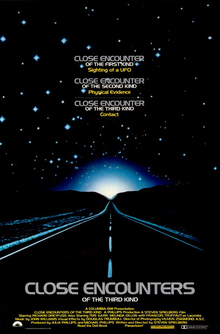
Behind the film
- Year
- 1977
- Director
- Steven Spielberg
- Writers
- Steven Spielberg, Paul Schrader, Jerry Belson
- Runtime
- 2h 14m
- Genres
- Science fiction, Adventure, Drama, Speculative fiction
- Production
- EMI Films, Columbia Pictures
- Country
- United States
- Cast
- Richard Dreyfuss, Melinda Dillon, François Truffaut, Teri Garr, Bob Balaban, Cary Guffey, Roberts Blossom, Lance Henriksen
About the film
Contains story spoilers.
Close Encounters of the Third Kind starts with evidence that seems impossible to fit into ordinary life. Roy Neary, played by Richard Dreyfuss, is an Indiana utility worker sent out during a power disruption when strange aircraft appear overhead. He is not introduced as an expert or a chosen leader: he is a husband and father returning to a familiar routine. The encounter leaves him with a vivid image he cannot put aside, and that image begins to intrude on his home and work. In another strand, Jillian Guiler, played by Melinda Dillon, discovers that her young son Barry has also been drawn into the mystery. The film keeps these lives separate at first, letting the same unexplained phenomenon create very different consequences for each household.
Government investigators are trying to understand the sightings while keeping the public away from the most sensitive events. Claude Lacombe, played by François Truffaut, approaches the evidence as a patient researcher, gathering witnesses and studying the sounds and patterns associated with the visitors. The film's world is not one in which every authority is malicious; some people are curious and humane, while the institutions around them manage information through secrecy. This tension makes the investigation feel both welcoming and unnerving. The visitors may be reaching out, but the people who have evidence cannot freely discuss it, and the public receives fragments rather than a clear explanation.
Roy's image of a mountain becomes the story's central practical obstacle. He cannot explain why he keeps drawing and building its shape, and the obsession puts pressure on his marriage and relationship with his children. Jillian recognizes a related image and faces a more immediate danger when Barry disappears. Their choices are not equivalent: Roy is pulled toward an experience he cannot interpret, while Jillian is trying to recover her child. The film lets wonder coexist with the collateral damage caused by Roy's fixation. That keeps the mystery attached to recognizable people instead of allowing the alien encounter to erase domestic life.
The investigators eventually identify Devil's Tower in Wyoming as the place where the scattered clues converge. The route there becomes a contest between the people trying to reach the site and the military authorities trying to control it. Spielberg makes the landscape part of the narrative: the mountain is a shape that can be recognized from a drawing, approached across open country and finally revealed as a meeting place. It is an unusually tangible destination for a story about an unconfirmed presence. The audience can understand why the characters travel toward it even before they know what they will find there.
The finale turns communication into the action. A human team and the visitors establish contact through light and a five-note musical phrase, then repeat and extend the exchange. John Williams's score is both the emotional language of the scene and an element of its fictional technology. Cinematographer Vilmos Zsigmond and effects artist Douglas Trumbull help make the encounter legible through light, scale and carefully staged visual effects; Effects sequences were shot on 65mm while much of the film used 35mm, giving the production different photographic tools for ordinary life and extraordinary contact. The mothership's appearance transforms a remote government site into a performance space where image, sound and human response work together.
Close Encounters moves toward a kind of answer without explaining everything about the visitors. Roy boards the spacecraft, leaving his family behind, and the final image treats that departure as both fulfilment and loss. The choice can feel exhilarating because the film has made contact an experience of wonder, but it also follows a long period in which Roy's pursuit has damaged his home life. The story does not settle that conflict with a simple moral. Instead, it asks viewers to hold the family consequences beside the pull of discovery. The approach matches the film's craft: Spielberg gives the audience enough concrete signals, locations and repeated patterns to follow the encounter, while leaving the visitors' larger purpose open.
The film's version history matters to the way its ending is discussed. A 1980 special edition showed the inside of the mothership; the original theatrical ending instead leaves the ship as a mysterious exterior presence. That distinction helps explain why the final boarding can feel like a leap beyond what the film has shown. For most of the story, the investigation proceeds through traces: strange lights, repeated musical notes, drawings and the shape of a mountain. The climax gives those fragments a shared point of origin, but not a complete explanation of alien society. Spielberg uses withheld information as part of the wonder. The audience reaches the threshold with Roy, and the film ends before that threshold becomes an ordinary setting.
This careful movement from hints to encounter also explains why the film's first half gives so much time to ordinary reactions. Roy is not the only person affected by the lights; Barry's disappearance makes the phenomenon a family emergency, while the investigators must decide what evidence can be trusted. The repeated five-note phrase works as both a clue and a test: when it returns in a controlled setting, the earlier sightings can be understood as communication rather than isolated spectacle. The finale does not erase the fear and confusion that preceded it. It changes their meaning by showing that people have been responding to a visitor capable of answering back.