
Behind the film
- Year
- 2010
- Director
- Louis Leterrier
- Writers
- Travis Beacham, Phil Hay, Matt Manfredi
- Genres
- Fantasy, Action, Drama, Sword-and-sandal
- Production
- Legendary Pictures, Warner Bros. Entertainment
- Country
- United Kingdom, United States
- Cast
- Sam Worthington, Gemma Arterton, Mads Mikkelsen, Alexa Davalos, Ralph Fiennes, Liam Neeson, Jason Flemyng, Luke Evans
About the film
Contains story spoilers.
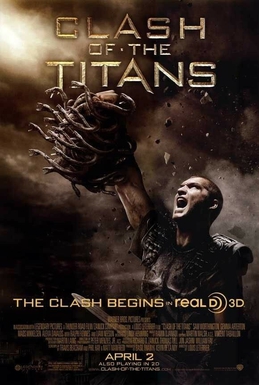
Perseus is raised by a fisherman after being cast into the sea as a baby. Hades destroys his adoptive family during humanity’s rebellion against the gods, and Perseus reaches Argos, where Hades threatens the Kraken unless Princess Andromeda is sacrificed. Learning he is Zeus’s son, Perseus joins Draco’s expedition and receives guidance from the immortal Io. The party survives Calibos and giant scorpions with help from djinn, then learns that Medusa’s head can defeat the Kraken. Perseus survives her lair, but Calibos kills Io. He kills Calibos, rides Pegasus to Argos and petrifies the Kraken, saving Andromeda. He drives Hades back to the Underworld and refuses both kingship and life on Olympus. Zeus accepts his choice and restores Io, allowing Perseus to continue a mortal life with her.
Louis Leterrier’s film makes divine ancestry a problem of belonging. Perseus has an inheritance that could explain his exceptional abilities, but accepting that explanation risks allowing it to replace the relationships that formed him. Sam Worthington gives the character a stubborn resistance suited to that conflict. The question is not simply whether he can discover a hidden greatness. It is whether greatness has to mean adopting the values of the people who claim him by blood. The film’s action places that disagreement in physical terms, asking how a person can use power without allowing its source to define everything he is willing to do.
The world turns worship into a relationship of dependence. Gods are immensely powerful, yet the lives of mortals matter to their standing in ways that make human defiance consequential. That arrangement keeps the divine realm from functioning only as a distant audience for adventure. It is involved in the pressures that produce the adventure, with authority shaped by pride, resentment and competing claims. Liam Neeson’s Zeus and Ralph Fiennes’s Hades give those claims different energies, one accustomed to recognition and the other carrying grievance. Their disagreement makes enormous power look emotionally familiar, even as its consequences remain far beyond the scale of ordinary conflict.
Argos gives the confrontation a civic setting. The city’s leaders can speak in the name of a population whose members have less control over what those declarations will cost them. Andromeda’s position makes that distance particularly visible: a political and religious struggle can be concentrated into demands upon a single body. Alexa Davalos’s presence helps distinguish the person threatened from the role the city’s crisis assigns her. The setting therefore supplies more than a destination to defend. It raises the possibility that public defiance can become another kind of coercion when those announcing it are not the people expected to bear its full consequences.
The expedition introduces a practical scale against that grand conflict. Mads Mikkelsen’s Draco belongs to a world in which judgment must become action, and in which courage cannot eliminate the need to respond to changing conditions. Travelling companions give Perseus people to stand beside rather than a population to imagine abstractly. The group also makes his insistence on a mortal identity more demanding. A declaration of independence sounds simple in isolation; within a vulnerable company, it has to coexist with the obligations created by shared danger. The film draws tension from the possibility that rejecting help can express integrity while also creating costs for someone other than the person doing the rejecting.
Gemma Arterton’s Io provides a different relationship with time. Her immortality places her beside events without giving her the effortless sovereignty associated with Olympus. That distinction allows longevity to seem burdensome as well as powerful. Within the adventure, her guidance gives Perseus an account of himself that his immediate experience cannot supply, yet guidance is not the same as command. The relationship gives the story room to imagine knowledge offered without complete ownership of the person receiving it. Io’s position matters because the film contains many figures who believe that explaining another person’s origin entitles them to determine that person’s future.
The monsters organise action around different kinds of physical attention. A giant attacker makes scale the problem, while a creature whose look is dangerous makes perception itself part of survival. The adventure can therefore change its rules without losing the larger purpose of the journey. Weapons, bodies and spaces acquire different meanings from one confrontation to another, turning the mythic world into a succession of conditions that must be understood rather than merely endured. This is the film’s invented version of mythology, not a definitive account of ancient Greek belief. Its mixture of creatures and divine conflicts serves a modern action story built around Perseus’s resistance to an assigned identity.
The ending separates accepting assistance from surrendering a life. Perseus cannot erase the origin of his abilities, but he can refuse the idea that origin settles where he belongs. At the same time, the restored relationship depends on divine action, leaving his independence connected to the powers he has challenged. The film’s resolution is consequently less absolute than its hero’s declarations may sound. He has made a choice within a world where no one can live entirely outside the consequences of other people’s decisions. The final emphasis falls on the kind of life he wants to inhabit, rather than treating a prestigious destination as the automatic reward for proving his strength.