
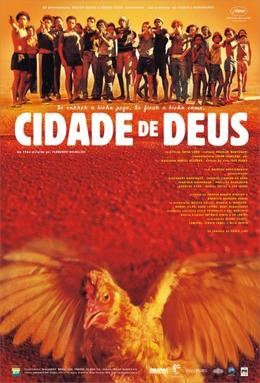
Behind the film
- Year
- 2002
- Director
- Fernando Meirelles, Kátia Lund
- Writers
- Bráulio Mantovani
- Runtime
- 2h 10m
- Genres
- Drama, Crime, Coming-of-age, Hood
- Production
- Videofilmes, StudioCanal, Wild Bunch
- Country
- Brazil, France
- Cast
- Alexandre Rodrigues, Leandro Firmino Da Hora, Phellipe Haagensen, Seu Jorge, Alice Braga
About the film
Contains story spoilers.
City of God begins with a chicken trying to escape a gang, caught between armed young men and Rocket, a photographer with a camera around his neck. The standoff sends the story backward through decades in the Rio housing project whose name gives the film its title. Rocket narrates, but he is not a conventional hero moving through a single plot. He remembers a neighbourhood changing around him: small-time robberies give way to drug territories, and children who once watched older criminals become the people carrying guns. The film is adapted from Paulo Lins’s novel, shaped into a fast-moving, non-linear account by Bráulio Mantovani and directors Fernando Meirelles and Kátia Lund.
In the 1960s, Rocket’s older brother Goose belongs to the Tender Trio, a group of amateur thieves who share their stolen money with residents and receive shelter in return. A boy called Li’l Dice persuades the trio to rob a motel, then waits behind while they leave. He lies that police are coming and guns down the motel’s occupants himself. The resulting crackdown scatters the trio: one member turns to religion, another is shot while trying to flee, and Goose is killed by Li’l Dice after taking money from him. The cruelty is not presented as a single origin story that explains everything; it is an early glimpse of how a child can learn that force brings immediate power and attention.
Years later, Li’l Dice has renamed himself Li’l Zé and runs a growing drug operation with his charismatic friend Benny. Rocket, meanwhile, is drawn toward photography and briefly hopes for a life outside the gang economy. Zé’s takeover of a drug apartment strengthens his control, while the rival dealer Carrot remains a tolerated exception partly because Benny likes him. For a time, Zé’s monopoly produces a brittle calm. Benny starts spending time with Angélica and her friends, and he and Angélica decide they want to leave the trade. At his farewell party, Zé argues with him; Blacky’s attempt to shoot Zé instead kills Benny. That accident removes the person who tempered Zé’s impulses and turns the gang’s internal conflict outward.
Zé beats Knockout Ned, a peaceful former soldier, and rapes his girlfriend after she rejects Zé. This attack makes the next stage of the story especially grim. After Ned’s brother wounds Zé, the gang shoots into the family home, killing Ned’s brother and uncle. Ned joins Carrot’s side, at first insisting that he will target criminals, but the war changes him: during a bank robbery he shoots a policeman, and that act creates a personal debt that returns later. The film follows a conflict whose original cause fades as both factions recruit and arm younger followers. Its shifting narration and quick cuts make the neighbourhood feel like a web of remembered incidents, while the violence has consequences that keep travelling beyond the scene where it happens.
Rocket’s camera becomes entangled in that war when Zé orders him to photograph the gang. A newspaper reporter publishes one of the pictures, giving Rocket a chance to enter journalism and making Zé pleased by the notoriety. Rocket returns to photograph the police as they confront Zé’s heavily armed group; when Carrot’s gang arrives, a gun battle breaks out. Ned kills Tiago, then is killed by a boy avenging the policeman Ned shot during the robbery. The sequence refuses the neat resolution of a duel between two leaders: personal vendettas and recruitment have made the conflict larger than either man.
After the fighting, police capture Zé and Carrot. The officers take Zé’s money and release him, exposing how thoroughly corruption has become part of the local balance of power. Rocket secretly photographs the exchange, then takes a final picture of Zé’s body after the Runts—children Zé had armed—turn on him and kill him in revenge for an earlier murder. Rocket must choose which image to give the paper: the evidence of police corruption or the dead gang boss, which will secure his place as a photographer. He chooses the latter, while the Runts walk off making a list of dealers to kill. The opening chicken returns to its dangerous crossroads, and the ending makes clear that Rocket’s escape does not end the cycle around him.
The film’s form keeps that cycle in view without flattening the characters into a list of victims and villains. Rocket’s voice-over sometimes leads into one person’s story, then yields to another; captions and brief returns to earlier moments alter what a scene means. The opening chicken chase is not solved immediately but becomes a frame the film revisits after we understand the young men surrounding it. Meirelles and Lund cast many performers from Rio’s favelas and worked with young actors through a preparatory school that later continued as a film school and nonprofit. Their presence helps the crowded streets feel inhabited, while the editing’s speed makes the shifting power struggles legible rather than tidy.