
Behind the film
- Year
- 1931
- Director
- Charles Chaplin
- Writers
- Charles Chaplin
- Runtime
- 1h 27m
- Genres
- Romantic comedy, Comedy drama, Tragicomedy
- Production
- United Artists
- Country
- United States
- Cast
- Charlie Chaplin, Virginia Cherrill, Harry Myers, Florence Lee, Al Ernest Garcia, Henry Bergman, Albert Austin, Granville Redmond
About the film
Contains story spoilers.
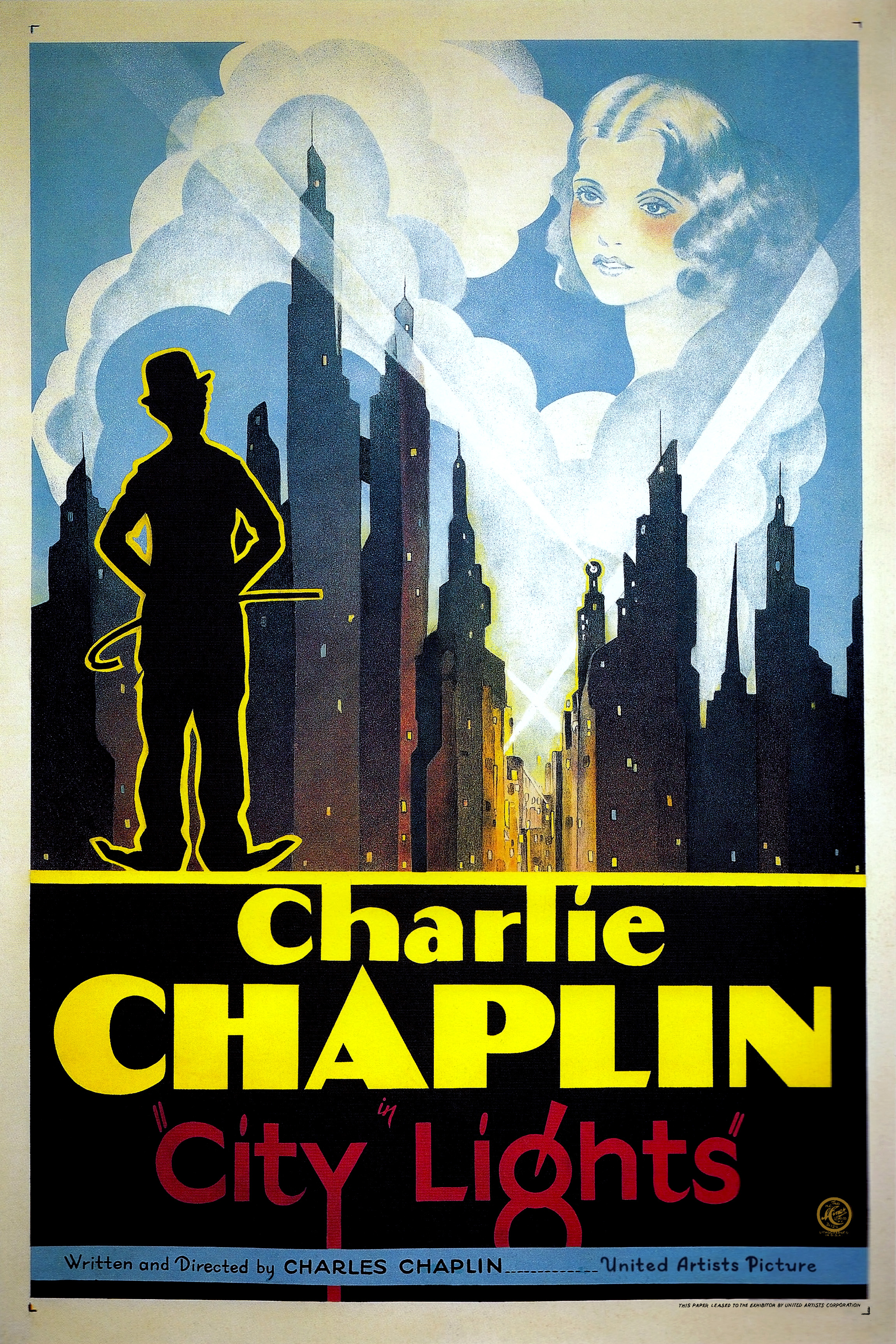
At a public unveiling, the Little Tramp is discovered asleep on a statue and chased away by the ceremony’s indignant crowd. In the street he meets a blind flower seller, buys a flower with his last coin and realizes she cannot see him. When he leaves beside a car whose door slams, she mistakes the sound for a wealthy customer driving away. That misunderstanding becomes the emotional engine of the story: the Tramp wants to help her, but she imagines a benefactor with means and status that he does not possess.
That night he encounters a drunken millionaire who is trying to drown himself. The Tramp persuades him to come home and the millionaire treats him as a dear friend, taking him to a party and giving him money and use of a car. In the morning, sober, the millionaire does not recognize the Tramp and throws him out. Their cycle repeats whenever the rich man drinks: generosity and companionship appear, then vanish with sobriety. The Tramp uses one of these brief openings to buy the flower girl’s flowers and drive her home, reinforcing her mistaken picture of who he is.
When the flower seller falls ill, the Tramp learns from a doctor that she needs care. He takes a job as a street sweeper and brings her groceries during his lunch break, reading aloud a newspaper story about a treatment for blindness. She imagines that she will finally see the generous young man she believes visits her. The Tramp also discovers an eviction notice hidden by her grandmother and promises to cover their rent. His good intentions repeatedly outpace his resources: he is fired for lateness and must look for another way to get money.
A boxer persuades him to enter a fixed match and split the prize money, but the planned opponent is replaced at the last moment by a serious fighter. The Tramp’s evasions create a comic dance around the ring, yet he is eventually knocked out and earns no solution to the rent problem. Another meeting with the millionaire gives him a chance: while drunk, the man hands him money for the operation. Burglars strike the house, knock the millionaire unconscious and take the rest. When police arrive, the millionaire cannot remember giving the Tramp anything, so the apparent theft lands on the wrong man.
The Tramp manages to get the money to the flower girl and tells her he will be away. He is arrested and imprisoned, while she undergoes the operation and later opens a flower shop with her grandmother. Released months afterward, he returns to her old street corner and finds it empty. In the shop, she briefly mistakes a wealthy customer for her benefactor; then she notices the shabby Tramp outside as boys tease him. He picks up a discarded flower, and she offers him a fresh one and a coin, still not knowing who he is.
When she touches his hand, she recognizes it. Chaplin ends not with a spoken explanation but with a sequence of looks, hesitation and touch: she understands that the man before her is the one who helped her, and he waits for her reaction. The film was made after sound cinema had become common, yet Chaplin keeps dialogue out and builds meaning through pantomime, music and carefully timed effects. A few sound moments punctuate the silent style, while the opening ceremony mocks talking-picture conventions. Comedy repeatedly arises from the Tramp’s bodily awkwardness; the final recognition gives the same gestures a quieter emotional weight.
Chaplin’s comedy depends on the gap between what the Tramp intends and what other people believe about him. The flower seller’s assumption that he is wealthy is created by an accidental sound, while the millionaire’s friendship is reliable only under intoxication. Both relationships turn on recognition: one person sees a benefactor where there is a poor wanderer, and another cannot recognize his closest companion once sober. This creates a repeating rhythm of access and exclusion, with money briefly available but never secure enough to change the Tramp’s social position.
The boxing match shows how much information Chaplin can place in a moving arrangement of bodies. The Tramp uses the referee as a barrier, keeping him between himself and the opponent, then tries to preserve that advantage as the men rotate and separate. His apparent cleverness is always precarious: a changed position can turn evasion into exposure. Elsewhere, meals and the millionaire’s entertainment make his attempts to behave comfortably among wealthy people another source of disruption. The comedy allows him to improvise, but it never gives him permanent command over those spaces. Virginia Cherrill’s flower seller belongs to a quieter register, where a slight change in attention or a hand held for a moment can transform what someone believes. At the end, the camera stays close enough for the Tramp’s hopeful smile to become uncertain as recognition arrives. The film leaves her response developing in front of him, without substituting a later wedding or a solved future for that immediate meeting.