
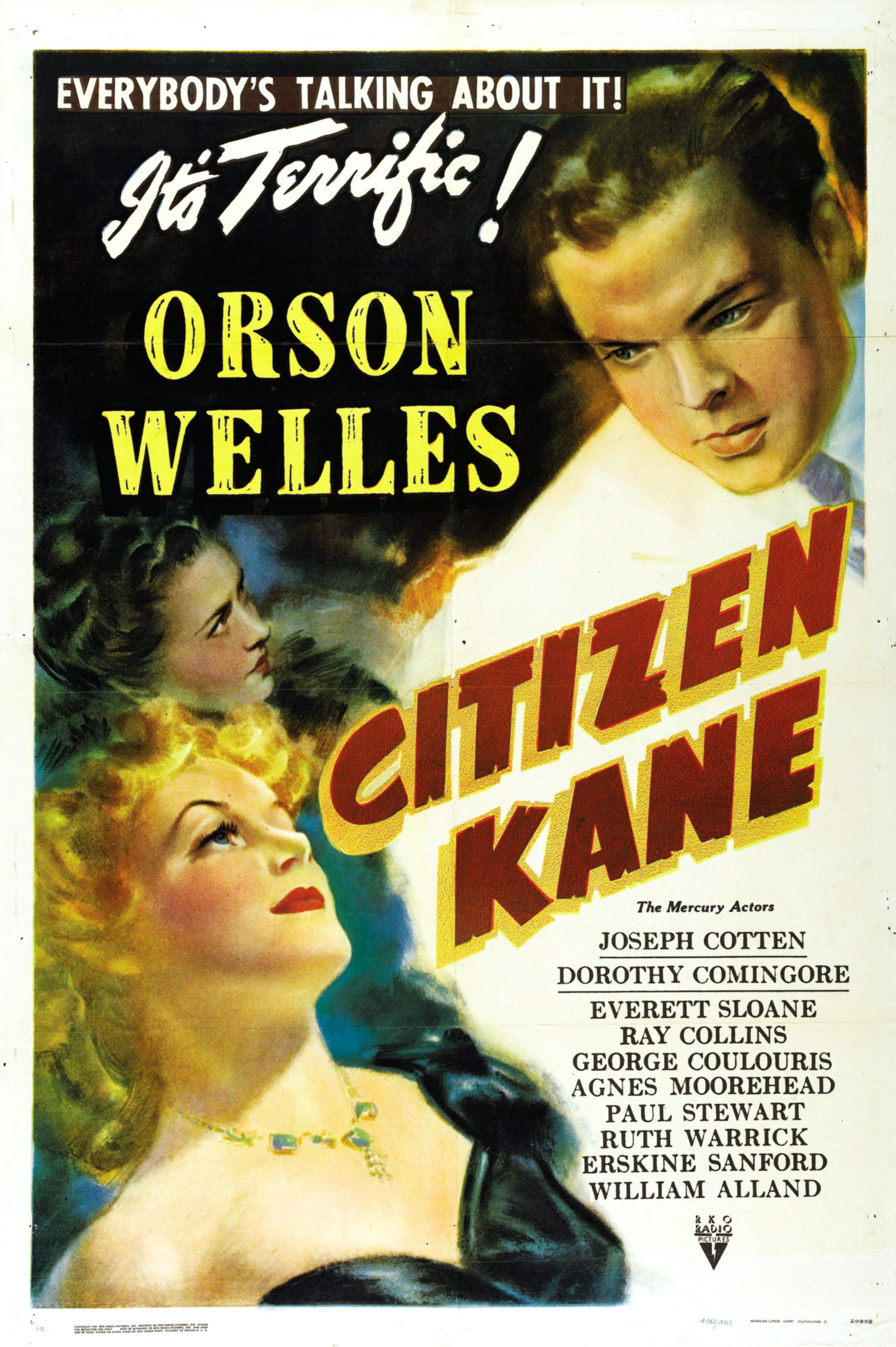
Behind the film
- Year
- 1941
- Director
- Orson Welles
- Writers
- Herman J. Mankiewicz, Orson Welles
- Genres
- Drama, Fiction, Flashback, Biographical
- Production
- RKO Pictures
- Country
- United States
- Cast
- Orson Welles, Joseph Cotten, Dorothy Comingore, Agnes Moorehead, Ruth Warrick, Ray Collins
About the film
Contains story spoilers.
The story begins at Xanadu, the immense Florida estate of newspaper owner Charles Foster Kane, where he dies alone after whispering “Rosebud.” A newsreel sketches his public life, but its tidy summary leaves reporter Jerry Thompson with a question: what did the last word mean? Thompson interviews people from Kane’s past, and the film moves through their recollections rather than following one neutral account. The shifting memories give the portrait its tension: each witness remembers a different Kane, and each version has its own limits. The investigation is less a detective puzzle than an attempt to see how a powerful man looks from several distances. The opening montage also compresses decades into public headlines, suggesting how an institution can turn biography into a sellable summary.
The earliest account comes from Walter Parks Thatcher, whose memoir takes the story back to Kane’s childhood in Colorado. When a valuable mine changes the family’s prospects, his mother arranges for the boy to be raised by Thatcher, a banker. The separation is presented as a decision made in the name of security, yet it leaves Kane’s adult life shadowed by a loss he cannot simply buy back. As a young man he inherits a fortune and takes control of the New York Inquirer. He brings energy and spectacle to the paper, making circulation and influence central parts of his identity. Thatcher’s papers are only one account, and Leland’s memories carry the hurt of a friendship that Kane’s success could not preserve.
Kane’s newspaper becomes both a business and a public stage. His longtime friend Jedediah Leland, a drama critic, is part of the paper’s early circle as Kane builds an operation that can challenge established institutions. Kane campaigns for governor while married to Emily Norton, but his relationship with Susan Alexander, a young singer, gives his opponent leverage. The campaign appears poised for success until an opponent exposes Kane’s affair. The scandal ends his bid and damages his marriage. Instead of retreating, Kane shifts his ambitions toward Susan, using money and influence to launch her as an opera singer even though she lacks the ability or desire to sustain the career he imagines for her.
Leland’s recollection complicates the image of Kane as merely a forceful publisher. At the beginning of his newspaper career, Kane publishes a declaration of principles promising to defend ordinary readers. He later poaches staff from a rival paper, and Leland’s recollection measures the distance between that pledge and Kane’s appetite for influence. Leland reviews Susan’s opera performance honestly; Kane completes the review himself, then fires Leland. The scene makes the dismissal an act of control over a friend and critic, not just a reaction to reading an unfavorable piece. The film’s compressed jumps between decades make success feel cumulative: each victory adds to the scale of Kane’s world, while his circle of genuine trust becomes narrower. Kane’s campaign places his private choices under public scrutiny, while the later interviews show how that scandal continued to shape his reputation.
Susan’s own account centers on the life built around the operatic project. Kane insists that she continue performing, and the production grows more lavish as audiences remain unimpressed. After she attempts suicide, he agrees to let her stop. Their marriage moves to Xanadu, where the estate’s rooms and collections make private life feel vast and isolating. Susan grows increasingly isolated and eventually leaves him. Kane reacts by wrecking her room, then stops when he notices a small snow globe. The gesture is intimate, but it cannot repair the relationship; the film leaves the object’s emotional force tied to the childhood separation shown earlier.
Thompson gathers these accounts from Thatcher’s papers, Leland, Kane’s former associates, and Susan, but no interview yields the answer he wants. He concludes that Rosebud may be unknowable to anyone outside Kane. The audience, however, sees workers burn the sled Kane rode as a child, with the name Rosebud painted on it; no character identifies it before it disappears. That final image links the word to a lost childhood without reducing the whole man to one symbol. The film closes on objects being discarded while the reporter’s investigation remains incomplete, preserving the difference between discovering a clue and understanding a life.
The film’s form makes that difference part of the experience. Deep-focus compositions often keep foreground and background legible at once, while low camera angles and vast interiors make Kane seem both commanding and trapped inside spaces he has built. Newsreel, memoir, interview, and remembered scenes each offer a distinct texture, yet none has final authority. The structure lets the same public figure change according to who speaks. Kane’s wealth can purchase papers, buildings, and spectacle; it cannot force other people to remember him in a single, satisfying way, which is why the reporter’s unanswered question matters even after the audience learns the word’s origin.