
Behind the film
- Year
- 1931
- Director
- Wesley Ruggles
- Writers
- Howard Estabrook
- Genres
- Western, Epic, Drama
- Production
- RKO Pictures
- Country
- United States
- Cast
- Richard Dix, Irene Dunne, Estelle Taylor, George E. Stone, William Collier Jr., Edna May Oliver, Eugene Jackson, Judith Barrett
About the film
Contains story spoilers.
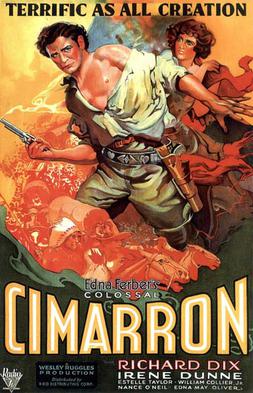
Yancey Cravat loses his preferred claim to Dixie Lee during the 1889 Oklahoma land rush, then establishes a newspaper in Osage with his wife Sabra. He kills the outlaw Lon Yountis and later his old acquaintance, the Kid, while protecting the town. Restlessness takes him away to another land rush, leaving Sabra to run the newspaper and raise their children. He returns years later and defends Dixie against a public-nuisance charge. Oklahoma develops, while Yancey's advocacy for Native Americans conflicts with Sabra's prejudice and their son's relationship with a Native woman. Yancey disappears again. Sabra eventually enters Congress and comes to embrace her daughter-in-law. Their final reunion comes after Yancey saves oil workers from an explosion; mortally injured, he dies with Sabra beside him.
The opening gives movement an enormous dramatic value. A rush across land promises that a life can be transformed by speed, nerve and a willingness to seize an opportunity. That promise supplies the Western with excitement, but it also establishes a troubling measure of success: getting somewhere before somebody else. The story that follows has to live with what happens after the race. A place cannot become a community through arrival alone, and a family cannot thrive indefinitely on the energy of departure. Wesley Ruggles's film sets those different kinds of effort beside one another. Yancey's appetite for possibility can look heroic in public while imposing a much less glamorous cost on the people who need him to remain present.
Richard Dix's Yancey is particularly useful to that tension because the film can admire his generosity without making him dependable. His confidence gives him an ability to intervene where others retreat into caution or convention. Yet confidence also lets him assume that the consequences of his choices will somehow be managed. The distinction matters. A person may be capable of an impressive act of courage while being much less capable of the repeated, ordinary commitments another life requires. The film's extended timescale makes that contradiction harder to hide behind one successful intervention. Heroism arrives in moments; responsibility occupies the time between them. Yancey's dramatic appeal does not settle the question of whether the people closest to him receive what his public identity appears to promise.
Irene Dunne's Sabra gives that missing time a human form. Her importance comes from persistence, from the possibility that the person left to keep things functioning gradually becomes the story's more substantial account of change. A household and a public enterprise both require attention that cannot be supplied by an inspiring reputation. That makes her role larger than waiting for a husband to return. The marriage also complicates the usual division between an adventurous man and a restraining woman. Sabra has ambition, judgment and limitations of her own. Her capacity to build a position in the world does not make all her beliefs admirable. The film leaves room to see her strength and her prejudice together, which is more revealing than treating either quality as a complete explanation of her character.
Dixie exposes how a community can mistake social respectability for moral worth. Estelle Taylor's character occupies a position from which judgment arrives before understanding. The interesting contrast concerns who receives the benefit of an individual account and who is reduced to a label. Yancey's willingness to look past that label gives his independence an ethical dimension, even when his other forms of independence are costly. Sabra's response shows that social belonging can be defended by narrowing the circle of people permitted to share it. The newspaper therefore matters as more than a convenient occupation. A public voice can reinforce the judgments a community already accepts, or it can ask the community to reconsider what those judgments conceal. That choice helps connect the domestic story to the town's changing sense of itself.
The treatment of race needs the same attention. The film contains racial stereotypes, even as parts of its story question exclusion and prejudice. Those elements should be held together rather than allowing the sympathetic argument to excuse the representation surrounding it. A fictional frontier narrative also cannot stand as a complete account of Indigenous history or the consequences of settlement. Its dramatic framework centres particular newcomers and measures change largely through their experience. Reading it carefully means asking who is allowed an interior life, whose presence becomes scenery or comedy, and whose claim to the world receives an explanation. That attention does not remove the film's historical distance. It makes the distance visible, allowing the story's moral aspirations to be considered alongside the limits of its own perspective.
The passage of years gives the world a shape that a single confrontation could not provide. Institutions, appearances and opportunities change, while old attachments continue to influence the people moving through them. That creates an epic in which growth is not merely a larger version of the opening excitement. It involves compromises, absences and the gradual redistribution of authority. A person who seemed central at the beginning may no longer be the one sustaining the world at the end. Cimarron is especially interesting through that imbalance between the figure who embodies adventure and the figure who absorbs its consequences. Its account of belonging remains contradictory, but the contradiction is part of what there is to understand: a public legend can be built from actions that leave a much more complicated private life behind.