
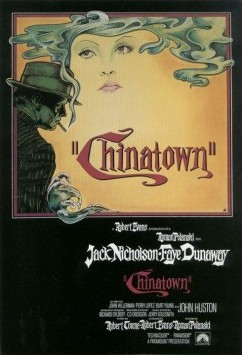
Behind the film
- Year
- 1974
- Director
- Roman Polanski
- Writers
- Robert Towne
- Genres
- Neo-noir, Mystery, Film noir, Crime thriller
- Production
- Paramount Pictures
- Country
- United States
- Cast
- Jack Nicholson, Faye Dunaway, John Huston, Perry Lopez, John Hillerman, Diane Ladd, Darrell Zwerling, Roman Polanski
About the film
Contains story spoilers.
Chinatown begins with a profession built around appearances. In 1937 Los Angeles, private investigator Jake Gittes sells proof of marital betrayal, photographing people who believe their private movements remain private. He takes pride in recognizing deception and presenting the evidence with confidence. A woman who says she is Evelyn Mulwray hires him to follow her husband Hollis, a water official seen in public opposing a proposed dam. Gittes finds him in the company of a younger woman and allows the apparent affair to become news. What seems like a completed job is actually the means by which someone has used his professional instincts against him.
The real Evelyn Mulwray arrives, revealing that the client was an impostor. Before Gittes can resolve the deception, Hollis is found dead, drawing the inquiry into a larger struggle over water. Los Angeles is publicly presented as a city facing scarcity, yet the investigator encounters signs that water is being deliberately diverted or wasted. The contrast between the official story and physical evidence shifts the film away from adultery toward control of the city’s future. Gittes can follow a person and take a photograph, but those methods are less straightforward when the subject is a network of institutions, property transactions and public claims that reinforce one another.
Evelyn’s father Noah Cross has money, influence and an unsettling ability to make conversation feel like an assertion of ownership. John Huston plays him with an ease that contrasts with Gittes’s increasingly visible injuries and uncertainty. Cross had a business relationship with Hollis and wants the investigator to find the young woman seen with him, presenting his interest as something Gittes might understand through the language of payment. Evelyn resists her father’s involvement. That resistance does not immediately tell Gittes what happened, but it establishes that the family relationships are part of the inquiry rather than a separate personal complication. The people competing over water also have reasons to control who can speak about the past.
Records lead Gittes toward land being acquired in the valley, where farmers are suffering from a shortage that makes their property easier to buy cheaply. Names attached to the purchases point to a retirement home, turning apparently ordinary paperwork into evidence of concealment. The significance is not simply that someone has lied about one sale. Control of water can determine which land becomes valuable and who gets to profit when the city expands. The film makes that corruption tangible through orchards, dry ground, maps and documents, letting the investigation connect places that appear unrelated. A future described as civic progress can also be a private fortune arranged before the public understands what is happening.
Gittes grows closer to Evelyn while continuing to doubt parts of her account. Faye Dunaway gives her controlled speech and careful movements the pressure of someone trying to protect another person without revealing why protection is necessary. The young woman, Katherine, becomes the focus of that uncertainty. When Gittes confronts Evelyn, her eventual explanation overturns the categories he has been using: Katherine is both her daughter and her sister, born from her father’s abuse. Evelyn’s secrecy has been an attempt to keep Katherine away from Cross. The revelation makes Gittes’s insistence on forcing a confession troubling, because his confidence in exposing a lie has again failed to account for the vulnerable person behind it.
Physical evidence also changes the interpretation of Hollis’s death. Saltwater and a pair of bifocals point away from the place where his body was discovered and toward the Mulwray home. Evelyn explains that the glasses were not her husband’s. Gittes connects them to Cross and confronts him about the murder and land scheme, but solving the puzzle does not give him the power to control the response. Cross can use armed assistance, public standing and the investigator’s own intended movements to reach Katherine. The film separates knowing what happened from being able to make justice follow, a distinction that becomes more important as Gittes tries to move Evelyn and her daughter out of reach.
Their attempted escape converges in Chinatown, a place associated with Gittes’s earlier police work and a memory of harm he could not prevent. The police detain him while Cross approaches the women. Evelyn wounds her father and tries to drive away with Katherine, but police fire kills her. Cross takes Katherine, leaving the investigator alive with knowledge that has failed to protect either of them. The outcome gives the mystery a solution without granting the usual reassurance of a solved case. Gittes has identified the man responsible, yet the institutions surrounding the confrontation have helped that man obtain what he wants. The city’s larger scheme remains beyond the investigator’s ability to undo.
Roman Polanski directs Robert Towne’s screenplay with most discoveries arriving through Gittes’s limited experience, keeping the audience close to his changing assumptions. Jack Nicholson’s performance moves from professional amusement to pain and helplessness, while Jerry Goldsmith’s score lends the sunlit settings an undertow of unease. Darkness is not confined to shadowed alleys; it exists in respectable houses, public hearings and the planning of growth. The story is a fictional noir drawing on the pressures of water and development, not a documentary reconstruction of Los Angeles history. Its final tragedy brings the private and public plots together: Cross’s desire to possess a city’s future and his desire to possess his family are expressions of the same unchecked power.