
Behind the film
- Year
- 2006
- Director
- Alfonso Cuarón
- Writers
- Clive Owen, Alfonso Cuarón, David Arata
- Runtime
- 1h 46m
- Genres
- Post-apocalyptic, Dystopian, Thriller, Tech noir
- Production
- Strike Entertainment, Hit and Run Productions, Universal Pictures
- Country
- United Kingdom, United States, Japan
- Cast
- Clive Owen, Julianne Moore, Michael Caine, Clare-Hope Ashitey, Chiwetel Ejiofor, Pam Ferris, Danny Huston, Charlie Hunnam
About the film
Contains story spoilers.
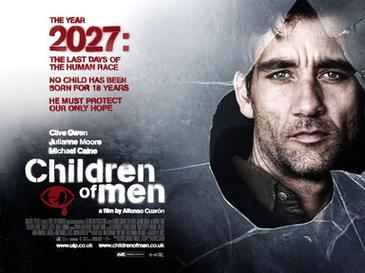
Children of Men takes place in Britain in 2027, after a worldwide infertility crisis has left humanity without a new generation. The country is under an authoritarian government, with Theo Faron, played by Clive Owen, drawn into a journey involving Julian, his former partner, and Kee, an illegal immigrant who is pregnant. The setting is not a pristine future full of advanced technology. London is crowded, worn and tense; refugees are treated as threats, detained and transported through a system that the state claims is necessary for order. Public screens report the death of the world's youngest person, making the absence of children a fact that everyone shares but experiences differently.
Theo begins as a former activist who has withdrawn from political life. Julian, played by Julianne Moore, is connected to the Fishes, a revolutionary group, and asks him to help Kee reach a place of safety. Kee's pregnancy makes her both a person in immediate danger and a symbol that competing groups may try to exploit. After Julian dies, Theo has to decide whether to remain involved and how far he can trust the factions around him. His route is not a clean rescue mission: government forces, the Fishes and other people all have their own objectives, while every checkpoint and transfer risks exposing Kee. The story stays close to Theo's perspective, so the world is learned through the obstacles he has to cross.
The film's politics are embedded in ordinary procedures and visible surroundings. Migrants are demonised and held in coastal camps, while London's streets show bomb damage, military presence and daily fatigue. This is a recognisable society under pressure rather than an invented world with elaborate gadgets. The lack of children changes public culture in small, telling ways: there is no ordinary expectation of a future generation, and images of the past sit alongside signs of continuing breakdown. The film does not require viewers to solve why infertility began; it treats the unexplained cause as part of the characters' environment. That focus leaves attention on how people respond to catastrophe and to vulnerable outsiders.
Theo's journey brings him through sharply different communities. His old friend Jasper, played by Michael Caine, offers a quiet refuge away from the city and holds onto humour even as the wider world collapses. The Fishes offer another kind of shelter, but their political commitment does not guarantee that they will protect Kee's interests above their own. Theo's job becomes less about choosing an ideal faction and more about reading what each person is actually doing. Kee herself is not merely cargo to be delivered: she makes decisions and insists on a role in her own future. The characters' competing agendas keep the story morally complicated without making its immediate goal hard to understand.
Cuarón and cinematographer Emmanuel Lubezki give the escape its force through long, travelling shots that keep bodies, vehicles and danger in one continuous space. The technically complex car ambush and the later passage through the Bexhill refugee camp make the danger part of the same space the characters occupy. These scenes are designed to feel close to unfolding events: the camera turns with Theo rather than cutting away to provide a safe overview. Some sequences described as single shots use digital compositing, but the movement preserves a strong sense of duration and physical geography. This approach makes the action legible as a route through a lived-in place, with nearby people and stray violence visible rather than abstracted into a distant spectacle.
The final movement at Bexhill brings the film's bleak public world into brief contact with a possibility no faction can fully control. Kee gives birth while Theo tries to move her and the baby through the camp. The scene's fragile pause, as people notice the infant, gives physical form to a change that the film has spent its running time withholding. It does not mean the conflict is solved or that safety is guaranteed. The Human Project remains a distant possibility, and the ending avoids explaining more than the characters can know. John Tavener's music, alongside Lubezki's long takes, helps connect the political journey to a moment of fragile attention. The film closes on movement toward hope, not proof that a broken world has been repaired.
That ending gathers the film's contrasting scales into one brief event. Theo has spent the journey negotiating checkpoints, factional plans and armed force; now the sound of a baby briefly interrupts the machinery of detention and combat. The last sequence uses carefully choreographed camera movement, which keeps the characters inside the unsettled camp rather than cutting to a safe, distant overview. The fragile pause is not a promise that the people around Kee have become allies or that the state has disappeared. It is a moment when their attention shifts. The film's hope remains conditional, attached to the dangerous next step of getting mother and child to a place where they might be protected.