
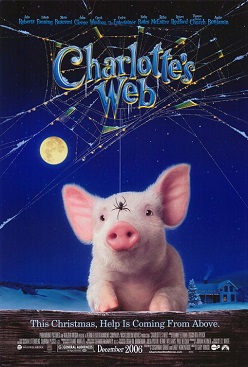
Behind the film
- Year
- 2006
- Director
- Gary Winick
- Writers
- Susannah Grant, Karey Kirkpatrick
- Runtime
- 1h 37m
- Genres
- Children's, Comedy
- Production
- Walden Media, Nickelodeon Movies
- Country
- United States
- Cast
- Dakota Fanning, Dominic Scott Kay, Julia Roberts, Steve Buscemi, John Cleese, Oprah Winfrey, Cedric the Entertainer, Beau Bridges
About the film
Contains story spoilers.
Fern persuades her father to spare a newborn runt, names him Wilbur and raises him. When he moves to her uncle Zuckerman's barn, loneliness gives way to friendship with the spider Charlotte. Learning that Wilbur is destined for slaughter, Charlotte uses words woven into her web to convince the humans that he is exceptional. Templeton the rat helps find material for her messages. At the fair, Wilbur loses the main contest but receives special recognition that secures his future. Charlotte produces an egg sac and, exhausted, remains behind to die. Wilbur takes the sac home with Templeton's help. He survives Christmas and sees the young spiders hatch in spring. Most depart, but three stay, giving him new friendships without replacing the friend who saved him.
The story begins by asking whose judgment counts when a life has been classified as expendable. Fern's response gives attention a practical force: she sees an individual where a routine sees a problem to be removed. Dakota Fanning's role makes that difference understandable without requiring an elaborate moral argument. Caring begins with noticing something specific and refusing to let an accepted category become its entire meaning. Gary Winick's live-action adaptation of E. B. White's novel carries that idea into a world where animals possess voices and relationships. The fantasy does not remove the ordinary structure of farm life; it changes the perspective from which the structure is understood. A decision that appears unremarkable from outside can become the defining danger of a life from within.
Wilbur's openness gives the barnyard an emotional centre. Dominic Scott Kay's voice allows the pig to encounter unfamiliar personalities without already possessing a settled account of how those personalities work. His need for companionship makes the world feel large at the scale of a pen and a collection of neighbours. That scale matters. The story does not need distant travel to produce discovery, because learning what another creature wants is itself a way of discovering the world. The other animals have their own habits and reasons for responding as they do. Wilbur's vulnerability gives those everyday negotiations a significance beyond comic disagreement.
Charlotte brings care into a relationship with skill. Julia Roberts's character can act because she understands how to use what is available to her, and because she is willing to direct that ability towards somebody else's need. The friendship therefore has a material dimension. Sympathy alone would not be enough if it remained separate from effort. Her work also asks why the humans respond to a change in presentation when the creature being presented has not suddenly acquired his worth. That gives the central device a quiet irony: people may need to be told how to look before they recognise what was already there. The spider's intervention changes their attention, making language into a bridge between the value she sees and the value they are prepared to acknowledge.
Templeton complicates the group by refusing an entirely sentimental account of cooperation. Steve Buscemi's rat has appetites and priorities that do not line up automatically with the others' hopes. His presence matters because a community need not consist only of people, or animals, whose motives are perfectly generous. Shared work can depend on negotiation, persuasion and an understanding of what another participant values. The barnyard's different temperaments give the story a social texture beneath its central friendship. Someone can be difficult company and still contribute something important. That does not turn self-interest into the ideal, but it prevents the world from dividing neatly between pure helpers and useless outsiders. The task becomes possible through a collection of unequal dispositions finding some practical way to act together.
The physical setting helps keep that collection imaginable. A barn contains spaces that different creatures occupy differently, so the same environment can supply safety to one inhabitant and exposure to another. The combination of live action and talking-animal fantasy lets familiar surfaces retain their ordinary character while acquiring an interior social life. That gives the adaptation a particular kind of intimacy. The viewer is not asked to imagine an entirely separate kingdom so much as another account of a place humans routinely pass through. Its inhabitants become visible as participants rather than background. The story's wonder lies partly in that altered attention, in the possibility that a small and apparently familiar environment contains relationships whose importance has been overlooked by the people who control it.
Loss prevents the friendship from becoming a promise that care can eliminate every limit. Saving someone and remaining beside him forever are different things, and the film allows that difference to matter. Gratitude has to outlast the immediate presence of the person who made the future possible. That makes Wilbur's continuing life more than the completion of a successful rescue. It becomes a form of responsibility to a relationship that can no longer be continued in its earlier shape. The seasonal movement gives that responsibility a gentle but definite passage of time. New attachments can emerge without making an earlier attachment disposable, and a changed world can contain both happiness and absence. The emotional difficulty comes from learning to hold those experiences together rather than replacing one with the other.
Charlotte's Web gives a modest world a substantial moral life. Its humour and varied voices make the barnyard companionable, but the comfort depends on effort rather than on an assumption that everything will naturally work out. Fern and Charlotte each recognise a life that others are prepared to misunderstand, while the wider group discovers reasons to participate in that recognition. The film's gentleness does not make its central problem trivial. It asks how a person's view of another being changes what that person considers permissible. Understanding the story means following the journey of that attention, from an individual protest to a collective response, and then into a future that has to remember the work and friendship that allowed it to exist.