
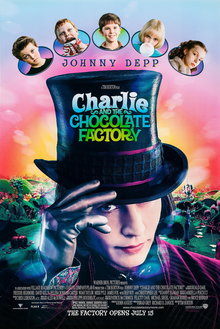
Behind the film
- Year
- 2005
- Director
- Tim Burton
- Writers
- John August
- Genres
- Family, Fantasy, Black comedy, Musical
- Production
- Warner Bros. Entertainment, Plan B Entertainment, Village Roadshow Pictures
- Country
- United States, United Kingdom, Australia
- Cast
- Johnny Depp, Freddie Highmore, David Kelly, Helena Bonham Carter, Noah Taylor, Deep Roy, Christopher Lee, AnnaSophia Robb
About the film
Contains story spoilers.
Charlie Bucket lives with his parents and four grandparents in a small, precarious home near a factory whose products he can rarely afford. His father works putting caps on toothpaste tubes until a machine replaces him, and the family's poverty affects ordinary things such as food and heating. Charlie's interest in Willy Wonka is therefore shaped by both desire and distance. The factory belongs to a world he can see without entering. Grandpa Joe remembers working there before Wonka dismissed his staff over stolen secrets. The building has continued producing sweets behind closed gates, leaving the town to wonder who makes them and what happens inside.
Wonka announces that five Golden Tickets hidden in chocolate bars will admit children and an accompanying adult to the factory. Buying sweets becomes a worldwide competition that gives wealth obvious advantages without making it a guarantee. Augustus Gloop, Veruca Salt, Violet Beauregarde, and Mike Teavee obtain four places. Charlie has far fewer chances and considers what a ticket could be worth to his family when he finally finds the remaining one. His decision to attend is not indifference to their needs. The grandparents recognize an opportunity that money would not necessarily reproduce. Grandpa Joe goes with him, bringing a former worker's excitement back to the place that once employed him.
The greeting outside the gates makes the owner strange before the tour has properly begun. Johnny Depp's Wonka speaks with an awkward brightness that does not amount to ordinary warmth, and his welcome offers spectacle with little reassurance about his judgment. Inside, a room of edible landscape and a chocolate river turns manufacturing into a fantasy of total abundance. Augustus drinks where he has been warned not to, falls into the river, and is carried into a pipe. Wonka's Oompa-Loompa workers handle the consequence and perform a song about him. The factory can fulfill an appetite while also turning that appetite into the reason its owner loses control of the visit.
Each subsequent invention catches another child in a problem connected to the behavior they bring with them. Violet insists on trying experimental gum despite a warning and becomes an enormous blueberry. Veruca wants one of the trained squirrels used to sort nuts, attempts to take one, and is discarded as an unsuitable nut herself. Mike uses the television-transmission invention and is reduced to a tiny image made physical. Their accompanying parents are part of these encounters, encouraging, excusing, or failing to contain the demands that lead to disaster. The children later emerge alive but altered. The tour's punishments belong to a dark comic fantasy, not a sensible program for teaching real children manners.
Charlie remains without having to win an argument against the others. His position is often that of an observer trying to understand a place where explanations arrive after the danger. Freddie Highmore gives him a reserve that contrasts with Wonka's restless performance and the other children's practiced certainty. Grandpa Joe supplies wonder alongside him without making every new machine safe. Their shared reactions keep the tour connected to people who have not grown accustomed to limitless choice. A chocolate river is extraordinary to them because chocolate itself has been a rare treat. For the richer visitors, the same abundance quickly becomes another thing to possess, improve, or use to demonstrate their superiority.
Flashbacks disclose why Wonka has trouble with families. His father, Wilbur, is a dentist whose strict rejection of sweets turned candy into something forbidden and intensely attractive. Young Willy's curiosity developed in conflict with his father's rules, and the separation remained unresolved as he built his career. Christopher Lee makes Wilbur imposing in those memories, while the adult Wonka can command a vast factory without speaking easily about home. This material belongs to Burton's 2005 adaptation and gives its inventor a personal history behind the elaborate machinery. His difficulties are not explained away as mere eccentricity. The visitor he chooses will challenge an assumption carried from that earlier relationship into his present offer.
The prize is succession: Wonka wants Charlie to inherit the factory, but insists that he leave his family behind. Charlie refuses. The decision makes the contest turn on a value the inventor has not prepared to accommodate, and wealth does not automatically settle it. Later, Charlie helps him visit Wilbur. The dentist has kept evidence of his son's achievements despite their separation, and their reunion allows both men to recognize care that the old conflict concealed. Wonka changes the condition of his offer, allowing Charlie's family to come with him. The ending expands what the factory can contain instead of making the boy prove that he is willing to abandon his old life.
Burton contrasts the Buckets' cramped domestic surroundings with rooms organized around bright colors, impossible production processes, and the owner's private imagination. The glass elevator carries the visitors through a structure that seems to ignore ordinary architectural limits. Deep Roy's repeated Oompa-Loompa appearances make the workforce a recurring visual presence, while the musical responses turn each departure into a staged event. Danny Elfman's music supports those shifts without giving Wonka the easy social fluency he lacks. Beneath the scale of the inventions, the story keeps asking what abundance is for. Charlie wants the people he loves to live better together; Wonka has to learn that sharing his life's work can include them rather than requiring a successor who accepts his isolation.