
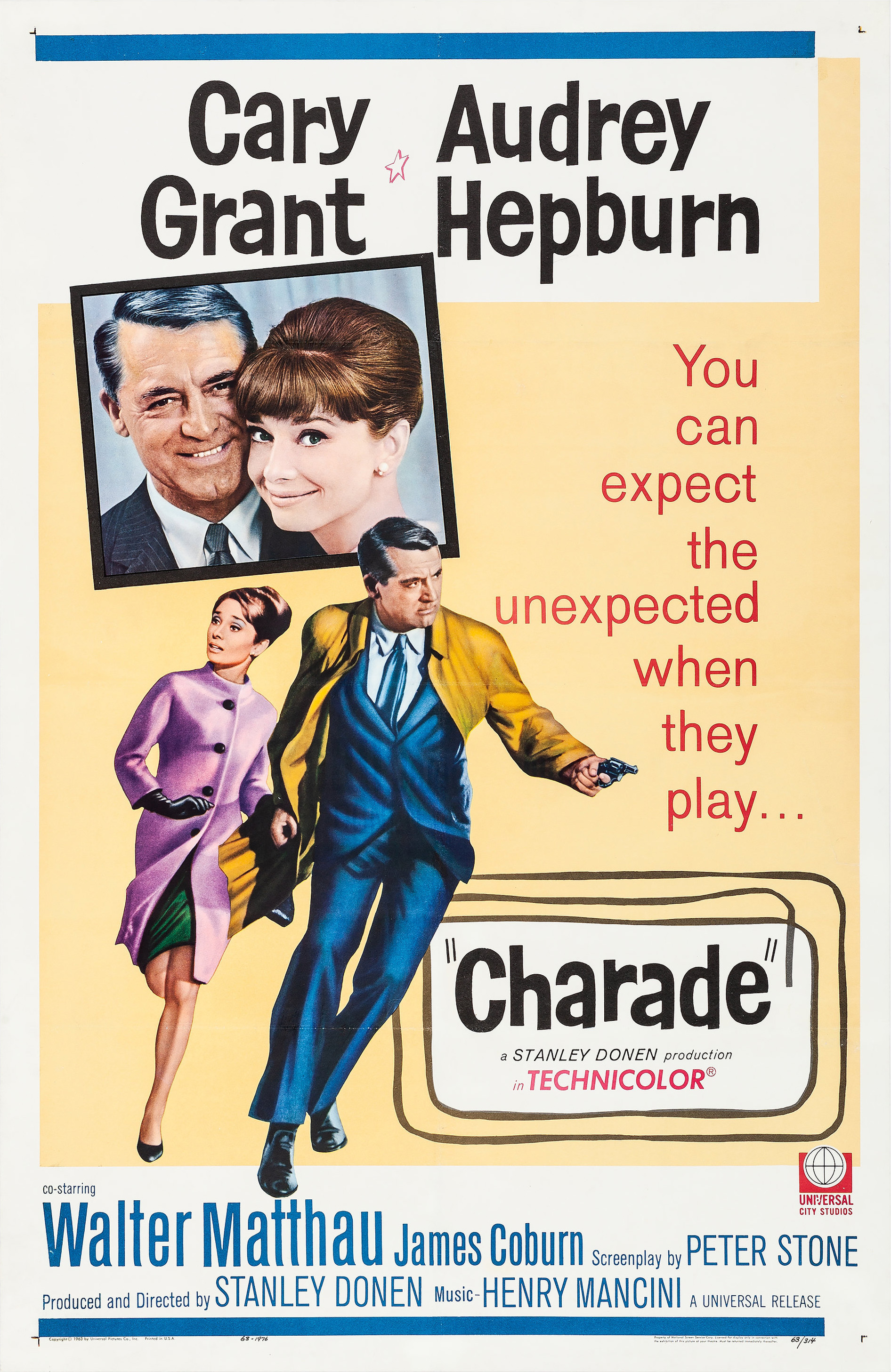
Behind the film
- Year
- 1963
- Director
- Stanley Donen
- Writers
- Peter Stone
- Runtime
- 1h 53m
- Genres
- Romantic comedy, Crime thriller, Mystery, Comedy thriller
- Production
- Stanley Donen Films
- Country
- United States
- Cast
- Cary Grant, Audrey Hepburn, Walter Matthau, James Coburn, George Kennedy, Ned Glass, Jacques Marin, Dominique Minot
About the film
Contains story spoilers.
Reggie Lampert returns to Paris to find her husband Charles murdered and their possessions sold. Supposed CIA official Hamilton Bartholomew says Charles stole wartime money from associates now threatening her. A helpful stranger, Peter Joshua, changes his story repeatedly, claiming to be Alexander Dyle and then thief Adam Canfield. As the former associates die, Reggie discovers the fortune was converted into rare stamps attached to Charles's letter. She retrieves them after giving them to her friend's son. A dying man's clue makes her distrust Adam and seek Hamilton. Adam reveals Hamilton is actually Carson Dyle, the surviving conspirator and murderer. At a theatre, he saves her by opening a trapdoor beneath Dyle. At the embassy, he finally reveals himself as Treasury agent Brian Cruikshank and proposes marriage.
The mystery makes trust a problem of attention rather than a simple contest between instinct and evidence. Reggie has information, but much of it has been supplied by people with reasons to arrange it misleadingly. A convincing explanation can therefore be more dangerous than an admitted gap in knowledge. Audrey Hepburn gives the story a central presence capable of responding with curiosity and humour without ceasing to be vulnerable. The audience follows someone trying to make an account of a life that turns out to have been organised partly outside her knowledge. That discovery gives the film's elegance an unsettling foundation. A familiar relationship can conceal a world, and entering that world does not come with a reliable guide to who is entitled to explain it.
Cary Grant's shifting persona gives attraction a particularly difficult place in that process. Charm can make a person easier to trust while supplying no dependable account of his intentions. The film enjoys that ambiguity without pretending it has no consequence. Reggie's interest remains active even when the information attached to the man keeps changing, making the romance a conversation with uncertainty rather than an escape from it. The important distinction is between finding someone appealing and knowing how to interpret his conduct. Grant's performance allows both responses to coexist. A gesture can seem affectionate, evasive or calculated depending on which identity the viewer currently believes, and a new explanation can make an earlier exchange feel different without changing the exchange itself.
Walter Matthau's role supplies the opposite form of persuasion. Institutional language can make an account appear trustworthy because it seems to arrive from somewhere larger than the speaker. That appearance is especially useful in a story where personal charm has already become suspect. The mystery therefore tests more than one shortcut to confidence. Someone may distrust an attractive stranger and still accept a formal explanation without examining who benefits from it. The film keeps those routes to belief in circulation, letting its protagonist encounter different ways of being made to feel that uncertainty has ended. Their apparent difference is part of the trap. A polished private performance and a respectable public identity can each organise attention around the story their user wants somebody else to accept.
The threatening ensemble gives that game a material urgency. James Coburn, George Kennedy and Ned Glass provide different presences within a group whose shared history has not produced shared loyalty. Their relationship to the missing fortune turns knowledge into a practical asset. Someone who understands what another person does not can temporarily control the encounter, but the control becomes unstable as information moves. That makes the story's objects important in an unusually playful way. A thing can seem trivial because its value has not been recognised, while an apparently obvious prize can be sought through the wrong category altogether. The mystery allows the viewer to reconsider ordinary appearances, making discovery depend on a change in how something is seen as well as on locating something previously hidden.
Paris supplies a world in which that instability can remain elegant. Public places permit encounters while leaving motives private, making company and isolation possible in the same frame. Stanley Donen's direction moves between danger and conversational pleasure without requiring one to cancel the other. That tonal balance matters to the romance. Humour becomes a way for Reggie to keep participating in a situation that could otherwise reduce her to frightened reaction. The film gives her exchanges energy and purpose, allowing wit to express curiosity, resistance and attraction. A joke can preserve a degree of independence even when practical control is limited. The city becomes a setting for that continuing negotiation, full of places to meet someone without becoming certain who the person is.
Peter Stone's screenplay keeps the changing explanations attached to relationships the audience can follow. The story is complicated, but each new account has an immediate consequence for somebody's trust or safety. That makes the twists more than an inventory of surprises. They alter the value of a conversation, the risk of accepting help or the meaning of a reassuring presence. Henry Mancini's music and the film's polished presentation allow the thriller to retain a playful social world rather than becoming solely an exercise in menace. The result is a mystery whose pleasures involve both solving and spending time with its central pair.
Charade resolves its danger through a clearer account of identity, but its enduring interest lies in how long clarity can be postponed by a persuasive performance. The film makes uncertainty entertaining without stripping it of emotional consequence. Reggie has to act before every explanation is secure, and the viewer has to keep revising the meaning of the people acting beside her. That gives the romance an active intelligence beneath its glamour. Attraction is neither dismissed as foolish nor allowed to become an infallible guide. The mystery asks for attention to what a person says, does and makes possible for someone else, then enjoys how often those forms of evidence disagree. Its world is charming because people are lively within it, and dangerous because liveliness can make a carefully managed fiction feel like the truth.