
Behind the film
- Year
- 1958
- Director
- Richard Brooks
- Writers
- Richard Brooks, James Poe
- Genres
- Drama
- Production
- Avon Productions
- Country
- United States
- Cast
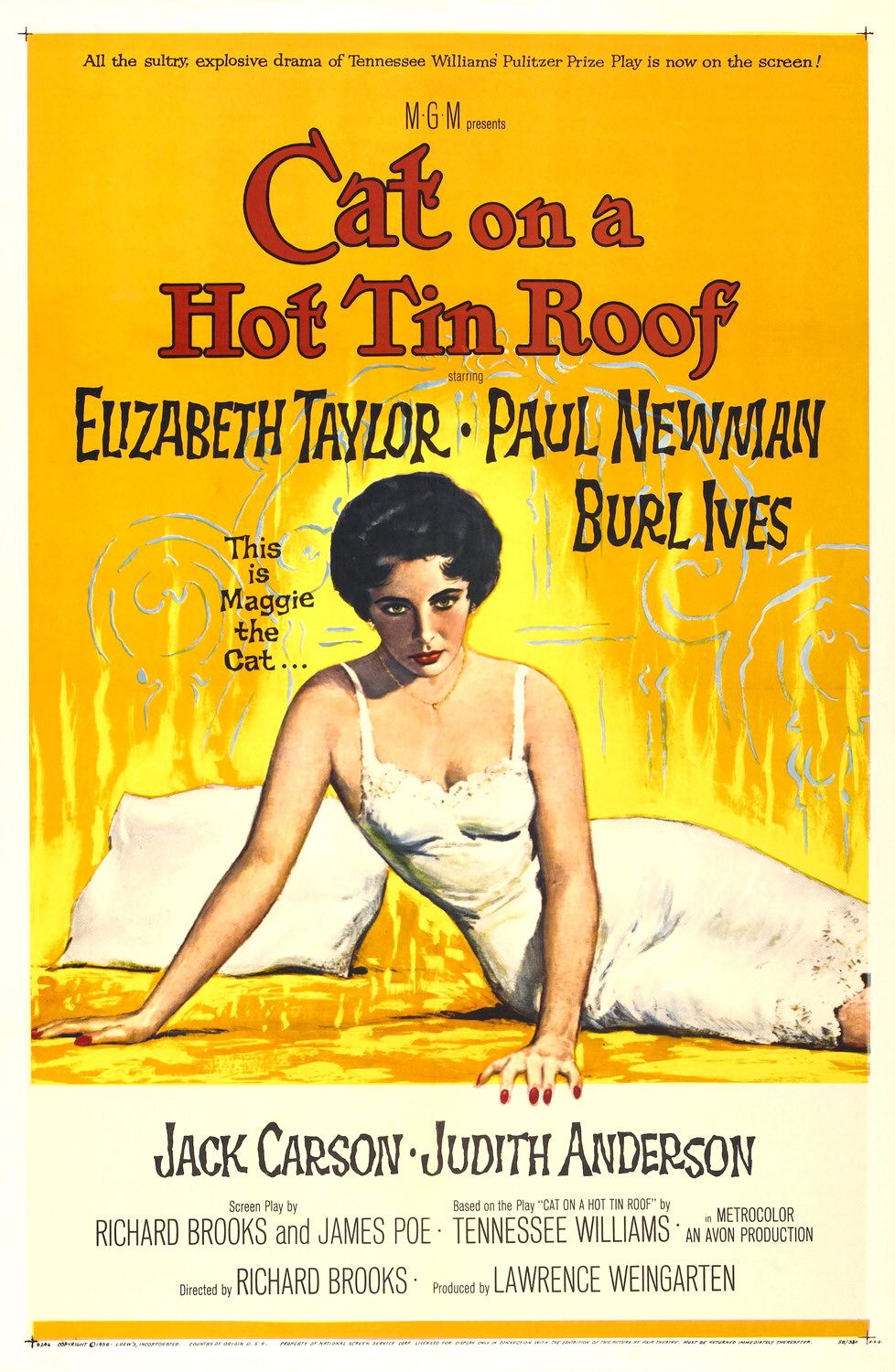
- Elizabeth Taylor, Paul Newman, Burl Ives, Jack Carson, Judith Anderson, Madeleine Sherwood, Larry Gates, Vaughn Taylor
About the film
Contains story spoilers.
Cat on a Hot Tin Roof makes a family celebration feel like a gathering organised around things nobody wants to say. Richard Brooks's 1958 adaptation of Tennessee Williams's play brings wealth, illness and marriage into the same house, where apparent security depends on carefully managed appearances. The setting is spacious and comfortable, yet the central relationships make it feel constricted. People can move between rooms without escaping the expectations attached to them. The birthday becomes a pressure chamber in which a husband's silence, a wife's determination and a father's authority expose different ways of demanding love without knowing how to receive it.
Brick Pollitt, drinking heavily and recovering from an ankle injury, joins his family for his father Big Daddy's birthday. Maggie wants to repair their marriage and protect their place in the inheritance. Doctors have concealed Big Daddy's terminal cancer from him. Confrontations expose Brick's guilt over the death of his friend Skipper and the resentment dividing him from Maggie. Brick reveals his father's illness, then challenges the assumption that material provision amounted to affection. They begin to reconcile. As other relatives press their claims, Maggie announces a pregnancy that is not yet real; Brick supports her and renews their intimacy. The film ends with a possibility of repair built around both disclosure and another hopeful assertion.
Elizabeth Taylor's Maggie keeps desire and calculation in the same performance. She wants her husband, but she also understands how rapidly a household can interpret childlessness and withdrawal as reasons to exclude a couple from its future. The inheritance is consequently more than a separate financial subplot. It gives emotional rejection a material edge, making the marriage's private uncertainty legible to everyone around it. Maggie's persistence can be both persuasive and exhausting because she cannot simply decide to stop caring. Taylor lets confidence function as work: an energetic presentation that has to be maintained in the face of a man who repeatedly refuses to respond.
Paul Newman's Brick offers a different form of resistance. His injured body limits his movement, while his drinking and silence make access to him uncertain even inside the room he shares with his wife. The character's withdrawal can appear like a refusal to participate in dishonesty, but it also prevents him from addressing the people whose lives are bound to his. Newman makes that contradiction central to the tension. Brick is wounded by an account of the past he cannot settle, yet treating everyone else's words as intolerable does not relieve him of responsibility for what happens in the present. The film continually tests whether silence protects a truth or postpones a necessary encounter.
Burl Ives's Big Daddy gives the family a centre of gravity that does not require him to be present in every conversation. Other people's arguments already assume his power to decide whose conduct counts and whose future is secure. The illness challenges a belief that wealth and force of personality can organise the world indefinitely. His exchange with Brick shifts the question of legacy away from possessions toward the kind of relationship a father leaves behind. That shift matters because the house has made property so visible. A room full of things can testify to success while failing to answer whether its inhabitants feel recognised by one another.
The supporting relatives make the celebration's social pressure tangible. Gooper and Mae understand family membership through evidence of duty, children and reliability, while Maggie and Brick threaten that account through a different claim on affection. Big Mama's position complicates the idea that the household simply belongs to one powerful man. Her loyalty is tested by information other people choose to conceal, making knowledge itself a form of authority. The ensemble lets a polite occasion become competitive without needing every conflict to begin as an open declaration. Who is told the truth, and who is expected to accept a reassuring account, helps define the hierarchy as clearly as money does.
The film is an adaptation with its own emphases, rather than an unchanged transfer of Williams's stage drama. Its screenplay, by Brooks and James Poe, substantially redirects the material around the father-son relationship; the original play's implications concerning Brick's attachment to Skipper were also softened in the process. That distinction is important to understanding the screen story's apparent reconciliation. A change in what can be expressed changes the meaning of what remains unspoken. The film's tense exchanges still make concealment a central subject, but its version of the conflict and its movement toward repair should be understood as specific choices within the adaptation.
The final assertion of pregnancy gives the ending an uneasy mixture of possibility and performance. A statement can challenge the family's arrangements before it is literally true, leaving the audience to consider whether hope differs sufficiently from the deceptions that brought everyone to this point. The renewed intimacy offers a route forward without proving that the household's appetite for control has vanished. Cat on a Hot Tin Roof draws much of its force from that closeness between tenderness and pressure. The characters want recognition, security and continuity, but the ways they pursue them repeatedly make it harder for other people to speak honestly in the same room.