
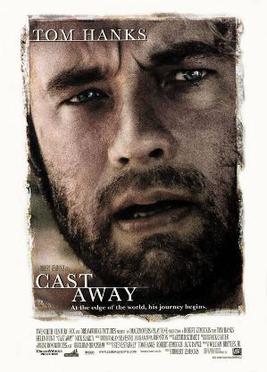
Behind the film
- Year
- 2000
- Director
- Robert Zemeckis
- Writers
- William Broyles Jr.
- Genres
- Adventure, Drama, Robinsonade
- Production
- Playtone, ImageMovers Digital, 20th Century Studios
- Country
- United States
- Cast
- Tom Hanks, Helen Hunt, Nick Searcy, Chris Noth, Lari White, Nan Martin, Elden Henson
About the film
Contains story spoilers.
Chuck Noland works for FedEx, moving between countries to solve delivery-system problems while his relationship with Kelly Frears waits around his work calendar. At Christmas dinner he is summoned to Malaysia, and Kelly gives him her grandfather's pocket watch with her photograph inside. Chuck leaves her a wrapped gift to open when he returns, suggesting an engagement. The cargo plane he boards loses radio contact in a severe storm and crashes in the Pacific; Chuck escapes in an inflatable raft, but its survival kit tears away. He washes onto an uninhabited island, finds other FedEx packages and eventually discovers one pilot's body, which he buries. The film turns a global logistics expert into a man without a timetable or a way to call for help.
Chuck initially treats the island as a temporary delay. He tries to signal passing ships and paddles out on a raft, but waves push him back and a reef badly injures his leg. The raft is ruined, and the practical hope of a quick rescue recedes. He opens most of the packages washed ashore and makes use of the objects inside, but keeps one marked with golden wings unopened. While attempting to start a fire, he cuts his hand and throws a volleyball in frustration. Its bloody handprint gives him a face to draw; he names the ball Wilson and begins speaking to it. The ritual is not presented as madness so much as a way to give conversation, conflict and companionship a place in a life with no other people.
Survival is a series of awkward experiments: Chuck learns to open coconuts, fish and make fire, and his toothache becomes so severe that he extracts the tooth himself with an ice skate blade and a rock. The film gives these tasks time and physical consequence, so improvement comes through repeated failure rather than a montage of instant competence. Wilson becomes a witness to his anger and fear. When a distant ship appears and his first raft attempt fails, Chuck understands that simply waiting may end with him dying alone. He later discovers that the timing of the island's prevailing winds may make escape possible, and begins constructing a larger raft using material from a washed-up portable-toilet enclosure.
Four years pass before Chuck attempts the crossing. He waits for the wind to shift and uses makeshift panels as a sail, securing Wilson and the still-sealed package to the raft. A storm destroys the sail and damages the craft. Wilson breaks loose and floats away; Chuck tries to reach him, then loses his oars and gives up hope. A container ship finds him semi-conscious on the raft's remains. His return is not a simple homecoming. Four weeks after rescue, he is welcomed at FedEx headquarters, but Kelly is now married to her endodontist and has a daughter. She kept Chuck's Jeep, while the watch remained with him, yet the years apart have created a life she cannot abandon, even though they still love each other.
Chuck visits Kelly late at night, and they kiss, but both understand that leaving with him would mean leaving her family. He returns the watch and tells his friend Stan that he will miss Kelly. Then he drives to Texas with the unopened package to return it to its sender, a sculptor whose gate now carries only the name Bettina. She is not home, so he leaves the package with a note saying it saved his life. At a crossroads, Bettina stops and explains where the roads lead. Chuck notices the angel-wing image on her truck and watches her drive away, then looks down the roads and smiles. The ending gives him a choice of direction without claiming he can recover the future he had before the crash.
Robert Zemeckis uses the long island section to make time visible in Chuck's changing body and in the objects he learns to use. The pre-island scenes move quickly through worldwide delivery hubs and clock-driven decisions; the island slows that rhythm to hands, weather and repeated attempts. Hanks's physical transformation separates the early and later portions, while the near-silent stretches let Wilson function as a relationship rather than a comic prop. The film's ending leaves the unopened parcel meaningful without revealing its contents. Chuck can return it, but the practical answer to what he does next remains open, like the roads at the final intersection.
Chuck's explanation to Stan after his return reveals a despair that the practical island routines could not solve. He had considered killing himself and tested the possibility, only to find that even death was beyond his complete control. Continuing to breathe became a task without assurance of rescue or reunion. This admission changes the meaning of his competence: knowing how to catch food and stay alive did not make isolation bearable every day. The returning executive also faces an abundance that once seemed ordinary. Food and company can be offered immediately, but nobody can give back the years that changed Kelly's life. His work had trained him to overcome delay and deliver a predictable result; survival has left him unable to demand either. The crossroads scene carries that experience into an open landscape. He has several roads available, yet choosing one will require acting without the timetable and certainty that organized his former life.