
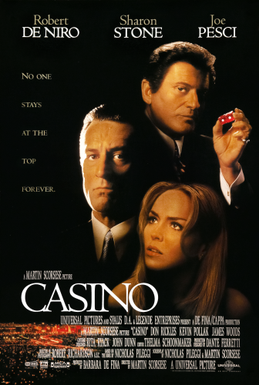
Behind the film
- Year
- 1995
- Director
- Martin Scorsese
- Writers
- Martin Scorsese, Nicholas Pileggi
- Runtime
- 2h 59m
- Genres
- Epic, Biographical, Crime, Crime thriller
- Production
- Universal Pictures, Légende Entreprises
- Country
- United States, France
- Cast
- Robert De Niro, Sharon Stone, Joe Pesci, James Woods, Kevin Pollak, Don Rickles, Alan King, Frank Vincent
About the film
Contains story spoilers.
Casino is interested in how a glittering place is kept running. Its Las Vegas is a world of visible abundance supported by routines most customers never see: supervision, counting, movement of money and the ability to notice a small irregularity before it becomes expensive. Sam 'Ace' Rothstein understands those routines. Robert De Niro plays him as someone who regards attention to detail as a form of authority, whether he is managing a gambling floor or assessing the people around him. The difficulty is that the organisation employing him needs more than an efficient business. It needs that business to conceal another operation, and it relies on people whose impulses cannot be managed as neatly as a casino's procedures.
Ace runs the Tangiers for Midwest Mafia bosses, with profits skimmed behind its legitimate front. His friend Nicky Santoro supplies protection but expands into conspicuous crime. Ace marries Ginger McKenna, whose attachment to Lester Diamond and worsening addictions unsettle their household. A staffing dispute brings political retaliation against Ace's licence; his public response attracts more attention. Ginger and Nicky's affair deepens the collapse of trust. Investigators expose the skimming, and the bosses arrange killings to silence possible witnesses. Ginger dies, Ace survives a car bomb, and Nicky and his brother are murdered by their own associates. Ace returns to handicapping as corporate casinos replace the world he once managed.
The contrast between Ace and Nicky gives the criminal organisation two incompatible kinds of power. Ace wants stability, predictable income and the appearance of legitimacy. Joe Pesci's Nicky wants the freedom to act, take and intimidate. Protection can become a threat when the protector assumes that proximity gives him an unlimited claim on a place. Their shared background does not guarantee a shared strategy. Each can believe he is making the operation stronger while undermining what the other needs. The casino offers a concentrated version of that contradiction: it must persuade ordinary people that this is a safe, pleasurable environment, even while its owners depend on coercion and concealment elsewhere. The violence supporting the business cannot be allowed to dominate its public image.
Ginger occupies another difficult position inside Ace's desire for control. He recognises her ability to move through the casino's social world, but turns that recognition into an expectation that marriage can secure the person he admires. Sharon Stone's character has attachments, desires and vulnerabilities that do not fit the arrangement he imagines. Their daughter makes the household's instability a responsibility beyond either adult's wounded pride. Money can provide comfort or become leverage, but it cannot produce trust simply because somebody offers enough of it. The film allows Ginger's destructive choices to become part of the danger without reducing the marriage to a problem Ace could have solved through still more precise supervision. His talent for running a floor is not a talent for determining another person's feelings.
The narration turns the viewer into an observer of systems and rival interpretations at once. Ace and Nicky can explain how things work, but their explanations come from people deeply invested in presenting their own competence. That gap lets the film move between practical detail and self-justification. A decision that sounds logical in a voice-over may look much less secure when the consequences appear. The casino's density helps the approach: patrons, employees, security, entertainers and hidden beneficiaries all occupy different parts of the same economy. Its bright surfaces are not an interruption to the crime story. They are what the criminal arrangement is trying to preserve, because pleasure and spectacle keep customers participating in a structure whose full terms they do not know.
Ace's conflict with local power shows that criminal backing does not make him independent of ordinary institutions. A personnel decision can become a licensing problem because the employee has connections, and responding publicly can make a private arrangement harder to protect. Competence does not excuse him from politics. In the same way, Nicky's capacity to frighten people cannot exempt him from the priorities of the bosses who benefit from his work. The film's violence repeatedly exposes that conditional status. A person may feel untouchable while producing money or enforcing someone else's wishes, then discover that the organisation regards him as another risk to remove. Friendship and years of service offer little security when the governing principle is protecting the flow of profit.
Martin Scorsese and Nicholas Pileggi wrote the 1995 film from Pileggi's book, drawing on real people while constructing a dramatised story with fictional central names. Its ending widens the view from the broken relationships to a changing city. Ace mourns the disappearance of a world in which he knew the rules, but his nostalgia belongs to a survivor of that world rather than a neutral assessment of it. The spectacle continues under different ownership, and his remaining skill is the one that made him valuable before the casino. The final perspective joins survival to displacement: he can still calculate a wager, yet cannot recover the people, status or environment he once believed he could keep under control.