
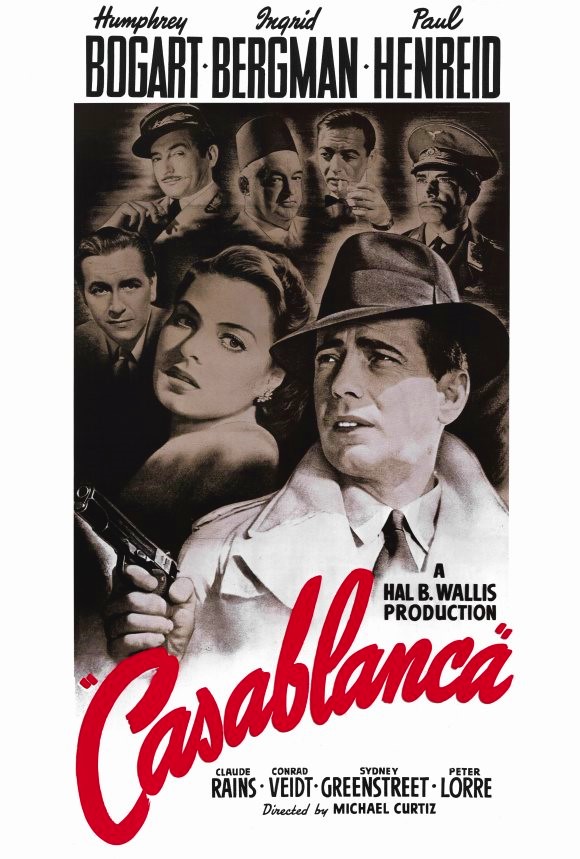
Behind the film
- Year
- 1942
- Director
- Michael Curtiz
- Writers
- Julius J. Epstein, Philip G. Epstein, Howard Koch
- Runtime
- 1h 42m
- Genres
- Romance, War, Drama, Flashback
- Production
- Warner Bros. Entertainment, Warner Bros. Pictures
- Country
- United States
- Cast
- Humphrey Bogart, Ingrid Bergman, Paul Henreid, Claude Rains, Conrad Veidt, Sydney Greenstreet
About the film
Contains story spoilers.
Michael Curtiz’s Casablanca takes place in a Moroccan city where refugees, officials and opportunists wait for routes out of occupied Europe. Rick Blaine owns a café and gambling room that serves visitors from many countries. He keeps a careful distance from the political arguments around him and insists that he sticks his neck out for nobody. Captain Renault, the local police chief, knows Rick well enough to treat his neutrality as a pose, while German Major Strasser represents the authority pressing down on the city. Rick’s club is busy and glamorous, but its guests are often counting money, searching for visas or listening for news that might change their plans.
Two letters of transit become the object everyone wants. Ugarte, a petty criminal who has acquired the papers, asks Rick to hide them, but he is arrested before he can leave the club. The papers remain with Rick. That evening Ilsa Lund arrives with Victor Laszlo, a resistance leader whose escape could allow him to continue his work against the Nazis. Ilsa and Rick meet again after their separation in Paris, and their reunion makes Rick’s practiced indifference harder to maintain. Victor knows Ilsa has a past with Rick but does not initially understand the full story. The pressure on the papers and the old romance now occupy the same room.
The film moves into a flashback to Paris, where Rick and Ilsa fell in love as the Germans approached. Ilsa says she will leave with Rick, but at the station she disappears and sends a note explaining that she cannot go. Rick does not know that Victor is alive; Ilsa had believed her husband was dead and returns to him when she learns otherwise. Back in Casablanca, that explanation changes how Rick reads her earlier choice. The flashback does not make either character’s situation simple. Ilsa was trying to respond to events she could not control, while Rick experienced her departure as a sudden betrayal. The Paris sequence gives their later conversations a history that neither can simply set aside.
Victor asks Rick for the transit letters and argues that his work matters beyond his own safety. Rick initially refuses, while Ilsa privately asks him to help Victor escape. She reveals that she still loves Rick, but says she will stay with him only if Victor is safe. Rick misleads her about his decision and arranges a plan in which she and Victor will leave together. At the airport, he tells Ilsa that she must board with her husband. Renault is present, and Strasser arrives to stop the departure. Rick shoots Strasser, while Renault orders the police to cover the incident by arresting the usual suspects. The papers get Ilsa and Victor onto the plane, but Rick’s choice costs him the possibility of their life together.
After the plane leaves, Renault and Rick walk into the fog. Renault suggests that Rick leave Casablanca, and the two head toward a Free French garrison. Their final exchange turns the café owner’s earlier neutrality into something more active: he has chosen to help a cause and accept the consequences. The film does not show Victor and Ilsa’s future, and it does not resolve the war. It ends instead on a changed relationship between two men who have been on different sides of the city’s informal arrangements. Rick’s goodbye to Ilsa is painful precisely because he knows what he is giving up and does not pretend the decision is cost-free.
Casablanca’s form lets a romantic triangle carry the pressure of wartime movement without reducing every character to a symbol. The café is a meeting point where small transactions and major political decisions overlap: a song can unify a room, a police order can close a route, and a piece of paper can determine who leaves. Humphrey Bogart’s Rick shifts from clipped detachment to openly difficult choice, while Ingrid Bergman’s Ilsa has to speak for a history Rick does not know. Claude Rains’s Renault supplies wit but is also a participant in the city’s system of power. The film’s story is fictional, set against a real war and occupation; its characters should not be mistaken for a documentary account of Casablanca’s refugees.
The club’s musical scene makes political disagreement audible. When German officers sing, Victor asks the band to play the French anthem, and patrons join in until their voices drown out the German song. Rick watches from the side, still holding the papers and not yet revealing his choice. The scene gives the café a temporary public role: strangers who have been negotiating in private briefly act together. Earlier, Ugarte’s arrest showed how quickly a small transaction could become a matter of police power; now the room itself becomes a risky declaration. The contrast helps explain why Rick’s later decision matters beyond the romance. He is choosing to use the club’s resources and the papers for a cause, after spending much of the story insisting that other people’s politics are not his concern.