
Behind the film
- Year
- 1976
- Director
- Brian De Palma
- Writers
- Lawrence D. Cohen
- Runtime
- 1h 38m
- Genres
- Horror, Teen, Thriller, Coming-of-age
- Production
- United Artists
- Country
- United States
- Cast
- Sissy Spacek, Piper Laurie, Amy Irving, William Katt, Betty Buckley, Nancy Allen, John Travolta, P. J. Soles
About the film
Contains story spoilers.
Carrie puts an adolescent's desire to belong inside a world that repeatedly makes her exposed. Brian De Palma's film gives school and home different forms of authority, but neither offers Carrie White a reliable place of safety. Sissy Spacek's reserved presence matters to that arrangement: the character's difficulty occupying an ordinary social space becomes visible before her supernatural ability changes what she can do within it. The horror grows from the disparity between having power and having support. A capacity to affect the world does not automatically give her the understanding or companionship she needs, and the film lets that gap remain troubling as events accelerate.
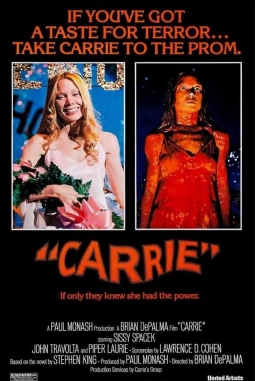
Bullied at school and abused by her mother Margaret, Carrie discovers telekinetic powers. Remorseful classmate Sue asks her boyfriend Tommy to invite Carrie to prom. Carrie accepts despite her mother's opposition, briefly finding apparent welcome at the dance. Chris and Billy rig a cruel prank, pouring pigs' blood over her when she is crowned queen. Carrie perceives the room as mocking her and unleashes destruction, then kills the fleeing pranksters. At home, Margaret attacks her; Carrie kills her mother and dies when the house collapses. The final image of a hand grabbing Sue occurs within Sue's nightmare, leaving the horror with a survivor rather than revealing that Carrie returned from death.
Piper Laurie's Margaret gives the domestic scenes an intensity that is distinct from the school's social cruelty. Her authority claims to explain what her daughter should fear and what her experiences mean, leaving little room for the girl to understand herself on other terms. Laurie makes that certainty physically imposing, so an exchange between mother and daughter can become a confrontation over who is permitted to name what is happening. The home does not merely repeat the classroom's pressure in another room. It gives coercion the intimacy of a relationship that should have offered care, making separation from it difficult even when its harm is clear.
Spacek's performance lets acceptance remain a genuine possibility within a story whose audience expects disaster. A tentative response can carry the effort involved in believing that another person means well. This keeps the character from becoming simply a mechanism through which the film will deliver its horror climax. She has hopes that can briefly take shape, and the audience can attend to those hopes even while anticipating their vulnerability. Her small changes of expression and bearing make social recognition consequential. The later catastrophe gains emotional force because the film has allowed a different experience to seem possible before destroying it.
Amy Irving's Sue and William Katt's Tommy give kindness an uncertain route into the story. An intention to help must pass through assumptions about who is trustworthy, and previous cruelty has already made those assumptions difficult for Carrie to revise. Betty Buckley's Miss Collins occupies another position, exercising adult authority within the same space. The film consequently gives the school more than one attitude toward its central character without making goodwill sufficient to control events. People can want a better outcome and still misread another person's purpose. That fragility is part of the drama's cruelty, because recognition can arrive without the ability to prevent what follows.
The prom transforms a familiar ritual of belonging into a setting whose arrangements become threatening. Attention concentrates on the person being celebrated, giving public recognition the possibility of turning instantly into exposure. De Palma builds tension by making the audience aware of a danger within the occasion's apparent pleasure. The scene's spatial organisation matters: looking, waiting and the direction of other people's attention all affect how a moment is understood. Celebration is not merely interrupted by an unrelated threat. Its own visibility becomes part of the trap, making the movement from apparent acceptance to humiliation feel inseparable from the social ritual around it.
Telekinesis turns emotional pressure into something the surrounding space can register. An object no longer remains passive simply because nobody appears to touch it, and familiar rooms lose their ordinary stability. That device gives the supernatural a close relationship to the film's human conflicts without making violence a satisfactory resolution to them. Carrie's ability can answer an immediate threat while reaching far beyond a proportionate response. The film's tragedy lies partly in that mismatch. The existence of power does not undo the damage that preceded it, and the destructive release cannot provide the life of belonging the character briefly hoped to enter.
The film adapts Stephen King’s novel through Lawrence D. Cohen’s screenplay; King is the source author, not the screenwriter of this 1976 movie. De Palma’s direction uses split attention, controlled framing and musical tension to turn a high-school setting into a pressure chamber. The prom becomes powerful through the long build from vulnerability to a brief experience of belonging, then betrayal. Spacek’s stillness and Laurie’s intensity ground the supernatural elements in a damaged family and an unforgiving social world. Carrie’s telekinesis is part of the fiction’s horror, while the ending keeps its most unsettling consequence human: the people left alive must carry what happened.