
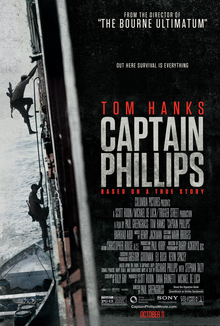
Behind the film
- Year
- 2013
- Director
- Paul Greengrass
- Writers
- Billy Ray
- Runtime
- 2h 14m
- Genres
- Action, Thriller, Biographical, Survival
- Production
- Trigger Street Productions
- Country
- United States
- Cast
- Tom Hanks, Barkhad Abdi, Catherine Keener, Barkhad Abdirahman, Faysal Ahmed, David Warshofsky, Michael Chernus, Yul Vazquez
About the film
Contains story spoilers.
Captain Phillips follows the Maersk Alabama, an unarmed container ship sailing from Oman toward Kenya, as pirate leader Abduwali Muse and his men pursue and board it. Captain Richard Phillips orders the crew to hide while the pirates take control of the bridge and demand a ransom. The crew uses the ship’s passages and machinery to capture Muse, but a pirate forces Phillips into a lifeboat with the departing group. A U.S. Navy operation surrounds the craft, and negotiations unfold as tensions rise among the pirates. Phillips attempts to escape, is recaptured, and is later bound inside the small cabin. When a momentary shift gives Navy marksmen a clear line of sight, they kill the three remaining pirates; Muse is arrested and Phillips is rescued. The film is based on a real hijacking but dramatizes the event through a tightly limited feature perspective, not as a complete historical account.
The ship’s industrial scale gives the film a world with rules that are visible and practical. Doors, ladders, radios and power controls determine who can move where. Phillips’s authority is not abstract: he must coordinate people whose work depends on access to particular decks and systems. This attention to routine gives the sudden emergency force, because the same familiar passageway can become a route to concealment or a point of exposure. The ship itself is not merely a setting behind the action; it shapes the choices available to both crew and captors.
The film’s central tension is command under incomplete information. Phillips has to gauge what the pirates intend, what his crew can accomplish and whether a bluff might buy time. His profession requires calm communication, but the crisis does not permit him to control all the variables. The story uses this gap between responsibility and control to complicate the usual action-hero model. Skill remains important, yet it does not guarantee safety, and good decisions do not remove danger. His composure gradually narrows into a survival effort that the crew cannot entirely manage for him.
Muse is given a parallel role as a leader under pressure, not simply an anonymous antagonist. He arrives with instructions to seize a ship for a ransom, then faces disagreement from men who are younger and increasingly impatient. The film’s paired opening suggests that the two captains inhabit different systems, though it does not supply a broad survey of Somali piracy. This focus creates immediacy and also marks the drama’s boundary: the movie is most specific about the hostage encounter, and less expansive about the surrounding economic and political conditions.
The lifeboat changes the film’s spatial logic. The ship offered corridors, multiple decks and the possibility of collective resistance; the smaller craft compresses the characters into a cabin where every movement has immediate meaning. Around it, the Bainbridge and other Navy vessels command the sea but must avoid making the hostage situation more dangerous. Scale is therefore paradoxical: overwhelming military capacity cannot be used freely when the target space is only a few feet across and one hostage is inside. The film’s sound keeps radio instructions, waves and shouted exchanges in tension.
Greengrass’s handheld camera and overlapping dialogue produce a close, unsettled point of view. Details arrive at the same pace they would to someone trying to understand an emergency: fragments of instruction, glimpses through a doorway, a radio call partially obscured by machinery. The editing avoids turning each decision into a clean explanatory beat, and the audience has to track changing control. These choices suit a story about professional procedures breaking down under pressure. The effect is not simply speed; it is the absence of a fully secure vantage point.
The rescue does not end on the image of a victorious captain. Phillips receives medical treatment while still visibly shaken, struggling to answer questions and crying after he is safe. That scene shifts attention from the Navy’s tactical success to the body and mind left behind by the crisis. Hanks plays the moment with a loss of practiced command, a sharp contrast with his earlier effort to keep the crew organized. The ending proposes survival as an event with consequences rather than a return to normal, and it leaves the wider history of the hijacking outside its narrow final focus. It is a choice of perspective that makes the story tense, while also limiting its historical scope.
By the closing medical examination, command has become something Phillips no longer has to perform. Other people ask the questions, check his injuries and tell him what will happen next; he can finally respond without maintaining the composure needed to negotiate. That change reverses his position on the bridge, where reassurance was part of his responsibility to the crew. Hanks’s speech and physical reactions allow the crisis to continue after the guns have fallen silent. Rescue restores safety before it restores his ability to describe what happened, leaving the ending with an ordinary human need for care rather than another display of professional control.