
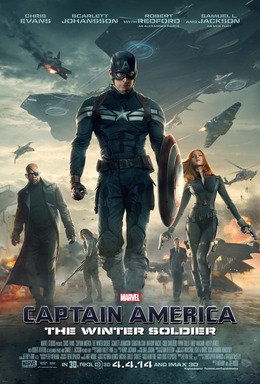
Behind the film
- Year
- 2014
- Director
- Anthony Russo, Joe Russo
- Writers
- Christopher Markus, Stephen McFeely
- Runtime
- 2h 16m
- Genres
- Action, Adventure, Superhero, Science fiction
- Production
- Marvel Studios
- Country
- United States
- Cast
- Chris Evans, Scarlett Johansson, Sebastian Stan, Anthony Mackie, Samuel L. Jackson, Robert Redford
About the film
Contains story spoilers.
Steve Rogers has spent years learning how to function in a world that has moved on without him, but the film makes that adjustment feel less like a novelty than a quiet dislocation. He runs through Washington with a speed that turns ordinary conversation into a comic contest, keeps a list of things he missed, and visits the Smithsonian display devoted to his own wartime life. When he meets Sam Wilson, another veteran who has returned from service, their talk about loss and routine gives Steve a rare peer rather than another admirer. That grounding matters once his job changes from serving an institution to asking whether he can still trust one.
The opening rescue aboard a hijacked ship shows the Avengers-era Captain America in efficient field action: Natasha Romanoff and the S.T.R.I.K.E. team board the vessel, while Steve discovers that Natasha has a separate intelligence objective. Her unexplained extraction of data becomes an early signal that the operation is not as transparent as it appears. Back in Washington, Nick Fury presents Project Insight, three armed helicarriers designed to identify threats before they act. Fury is attacked on the road by masked operatives led by the Winter Soldier, escapes to Steve's apartment, and is shot there. His warning that he cannot trust anyone turns Steve into a fugitive within the organization he served.
Steve refuses to answer Pierce's questions about Fury, and that choice brings an official manhunt into a series of close encounters: a strike team attacks him inside an elevator, and he escapes through the building rather than surrendering. Natasha joins him, not because either fully trusts the other, but because both need to discover what the drive contains. They travel to Camp Lehigh, where Steve's old military history intersects with SHIELD's modern secrets. A reconstructed Arnim Zola reveals that Hydra survived the war by infiltrating SHIELD over decades. Project Insight is therefore not merely a controversial security policy: Hydra means to use it to eliminate people it sees as obstacles before they can resist.
The film tightens its conspiracy plot around bodies and faces Steve knows. Sam, a former pararescue soldier with a powered flight rig, becomes their ally; the Winter Soldier repeatedly intercepts the group, and Steve recognizes him as Bucky Barnes, his friend from the 1940s. The recognition does not instantly restore Bucky's memory. He is a weapon shaped by captivity and conditioning, and the film makes Steve's refusal to treat him as disposable collide with the urgent need to prevent a mass killing. Natasha, meanwhile, carries her own history of secrecy, and the partnership asks whether trust can be built through choices made under pressure rather than through confession alone.
Their plan turns the Insight launch into a public and physical confrontation. Steve and Sam enter the helicarriers while Natasha infiltrates the political machinery around Alexander Pierce; the team replaces targeting chips so the carriers will attack one another instead of the people Hydra selected. Fury, who survived the apparent assassination, returns to confront Pierce. Steve fights Bucky on a carrier as the weapons platform loses control, repeatedly addressing him as the friend he remembers. The helicarriers fall, SHIELD's Hydra network is exposed, and the institutional victory is messy rather than clean: Steve is injured, Bucky disappears after saving him, and the film closes with Sam agreeing to help search for him.
The movie's action style supports this shift from polished heroics to institutional paranoia. Wide shots establish the geometry of the ship raid, while tighter framing and quick changes in direction make the elevator fight feel like Steve has run out of room to maneuver. The highway assault gives the Winter Soldier frightening weight through abrupt impact and close pursuit, rather than treating him as a distant supervillain. Across the story, the familiar shield becomes both tool and symbol: Steve uses it to survive, but his deepest conflict concerns whether an organization can claim moral authority simply because it carries a badge, a flag, or a security mandate.
The film's other thread follows Natasha's attempt to determine what kind of person she can be when her intelligence work has trained her to change identities. She has been taught that information and deception are tools, and Steve initially sees her omissions as proof that she is playing both sides. Their exchange of coded questions in the car gives that mistrust an almost playful surface, but it also shows how unfamiliar direct honesty is to both of them. When Natasha later exposes classified information to the public, she trades the protection of secrecy for accountability. That decision parallels Steve's refusal to accept orders without understanding their purpose, while preserving a difference between them: he challenges authority openly, and she knows how to work from inside it. The credits sequence also leaves a quiet image of the Winter Soldier in a museum exhibit, suggesting that recovering his past will take more than winning one battle.