
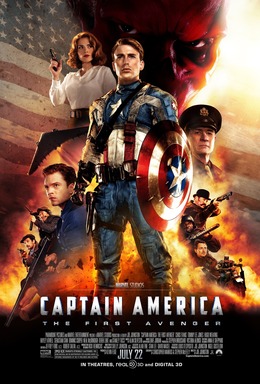
Behind the film
- Year
- 2011
- Director
- Joe Johnston
- Writers
- Christopher Markus, Stephen McFeely
- Genres
- Action, Science fiction, Superhero, War
- Production
- Marvel Studios, Paramount Pictures
- Country
- United States
- Cast
- Chris Evans, Tommy Lee Jones, Hugo Weaving, Hayley Atwell, Sebastian Stan, Dominic Cooper, Toby Jones, Neal McDonough
About the film
Contains story spoilers.
The film opens in the present day, where an Arctic expedition finds an old aircraft buried in the ice. It then moves to 1942, when Hydra leader Johann Schmidt steals the Tesseract from a Norwegian town. In New York, Steve Rogers repeatedly tries to enlist in the U.S. Army despite his small stature and poor health. He wants to fight because his friend Bucky Barnes has joined the service, but recruiters keep rejecting him. Dr. Abraham Erskine hears Steve’s determination and offers him a place in a Strategic Scientific Reserve experiment, even though Colonel Chester Phillips remains skeptical.
Steve proves his character during a test when he throws himself onto a grenade to protect the others. Erskine explains that he once worked for Schmidt, whose prototype treatment gave him great strength but changed his appearance. Steve undergoes the serum and vita-ray procedure, emerging taller and stronger. The assassin Heinz Kruger kills Erskine and escapes with the last vial, which is destroyed during Steve’s pursuit. With the formula lost, Senator Brandt uses Steve as a touring mascot to sell war bonds instead of sending him into combat. Steve wears the costume and performs staged patriotic routines, but the role does little to help the soldiers whose units are missing.
When Steve learns that Bucky’s unit is missing in action, Peggy Carter and Howard Stark help him travel behind enemy lines. He infiltrates a Hydra fortress, frees Bucky and other prisoners, and meets Schmidt, who removes his mask to reveal the Red Skull. Steve returns with rescued soldiers and forms the Howling Commandos. He is given a new uniform and a circular vibranium shield, turning the public symbol into equipment for the dangerous work he wants to do. The rescue establishes Steve’s difference from the propaganda image: he is useful because he risks himself for people, not because he performs a polished version of heroism.
The commandos raid Hydra operations, while Steve and Peggy develop a relationship that neither has much time to explore. During an assault on a train carrying scientist Arnim Zola, the team captures Zola but Bucky falls from the train and is presumed dead. Steve is devastated, yet the information they recover points toward Hydra’s last stronghold and its plan to attack major American cities with advanced weapons. The Tesseract powers Schmidt’s machines, giving Hydra a technological advantage that makes the final mission more than a conventional battle. Steve decides to stop the bomber even though the aircraft may not have a safe way to land.
Steve boards the bomber as it takes off and fights Schmidt inside. The Tesseract breaks free of its container; Schmidt picks it up, and a portal opens through which he is pulled. The artifact burns through the plane and falls into the ocean. Steve radios Peggy to say goodbye, then crashes the aircraft in the Arctic to keep its weapons from reaching their targets. He is presumed dead, while Stark later recovers the Tesseract but cannot locate the aircraft. The film’s wartime story closes on a sacrifice made without certainty of rescue or recognition.
Steve wakes in a hospital room decorated to resemble the 1940s. A baseball broadcast gives him the clue that something is wrong; he recognizes the game as one he remembers attending. He escapes outside and finds himself in modern Times Square, where Nick Fury tells him he has been asleep for nearly seventy years. Peggy remains in Steve's wartime era, so the dance they promised cannot happen as planned. The jump from wartime New York to a crowded city decades later gives him a new dislocation: the mission ended, but the people and future he expected to return to are gone. The post-credits scene extends that transition as Fury approaches him with another assignment.
The film's wartime adventure is organized around Steve's movement from a public symbol to a field leader. The bond tour places him on stages in front of audiences, while the rescue of Bucky and the prisoners gives him a chance to act directly rather than represent someone else's idea of patriotism. His uniform and shield become useful tools only after the team starts operating together. Peggy is an officer and partner in that work, not simply a reward waiting at the end, and the film lets her continue her life in the wartime world after Steve disappears. That separation gives the last radio conversation its weight: both know the promise of a dance cannot be kept as planned.
Joe Johnston gives the film a pulp adventure shape, using its wartime setting, Hydra’s theatrical machinery, and Steve’s bright uniform to distinguish the story from a documentary account of the Second World War. The battle is a superhero fantasy within a historical backdrop. Its emotional anchor is Steve’s steady refusal to treat strength as permission to dominate; before the experiment, he already chooses to protect others. Peggy and the commandos give his work a team context, while his last decision turns that same instinct into a sacrifice. The ending closes one era and places him in a world whose customs and scale he does not yet know.