
Behind the film
- Year
- 2025
- Director
- Julius Onah
- Writers
- Rob Edwards, Malcolm Spellman, Dalan Musson, Julius Onah, Peter Glanz
- Genres
- Superhero, Action, Adventure, Science fiction
- Production
- Marvel Studios
- Country
- United States
- Cast
- Anthony Mackie, Danny Ramirez, Tim Blake Nelson, Shira Haas, Carl Lumbly, Harrison Ford, Liv Tyler, Giancarlo Esposito
About the film
Contains story spoilers.
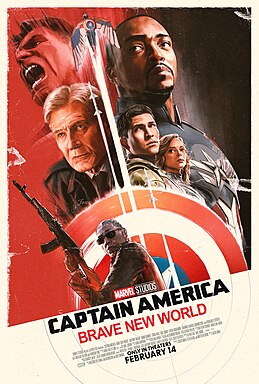
Captain America: Brave New World places Sam Wilson's new role between a public symbol and the institutions that want to use it. Carrying the shield gives him recognition, but it does not make every request from the government a reliable expression of the interests he is meant to serve. Julius Onah's film combines a superhero confrontation with a conspiracy structure, asking its protagonist to distinguish an official account from the forces arranging events behind it. Sam's lack of a super-soldier serum gives that question a particular emphasis. His judgment, relationships and equipment must answer threats that cannot be settled by assuming he can overpower everyone in the room.
An attack at a presidential summit implicates Isaiah Bradley and threatens a treaty governing adamantium from Celestial Island. Sam and Joaquin Torres investigate manipulation by Samuel Sterns, whom President Ross has secretly kept imprisoned. Sterns has supplied treatments for Ross's failing health while engineering his downfall through mind control and gamma radiation. After a military crisis injures Torres, Ross transforms into Red Hulk. Sam confronts him and ultimately reaches the person beneath the rage. Bradley is cleared, the treaty proceeds and Ross resigns and accepts imprisonment, where his daughter visits him. The immediate crisis ends through both exposure and a personal appeal, rather than treating the defeat of a conspiracy as permission to leave its institutional consequences unexamined.
Anthony Mackie's Sam has to make the Captain America identity his own while other characters continue to measure it against a predecessor. The comparison can impose an impossible expectation if the shield is taken to certify a particular body rather than a set of responsibilities. Sam's earlier experience as a soldier and counsellor gives the film another measure of competence: noticing motives, maintaining relationships and knowing when a person can still be reached. Those qualities do not remove danger from the action. They determine how he chooses to respond to it, which matters when a display of strength might intensify the crisis it is intended to end.
Danny Ramirez's Joaquin Torres places succession alongside mentorship. He is becoming Falcon as Sam carries a role that others expect him to understand completely, leaving both men to act inside identities still being shaped. The relationship allows enthusiasm and concern to coexist. A mentor can recognise a younger partner's capacity while fearing the risks attached to its use, and that fear can become another way of trying to control someone else's development. Their partnership keeps the film's institutional plot connected to an immediate responsibility: the person beside Sam is not simply another resource he can deploy without considering what participation may cost him.
Carl Lumbly's Isaiah Bradley gives official trust a different history. The character's experiences make it impossible to regard state recognition as a guarantee of fair treatment. His implication in the attack therefore raises stakes beyond finding a culprit; Sam must question how quickly an institution can turn a person into an explanation when the circumstances are not understood. This strand gives the investigation a moral direction without making the character merely a lesson delivered to the protagonist. Sam's decision to stand beside him is a commitment to examine evidence and history rather than accept the apparent convenience of the first public accusation.
Harrison Ford's Ross combines authority with a dependence he wants concealed. The president's physical vulnerability becomes entangled with control over someone whose help he needs, making a private arrangement consequential on an international scale. Red Hulk gives that contradiction an outsized visible form: a man who has tried to project order becomes a source of destruction he cannot contain. The transformation is not just a larger opponent added to the final action. It turns the costs of secrecy and coercion back toward the figure who believed his office could keep them manageable, while the estrangement from his daughter supplies a relationship political status cannot repair for him.
Tim Blake Nelson's Sterns works through information and manipulation rather than an ordinary match of physical force. A conspiracy antagonist can make apparently separate events converge because other people do not know which of their decisions have been anticipated or directed. The story's resource dispute widens that uncertainty from individuals to governments, where fear of losing an advantage can accelerate conflict. This is a fictional international situation inside the Marvel world, not an account of real diplomacy. Its dramatic purpose is to let the audience see why Sam needs to investigate what connects events before accepting the most immediate interpretation of each one.
The final confrontation brings the film's two scales together. A transformed president requires an extraordinary physical response, yet Sam's attempt to reach Ross through an intimate memory makes the resolution depend on recognition as well as damage. The subsequent resignation and imprisonment acknowledge that returning to human form is not the same as erasing responsibility. Brave New World uses the superhero framework to test what Sam's version of the mantle can contribute when symbols, institutions and personal histories conflict. Its immediate answer combines persistence with the capacity to listen, leaving the larger franchise's future outside the resolution of this particular crisis.