
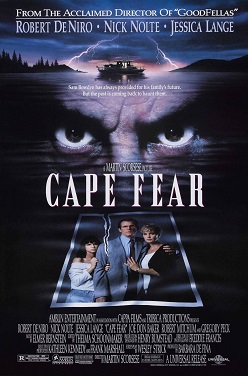
Behind the film
- Year
- 1991
- Director
- Martin Scorsese
- Writers
- Wesley Strick
- Runtime
- 2h 8m
- Genres
- Thriller, Psychological horror, Drama, Crime drama
- Production
- Amblin Entertainment, TriBeCa Productions
- Country
- United States
- Cast
- Robert De Niro, Nick Nolte, Jessica Lange, Juliette Lewis, Joe Don Baker, Robert Mitchum, Gregory Peck, Martin Balsam
About the film
Contains story spoilers.
Max Cady is released after serving a sentence for rape and battery. He blames his former public defender, Sam Bowden, for hiding a report that might have helped his case. Now living in New Essex with wife Leigh and daughter Danielle, Sam finds Cady following and threatening the family. Attempts to have him arrested fail; an investigator’s plan also collapses, and Cady exploits Sam’s own recorded threat to obtain a restraining order. He later kills the family’s housekeeper and investigator, forcing the Bowdens to flee aboard their houseboat. Cady follows them onto the Cape Fear River. During a storm, Danielle and Leigh escape to shore, Sam restrains Cady to the wrecking boat, and Cady is swept away and drowns as the family survives.
The conflict begins with a professional compromise that Sam has kept hidden. He concealed evidence that might have helped Cady because he was appalled by the crimes, but the film presents this as a breach with consequences rather than a neat moral victory. Cady turns that choice into a story about his own victimization and uses legal procedures to pressure the family. The tension grows from the gap between what Sam believes he did for justice and what he did as an advocate. The movie does not offer legal advice; it builds a fictional ethical trap around secrecy, duty, and accountability.
Robert De Niro constructs Cady through deliberate physical detail. Tattoos, posture, speech, and self-presentation make him seem to be performing a version of menace he has taught himself. That performance is not a disguise that makes him less dangerous; it is part of how he controls a room and unsettles the people around him. His command of legal language gives him another mask, letting him turn grievance into a strategy. The character’s theatricality complicates the family’s attempts to treat him as a problem they can manage through conventional channels.
Nick Nolte’s Sam is defined by restraint and avoidance. He is a lawyer accustomed to managing conflict through procedure, but the danger has entered his household and the legal system cannot quickly give him control. Jessica Lange’s Leigh reads that failure differently, while Juliette Lewis’s Danielle notices both her parents’ tensions and Cady’s ability to command attention. Their family does not respond as one unit. The film’s dread comes partly from these separate perceptions: the adults are trying to preserve authority, while Danielle is old enough to understand the threat and young enough to be exposed to it.
Scorsese turns the Bowden home and its surrounding community into spaces where ordinary security feels compromised. Cady’s appearances are staged to make the family question whether he is physically present, legally protected, or simply watching. The tension is not only in what he does but in how institutions respond when evidence is incomplete. Police and courts cannot act on what Sam suspects alone, while his own retaliatory plan gives Cady leverage. The story’s domestic scale makes the danger intimate: a front door, a family meal, or a trip away from home can become part of the contest.
The film’s wide framing and intense color make the landscape feel unsettled rather than safely picturesque. Freddie Francis’s cinematography uses the Carolina setting to hold family life and threat in the same visual field. The score adapts Bernard Herrmann’s music from the 1962 film, carrying a familiar sense of dread into a new production. Scorsese’s references to the earlier version are not merely cameos or decoration; the remake is in conversation with an existing screen memory while changing the emphasis toward the Bowden family’s vulnerability and Cady’s use of performance.
Danielle’s school assignment frames the story as a memory she is already trying to organize. That device matters because the adults’ conflict has become part of a child’s understanding of safety and justice. She sees her father not as an abstract lawyer but as someone whose choices have consequences inside the family. Her encounters with Cady are disturbing because he knows how to manipulate adult roles and expectations. The film keeps her perspective active without making her responsible for resolving the situation. Her survival depends on the decisions of others, even as she perceives what they fail to see.
The houseboat gives the climax an especially unstable image of refuge. A space associated with leisure becomes confined, exposed and difficult to control, carrying the domestic threat into an environment where ordinary procedures have little force. Scorsese makes that change feel like the physical expression of the family's failing assumptions about safety. The violence does not become morally simple just because it becomes immediate. Sam's wish to protect his family exists alongside anger and the consequences of his earlier concealment, while Cady's grievance cannot excuse his brutality. The film's terror rests on keeping those distinctions clear without making them reassuring. Surviving an attack is a different thing from restoring trust. Danielle's perspective gives the ordeal an afterlife in memory, reminding us that an immediate threat can end while the experience continues to shape the people who faced it.