
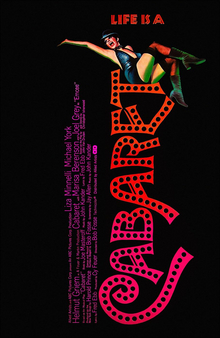
Behind the film
- Year
- 1972
- Director
- Bob Fosse
- Writers
- Jay Presson Allen
- Genres
- Musical, Lgbtq-related, Drama
- Production
- ABC Pictures
- Country
- United States
- Cast
- Liza Minnelli, Michael York, Joel Grey, Helmut Griem, Fritz Wepper, Marisa Berenson, Ralf Wolter, Elisabeth Neumann-Viertel
About the film
Contains story spoilers.
Cabaret offers the nightclub as a place where people can appear to set aside the world, then asks how long that separation can hold. The Kit Kat Klub has its own welcome, its own performances and its own invitation to enjoy what is immediately in front of you. Beyond that invitation, Berlin is changing. The film's tension comes from keeping pleasure and danger close enough that neither can be dismissed as somebody else's story. Its musical form makes that closeness especially unsettling: an attractive performance can interrupt anxiety, comment on it or reveal how readily an audience participates in something it has not fully questioned.
Bob Fosse directs the 1972 film, with Liza Minnelli as Sally Bowles, Michael York as Brian Roberts and Joel Grey as the Master of Ceremonies. Jay Presson Allen wrote the screenplay, drawing on a chain of stage and literary sources connected to Christopher Isherwood's Berlin writing. John Van Druten belongs to that source history rather than the film's screenplay credit. The distinction matters because this is a particular adaptation with its own relationships and dramatic emphasis. It should not be assumed that every version of Cabaret tells precisely the same story or arrives at the same account of its characters.
In 1931, Sally and Brian become friends and lovers, then both become involved with wealthy Max. Sally's pregnancy brings the possibility of leaving for England, but she has an abortion and remains in Berlin while Brian departs. Fritz reveals his Jewish background before marrying Natalia. Alongside these relationships, Nazi presence grows, culminating in uniformed audience members inside the club. The ending does not show Sally escaping the surrounding political danger. It leaves her continuing within the world she has chosen, while the club's audience makes the changing conditions impossible to treat as entirely outside.
Sally's attraction to performance is more complicated than a simple refusal to be serious. A stage can offer a person an identity that everyday circumstances have not secured. Applause supplies immediate confirmation, even when it cannot guarantee a future. The film makes that appeal understandable without making it sufficient protection. Wanting life to become exciting can coexist with a reluctance to imagine what follows the exciting moment. That tension gives Sally's choices emotional force. A conventional escape may look like safety from one perspective and the disappearance of the self she wants to be from another.
Brian enters with a different relationship to the city, but being an observer does not keep him outside its encounters. Private experimentation and political recognition proceed alongside one another. The film asks what it means to notice danger while continuing to live among pleasures that make danger feel temporarily remote. Awareness is not a single achievement after which judgement becomes reliable forever. It must affect choices, including uncomfortable choices about attachments and departure. That makes his relationship with Sally part of the broader question of who can leave, who intends to stay and what staying requires someone to overlook.
Max's wealth introduces the confidence that access and influence might be enough to manage events. In the romantic triangle, material generosity can make an unequal arrangement appear glamorous rather than precarious. In the wider setting, the same habit of confidence can become a dangerous misreading of power. The film allows those two scales to speak to each other without claiming that every personal betrayal is identical to a political catastrophe. What links them is the temptation to treat another person's forces and intentions as manageable because one's own position has previously supplied protection. Past privilege is no guarantee of future control.
The performances make the audience part of that problem. Music is not simply a pause in which the surrounding story stops mattering. It can expose a shared appetite, make an assumption entertaining or carry a disturbing implication beneath an inviting surface. The Master of Ceremonies occupies the boundary between welcome and discomfort, drawing attention to the conditions under which a room agrees to enjoy itself. Reading those conditions matters more than treating every number as a detachable statement with one meaning. The film's musical world is active within its drama, creating relationships between what people applaud and what they are willing to see.
The final presence of Nazi uniforms inside the club removes the comfort of imagining a secure private enclave. An entertainment space exists within a society, and its changing audience can disclose that society's direction even while the show continues. Cabaret leaves its personal stories alongside that recognition rather than supplying a romantic resolution that would overwhelm it. The film's world is compelling because pleasure remains vivid as the danger becomes clearer. Its harder question is what people do when pleasure ceases to be a reliable barrier: whether they recognise the change, explain it away or keep performing as though the room has remained the same.