
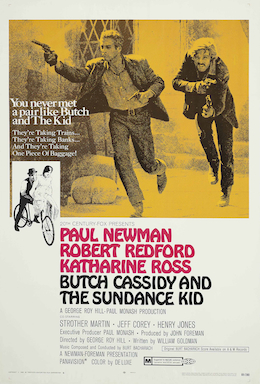
Behind the film
- Year
- 1969
- Director
- George Roy Hill
- Writers
- William Goldman
- Genres
- Buddy, Comedy drama, Western, Biographical
- Production
- 20th Century Studios
- Country
- United States
- Cast
- Paul Newman, Robert Redford, Katharine Ross, Strother Martin, Henry Jones, Jeff Corey, George Furth, Cloris Leachman
About the film
Contains story spoilers.
Butch Cassidy and the Sundance Kid begin as train robbers whose repeated success brings the Union Pacific’s determined posse after them. They escape across a river and learn the railroad has hired an elite team to pursue them until they are dead. Butch, Sundance and Sundance’s partner Etta Place flee to Bolivia, where they become bank robbers known as the Yankee Bandits. A short attempt at honest work ends when their employer is killed in a robbery, and Etta returns to the United States. Butch and Sundance resume holding up banks, until local authorities surround them in San Vicente and call in the army. Wounded and low on ammunition, they rush out of cover together; the film freezes on their run as gunfire begins, leaving their deaths implied rather than shown.
George Roy Hill approaches the western as a story about people who are already learning how to enjoy their own reputations. The attraction of the outlaw image matters alongside the trouble of maintaining it. A reputation can make strangers generous, frightened or eager to join an adventure, but it can also tempt its owner to mistake applause for security. The film's lightness depends on that double perspective: viewers can appreciate a stylish escape while recognising that charm will not keep every problem manageable. Its heroes seem at home in a story about themselves, even as the surrounding world becomes less willing to follow the rules of that story.
Paul Newman and Robert Redford create a partnership through contrasting energies. Newman’s Butch is talkative, inventive and keen to imagine a fresh angle, while Redford’s Sundance is more reserved and quick to measure danger. Their exchanges have the rhythm of people who know each other well enough to disagree without explaining every assumption. The film’s comedy often comes from that difference: one man can turn a problem into a scheme, the other can puncture the scheme with a practical question. Friendship here is less a declaration than a shared way of moving through uncertainty.
Butch’s charm is not a substitute for competence, and Sundance’s skill does not make him a complete strategist. Each relies on the other’s strengths, while their confidence in their own improvisations repeatedly encounters a world that has begun adapting to them. The Union Pacific’s pursuit matters because it is organized and persistent rather than a single foe to outdraw. The pair can be funny and magnetic without being made invulnerable. Their outlaw life has consequences, and the film’s buoyancy gains tension from watching two men accustomed to escape meet a system that can keep following.
Katharine Ross’s Etta Place adds a third perspective to a story otherwise tightly organized around male friendship. She is neither an ornament nor a moral lecturer; her presence offers intimacy, practical intelligence and a limit to the men’s fantasy of endless escape. The film gives her a separate point of view about what it means to live beside outlaws, even though the narrative remains more interested in Butch and Sundance. Her decision to leave marks a boundary the men cannot charm away. That choice changes the emotional shape of the trio without requiring the film to turn her into a villain or a prize.
Conrad Hall's widescreen photography makes space a part of the partnership. Open country offers freedom of movement, but it also exposes fugitives whose survival depends on remaining difficult to locate. The image can make the men look expansive and vulnerable within the same journey. The film's use of sepia supplies a different kind of distance, suggesting a remembered past rather than an unmediated historical record. That visual invitation suits a tale whose characters have become larger than the surviving facts of their lives. The audience is asked to enjoy a crafted legend while still noticing the boundary between a persuasive screen personality and a person who existed outside the frame.
The bicycle sequence and Burt Bacharach’s score make the film’s tonal mixture unusually clear. The music can bring a contemporary pop sensibility into a western without insisting that every moment be solemn or historically sealed. A playful tune can accompany a quiet interlude, then leave the audience aware of how different that ease is from the characters’ unsettled future. The bicycle itself changes the usual frontier iconography: the scene lets the outlaws play rather than simply prove toughness. These departures help explain why the film’s humor feels part of its world, not a pause from it.
William Goldman's story makes friendship capable of sustaining a life without necessarily changing its direction. The pair can respond brilliantly to a sudden problem while remaining less imaginative about what they want beyond the next escape. That is a different limitation from cowardice or a lack of skill. Familiar roles can become comfortable enough to outlast the circumstances that made them useful. The film's humour allows the audience to recognise that trap without withdrawing affection. Butch and Sundance remain appealing because their confidence is shared, fallible and vividly human; the unease comes from seeing how easily mutual understanding can become a reason to keep attempting the same kind of future.