
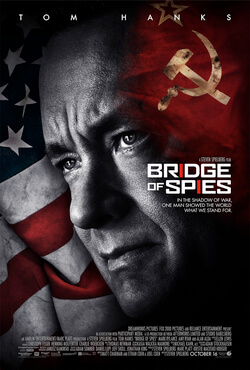
Behind the film
- Year
- 2015
- Director
- Steven Spielberg
- Writers
- Matt Charman, Ethan Coen, Joel Coen
- Genres
- War, Trial, Biographical, Historical
- Production
- Touchstone Pictures, DreamWorks, Reliance Entertainment
- Country
- United States, Germany, India
- Cast
- Tom Hanks, Mark Rylance, Amy Ryan, Alan Alda, Austin Stowell, Will Rogers, Sebastian Koch, Mikhail Gorevoy
About the film
Contains story spoilers.
The story begins in 1957 New York, where Rudolf Abel is arrested for espionage and James B. Donovan is appointed to defend him. Donovan is an insurance lawyer with past government service, not a specialist in spies. He nevertheless treats the case as a test of the legal system: Abel deserves a vigorous defense even when the public assumes his guilt. Donovan protects the confidentiality of his conversations from CIA pressure and argues that the government’s search lacked a warrant. Abel is convicted, but Donovan persuades the judge to spare him execution, reasoning that a living prisoner could matter if the United States ever needed an exchange.
The courtroom argument brings danger into the Donovan family’s life. People harass him, and shots are fired at the family home. The film shows this hostility through ordinary places—a street, a kitchen, a doorway—rather than presenting the Cold War only as distant headlines. Donovan’s wife Mary and their children see the cost of his decision, while he continues to insist that the treatment of an unpopular defendant reflects on the country doing the prosecution. His appeal reaches the Supreme Court but fails, leaving Abel in prison. Years later, that failed defense becomes the reason American officials turn to Donovan when a new crisis presents a possible use for the prisoner.
Later, U-2 pilot Francis Gary Powers is shot down over the Soviet Union and captured. East German intermediaries send Donovan a message suggesting a back channel may permit an exchange. Donovan travels to Berlin as the wall is being built and finds a city physically divided by checkpoints, fences and armed guards. The proposed deal is not simple: the Soviets want Abel for Powers, while East Germany wants recognition and has also detained American student Frederic Pryor. The CIA is chiefly interested in its pilot. Donovan argues that leaving Pryor behind would make the exchange morally and politically incomplete.
Donovan has to negotiate with more than one authority. He meets Soviet representatives and then Wolfgang Vogel, the East German lawyer acting for his government. Each party treats the meeting as a chance to claim leverage, and even the location of a conversation signals who holds power. Donovan’s insistence on including Pryor makes the Americans impatient, but he bluffs that there will be no agreement unless both men are released. The film makes his work look less like an action mission than a series of small decisions about what to say, what to concede, and when to keep a possibility alive. Abel remains an important presence in the negotiation despite being absent from most of it.
The exchange is arranged at Glienicke Bridge for Abel and Powers, with Pryor’s release to occur at Checkpoint Charlie. At the bridge, the wait becomes the central suspense: Powers is present, but officials cannot yet confirm Pryor’s release. Donovan insists that Pryor’s release must be part of the deal. Abel, seeing the care Donovan took over his case and the second prisoner, also refuses to move ahead alone. Once confirmation arrives, the exchange proceeds. Making Abel’s patience part of the climax gives the spy story a quiet counterweight to tense statecraft.
The film is based on actual Cold War events, but dramatizes conversations, motives and the personal rhythm of Donovan’s work. It closes by noting the government’s public recognition of him, Abel’s reunion with his family, and the later request for Donovan to undertake further negotiations. Spielberg repeatedly places a single person against architectural lines: courthouse benches, fences, train platforms and the stark span of the bridge. Those spaces make diplomacy visible without reducing it to speeches. Tom Hanks plays Donovan as persistent and practical, while Mark Rylance gives Abel a guarded humor and composure that complicate the public image of an enemy agent.
The title’s bridge is both a real crossing and a way to understand the film’s central labor. Donovan does not erase antagonism between governments; he creates a narrow route through which captives can return home. The legal defense and prisoner exchange are linked by his belief that procedure and humane treatment matter even when inconvenient. The film’s major turns come from holding that principle under pressure: in court, in the family home and in Berlin as officials bargain over people as symbols. Its final passage back to American life is modest after the exchange, showing the personal consequences of his work follow him home.
The movie’s shifting locations give its negotiation scenes different textures. In New York, legal procedure unfolds in wood-paneled courtrooms and familiar neighborhood streets; in Berlin, barriers and cold exteriors make every crossing feel provisional. Janusz Kamiński’s photography uses gray winter light and strong lines of separation, while Thomas Newman’s score stays measured rather than turning each discussion into a victory speech. The restrained style suits Donovan’s method: he watches, listens and presses a point again when others want to move on. The suspense comes from the uncertain status of the people being exchanged, not from a hidden gadget or a last-minute fight.