
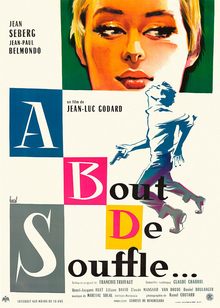
Behind the film
- Year
- 1960
- Director
- Jean-Luc Godard
- Writers
- Jean-Luc Godard
- Genres
- Drama, Crime
- Country
- France
- Cast
- Jean-Paul Belmondo, Jean Seberg, Daniel Boulanger, Jean-Pierre Melville, André S. Labarthe, Claude Mansard, François Moreuil, Henri-Jacques Huet
About the film
Contains story spoilers.
Michel steals a car and kills a pursuing policeman, then reaches Paris and seeks Patricia, an American student and aspiring journalist with whom he has had an affair. He tries to collect money and persuade her to escape to Rome, while she remains uncertain about their relationship. His photograph appears in the press, and the police question Patricia. She initially protects him but eventually reports his location, then tells him what she has done. Michel refuses to run away. When the police arrive, he is shot and staggers through the street before collapsing. His dying words pass through another person’s explanation, leaving Patricia trying to understand both the language and the man. The escape story ends with a gap in understanding rather than a romantic resolution.
Jean-Luc Godard gives Michel a style before granting him much substance. Jean-Paul Belmondo’s gestures suggest a man who has learned to recognise himself through images of male confidence. A pose can offer an identity quickly, without requiring the difficult work of earning it. That is part of Michel’s attraction and part of his danger: he can make carelessness look like independence. The film lets the audience see the performance as performance, so fascination does not require accepting his account of himself. He behaves as though a suitably convincing attitude might turn an ordinary criminal predicament into an adventure with the glamour of a movie he remembers.
Patricia introduces a different uncertainty. Jean Seberg does not make her a stable moral answer to Michel, and the relationship depends on the distance between their ways of speaking and interpreting each other. To him, hesitation can look like an obstacle that charm ought to overcome. To her, the same hesitation can be a way of finding out what she wants before committing to a role he has already imagined. The romance therefore contains a struggle over authorship. Michel wants a partner in his escape, but wanting someone to join a story is not the same as knowing what that person would choose independently.
Paris provides more than a picturesque setting for that disagreement. The city allows people to move among strangers, pass through public spaces and appear briefly at ease without possessing any secure place within them. A street can suggest possibility while also making a person conspicuous. The film’s movement keeps that double meaning active: Michel may look free because he is always going somewhere, yet going somewhere can also mean that he cannot safely remain where he is. Urban life supplies audiences for his self-presentation and routes for his evasion. It does not promise that either one will give him a future beyond the next encounter.
The jump cuts make continuity feel provisional. Instead of treating every transition as something to conceal, Godard allows the removal of time to register within the movement of a scene. The effect can make a conversation seem impatient with its own duration, as though the film were moving past connective material to catch an attitude or a glance. That rhythm suits a character whose confidence outruns his planning, but it is not simply an illustration of Michel’s mind. It also gives the viewer an active relationship with the image, asking what has been omitted and refusing the comfort of a world whose every step arrives smoothly explained.
The conversations create a different rhythm from the criminal pursuit. A question can wander into a performance of cleverness, and apparent intimacy can dissolve into a remark that reveals how little the speakers understand each other. Godard permits that uncertainty to occupy time rather than turning every exchange into a clue that advances a chase. The result is a crime film in which the relationship is not merely a delay before the decisive action. Talking becomes an activity with consequences of its own. Michel and Patricia are trying out descriptions of life, desire and freedom, and those descriptions can bring them together without giving either a reliable account of the other.
Raoul Coutard’s black-and-white photography helps join the immediacy of faces to the public world around them. The actors can seem intensely present without the city becoming a neatly arranged frame for their feelings. That relationship between a fictional couple and ordinary-looking surroundings gives the film a useful friction. A glamorous self-image must share space with the unromantic details of moving, waiting and asking for money. Godard’s screenplay, developed from François Truffaut’s original treatment, keeps the recognisable outline of a fugitive story while allowing its texture to resist the polish that outline might suggest. The narrative can be familiar even when the experience of its scenes remains unsettled.
The difficulty of translation becomes a fitting place to leave the relationship. Language offers the possibility of intimacy, but it can also let a person believe that a shared word guarantees a shared meaning. Michel’s manner has relied on being recognisable, and Patricia’s uncertainty has repeatedly exposed the limits of that recognition. The ending does not settle their connection by announcing which person understood love correctly. It leaves a face trying to make sense of an explanation. That unresolved act of looking prevents the romance from becoming a simple legend of doomed lovers, preserving the more awkward possibility that fascination and misunderstanding have occupied the same space from the beginning.