
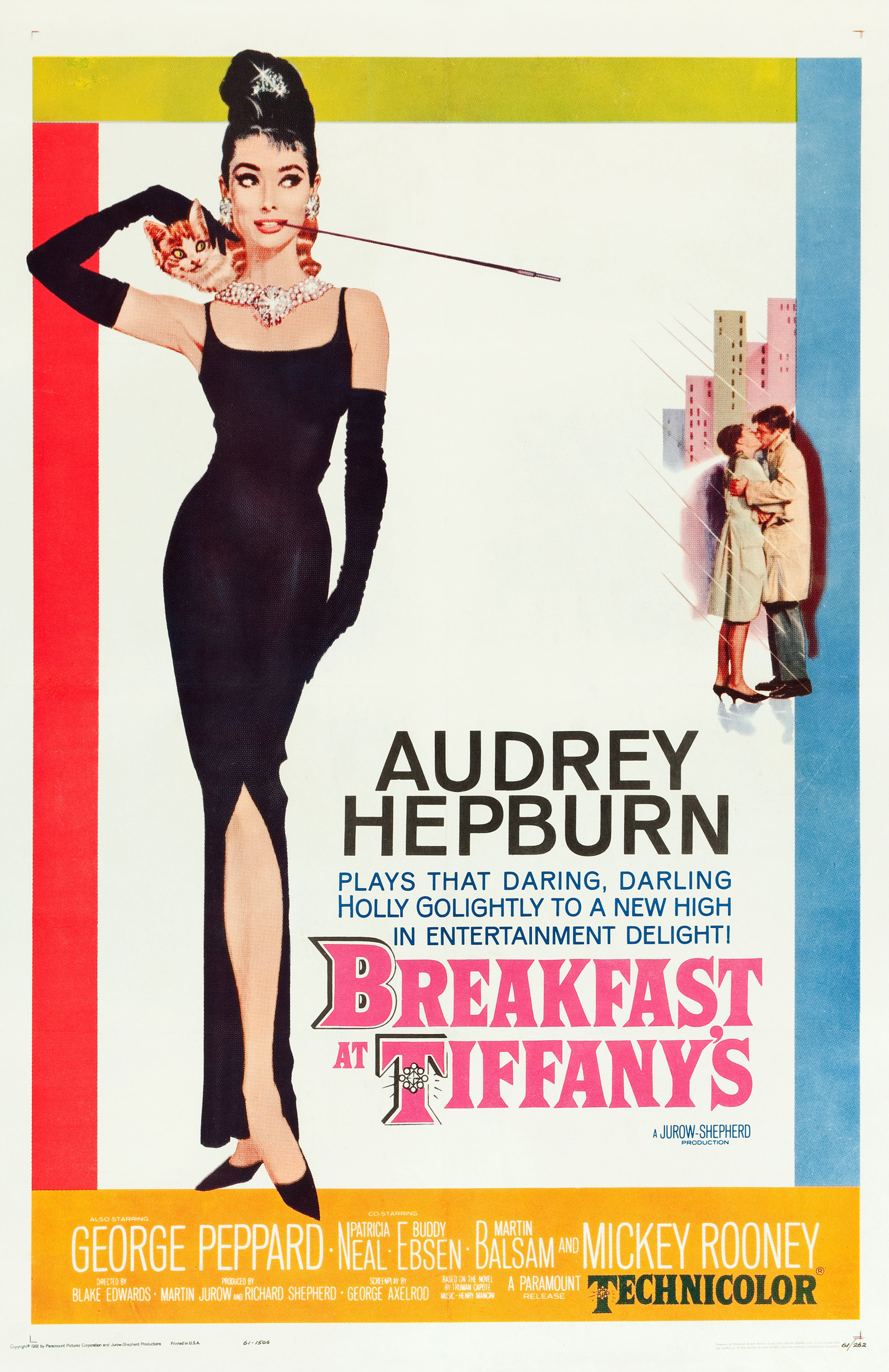
Behind the film
- Year
- 1961
- Director
- Blake Edwards
- Writers
- George Axelrod
- Runtime
- 1h 54m
- Genres
- Romantic comedy, Drama
- Production
- Paramount Pictures
- Country
- United States
- Cast
- Audrey Hepburn, George Peppard, Patricia Neal, Mickey Rooney, Buddy Ebsen, Martin Balsam, José Luis de Vilallonga, Alan Reed
About the film
Contains story spoilers.
Holly Golightly begins her day outside Tiffany’s, a quiet and glamorous counterpoint to the hurried parties and unstable arrangements that fill her life. She lives in a modest East Side brownstone with a cat she refuses to name and often relies on the upstairs neighbor, Mr. Yunioshi, to let her into her own apartment. The film treats this mix of polish and disorder as part of Holly’s self-presentation: she can stage an elegant entrance, then admit that she has no settled home or plan. Her visits to the jewelry store calm what she calls the “mean reds,” but that sense of refuge is personal, not proof that she simply wants marriage or a wealthy protector.
Her new neighbor Paul Varjak is a writer who has not published in years and is financially supported by an older, married woman he calls 2E. Holly makes a living through paid social visits and a weekly trip to Sing Sing to see Sally Tomato, an imprisoned former mobster. His lawyer pays her to relay coded weather reports from the prison visits, a routine she regards as harmless and useful income. Paul becomes curious about her as she moves between cocktail parties and private anxiety. Their conversations show different kinds of dependence: Holly accepts money from men while defending her right to choose her next step, and Paul accepts 2E’s support while privately imagining himself as a serious author.
The film lets Paul enter Holly’s past through an unexpected visitor: Doc Golightly, the Texan she married as a teenager. Holly explains that the marriage was annulled and that she once cared for Doc’s children; she does not want to resume that earlier life. Paul helps send Doc away, but the encounter makes clear that her polished city identity has been built after a difficult departure. She also talks about her brother Fred, whose return from military service is a concern and a reason she says she needs money. Rather than treating Holly’s life as a puzzle for Paul to solve, the story gives her own ambitions and anxieties room to steer the relationship, even when she conceals parts of them.
Paul and Holly spend a day together doing things each has never done before. The sequence includes a visit to Tiffany’s, where Paul has a ring from a box of Cracker Jack engraved for her, and small adventures that loosen their usual roles. Their closeness grows, but Holly continues to imagine a different future: she plans to marry José, a wealthy Brazilian, and leave for Brazil. Paul’s attachment does not automatically become her obligation. The film’s romantic comedy structure increasingly asks whether the life Holly pictures for herself is really the life she wants, while her choices remain shaped by money, the desire to escape insecurity, and a fear of becoming emotionally tied to one place.
When Holly returns from an outing with José, she learns that Fred has died and tears through her apartment in grief. Later she is arrested because the coded messages she carried for Sally Tomato have connected her to a narcotics investigation. Her innocence in the larger scheme does not prevent public scandal, and José ends their engagement rather than accept the risk to his reputation. Paul picks Holly up after O.J. Berman arranges her bail. She still intends to leave for Brazil, but now the plan is mixed with anger, shame, and the feeling that everyone else is deciding what her future should be. The crisis puts her independence under pressure without turning it into a simple choice between romance and selfishness.
In the cab, Paul tells Holly that he loves her and challenges her habit of treating every attachment as something she can discard before it hurts. Holly responds by pushing the nameless cat out into the rain and insisting that she will still go to Brazil. Paul leaves her with the engraved ring and gets out to search for the cat. Holly then changes her mind, races back through the wet streets, and finds Paul with the animal. The reunion is her decision, not a legal or financial rescue: she has to choose whether to acknowledge the bond she has formed. The film closes on that embrace, offering a romantic ending that differs from the more open-ended source novella.
The movie’s bright surfaces and breezy pace sit beside details that complicate its fantasy of effortless sophistication. Holly’s glamorous clothes and public performances coexist with loneliness, money worries, and the history she would prefer to leave behind. The film also contains a conspicuously racist performance: Mickey Rooney’s Mr. Yunioshi is played as a caricature of a Japanese man, a dated and harmful comic device that remains part of the finished film and should not be excused as harmless period humor. That portrayal sits uneasily beside the story’s attention to Holly’s self-definition. Audrey Hepburn, George Peppard, and Patricia Neal anchor the New York triangle, while the film’s songs and color design give Holly’s imagined freedom a polished, wistful surface.