
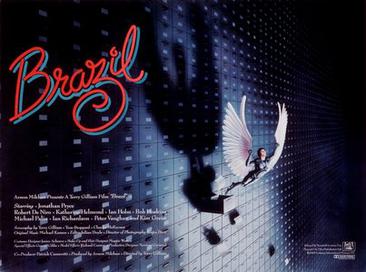
Behind the film
- Year
- 1985
- Director
- Terry Gilliam
- Writers
- Terry Gilliam, Tom Stoppard, Charles McKeown
- Runtime
- 2h 23m
- Genres
- Neo-noir, Science fiction, Fantasy, Science fiction comedy
- Production
- Regency Enterprises
- Country
- United Kingdom, Australia
- Cast
- Jonathan Pryce, Kim Greist, Robert De Niro, Katherine Helmond, Ian Holm, Bob Hoskins, Michael Palin, Peter Vaughan
About the film
Contains story spoilers.
Sam Lowry works inside a bureaucracy where a typing error sends the wrong man to his death. Trying to resolve the paperwork, he meets Jill, the woman who resembles the figure in his dreams. His pursuit of her brings him closer to the machinery he once tolerated. Meanwhile, unauthorised repairman Harry Tuttle offers practical help that the state treats as subversion. Sam alters records to protect Jill, but is arrested and taken for interrogation by his acquaintance Jack. A spectacular rescue appears to lead to escape with Jill. It is a fantasy: Sam remains in the torture chamber. This account follows Terry Gilliam's director's cut, whose bleak conclusion differs from the shortened version given a reassuring ending.
Brazil imagines oppression as an environment of administrative inconveniences that everyone has learned to accommodate. The terrifying feature is the intimacy of that accommodation. Forms, offices and service calls seem like mundane tools for keeping society organised, yet their combined effect is to make human beings subordinate to the categories assigned to them. Sam initially wants room for private comfort inside this arrangement, rather than a new arrangement altogether. Jonathan Pryce's performance gives that limited ambition a recognisable texture. His reluctance does not resemble grand defiance; it resembles the weary wish to get through a day without being drawn into someone else's problem.
The designed world makes such privacy almost impossible. Ducts and mechanisms intrude on living space, so the apparatus that supposedly serves people looks capable of swallowing them. Norman Garwood's production design turns functional infrastructure into a dominating visual presence. The clutter is more than atmospheric decoration. It makes comfort dependent on equipment that is awkward, conspicuous and subject to a larger authority. A room can promise domestic refuge while displaying the systems that prevent it from becoming one. Roger Pratt's cinematography lets bodies inhabit this imposing environment rather than allowing the setting to disappear behind a neatly isolated protagonist.
The humour depends on procedure continuing when common sense would require it to stop. An official response can be meticulous in its formal details and grotesquely inattentive to the situation before it. This is why the film's absurdity feels connected to ordinary frustrations, despite its extreme scale. The logic of responsibility becomes a means of avoiding responsibility: an individual can follow a rule and claim that the outcome belongs elsewhere. The bureaucracy protects that separation. Gilliam's comic vision places the smooth explanation beside the visibly disastrous reality, allowing the audience to feel how much effort a society might expend on remaining officially correct.
Sam's dreams answer that world through spaciousness, flight and a heroic self-image. Their appeal comes from more than the chance to possess power. They supply a reality in which intention seems to translate directly into meaningful action, without committees, paperwork or compromised motives. Yet that apparent freedom is also a simplification. A woman can become the embodiment of rescue rather than a complicated person with an independent life. The contrast between the dream's clarity and the waking world's friction makes fantasy a refuge whose limitations matter. Escaping into an image of oneself does not necessarily produce the attention needed to understand another person.
Kim Greist's Jill and Robert De Niro's Tuttle introduce energies that disturb Sam's preferred retreat. Practical activity becomes significant in a world where permission can matter more than usefulness. Michael Palin's Jack offers a different disturbance: a familiar social presence can coexist with participation in something appalling. That casting arrangement makes the danger harder to dismiss as the work of obviously alien monsters. Katherine Helmond's presence contributes to the film's interest in surfaces, status and the effort to maintain a desirable appearance. Across these relationships, private ambitions do not sit outside the system; they provide some of the reasons people accept or reproduce it.
Michael Kamen's music contributes to the uneasy relationship between reassurance and menace. A melody can seem to promise emotional shelter while accompanying a world that offers very little. The title's association with a song gives Brazil a sense of longing rather than a literal geographical destination. Combined with Julian Doyle's editing, the film's movement between elaborate spectacle and constricted daily life keeps its emotional scale unstable. A moment can expand toward extravagant liberation and then expose how narrow the available space actually is. The experience belongs to dark comic science fiction, but its unease comes from social habits as much as technological invention.
The director's cut runs 143 minutes in Criterion's edition; identifying that version is essential to understanding the film's argument. Its ending makes imagination powerful without pretending that imaginative freedom repairs material harm. The final separation between subjective refuge and objective defeat denies an easy conversion of endurance into victory. At the same time, the system's inability to reach every part of a person's inner life prevents its triumph from feeling uncomplicated. Brazil asks what remains when a society has made practical escape almost impossible, and whether that remainder is consolation, tragedy or both. Its grotesque machinery makes the question visible in rooms, bodies and everyday transactions rather than leaving it as an abstract warning.