
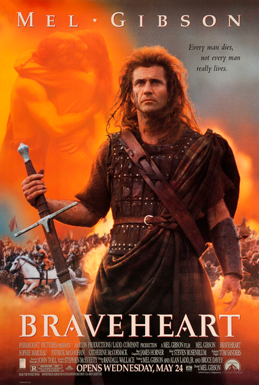
Behind the film
- Year
- 1995
- Director
- Mel Gibson
- Writers
- Randall Wallace
- Runtime
- 2h 58m
- Genres
- Biographical, Drama, War, Action
- Production
- The Ladd Company, Icon Productions
- Country
- United States
- Cast
- Mel Gibson, Sophie Marceau, Patrick McGoohan, Catherine McCormack, Angus Macfadyen
About the film
Contains story spoilers.
Mel Gibson’s Braveheart frames William Wallace’s rebellion through personal loss. As a boy, Wallace survives the fighting that kills his father and brother, then leaves Scotland with his uncle Argyle. Years later he returns as an adult, hoping to live quietly and marry his childhood sweetheart Murron. They wed in secret to avoid the English lord’s claim over local women. When English soldiers assault Murron, Wallace rescues her, but she is later arrested and executed in public. The violence turns his private grief into a political cause. He attacks the garrison in his home village and is soon followed by others willing to risk a fight against English rule.
Wallace’s early victories make him a symbol before he has become a reliable leader. He gathers a force of local fighters and wins at Stirling, where the film stages a large battlefield confrontation as both action spectacle and a contest over who can persuade ordinary people to stand together. The nobles reward him with a title, but their support is conditional and divided by ambition. Robert the Bruce is drawn between admiration for Wallace and his father’s effort to secure the Scottish crown through accommodation with England. Wallace’s tactical confidence contrasts with the cautious calculations of men who can gain power without sharing his risks. The conflict is not simply Scotland against England; it is also a struggle over whether noble status or popular resistance will determine the country’s future.
King Edward I responds by sending Princess Isabella to negotiate while preparing further military action. Isabella develops a relationship with Wallace instead, and later passes him information about English plans. The film makes this romance a personal channel into the politics of the court, while presenting Edward as a ruler who tries to manage the rebellion through force, money and dynastic influence. Wallace’s attention remains fixed on freedom, but the intimacy of the romance complicates the impression that his choices are purely strategic. The characters live inside a film that values bold gestures and intense feeling; private meetings and public confrontations alike are staged as moments that can redirect the whole conflict.
At Falkirk, Wallace’s army is undermined when the Scottish nobles fail to support him as promised. Robert the Bruce, acting under his father’s influence, appears to betray Wallace, and the defeat exposes how vulnerable a popular uprising is when it depends on aristocrats who can change sides. Wallace later kills two nobles who have taken English bribes, then continues the resistance. Mornay and Lochlan, the nobles who betrayed him at Falkirk, are killed before Wallace is captured. Bruce regrets his earlier conduct and tries to help, but Wallace is later lured into a separate conspiracy arranged by other nobles and seized in Edinburgh. The film then moves him to London for trial, narrowing the conflict from open battle to imprisonment.
Wallace is tried and condemned to death. Before his execution, he refuses to plead for mercy, and his final cry of “Freedom” becomes the film’s emotional hinge. The sequence turns the body under torture into a last political statement, and the crowd’s reaction suggests that the state can kill the leader without extinguishing what he represents. The film carries the rebellion beyond Wallace's death through Robert the Bruce's subsequent decision to fight. In the closing movement, he leads Scottish forces at Bannockburn and invokes Wallace’s cause as the army faces the English. The ending offers a victory of inheritance and conviction, though it is a cinematic resolution rather than a careful reconstruction of the chronology of the Wars of Scottish Independence.
Braveheart’s landscapes and battle scenes make political conflict feel physical: mud, distance and the mass of bodies determine what a commander can actually ask of his soldiers. Gibson’s Wallace is written as a charismatic center, but supporting characters give the campaign competing forms of loyalty, from Hamish’s friendship to Bruce’s divided conscience. James Horner’s score adds a lyrical sound to the film’s violence, especially when intimate scenes and wide views of the Highlands appear in succession. The movie’s emotional clarity is part of its effectiveness, while its historical simplification is also a limit: it compresses events and invents or reshapes relationships to build a dramatic arc around one hero.
The film should be read as historical drama, not as a source for the actual medieval record. Wallace was a real Scottish leader, but Braveheart rearranges chronology and invents important personal and political connections, including the film’s relationship between Wallace and Isabella. It also alters the circumstances and presentation of battles and the final campaign. The closing charge at Bannockburn turns Wallace's earlier call into a collective action, giving the film a dramatic culmination even though the hero himself cannot witness it. That distinction allows the final appeal to freedom to be considered as a piece of popular cinema without mistaking its dramatic inventions for evidence about what happened.