
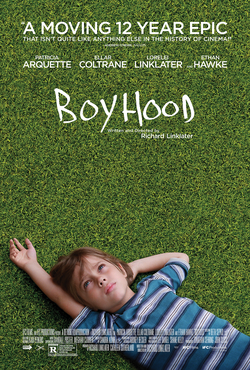
Behind the film
- Year
- 2014
- Director
- Richard Linklater
- Writers
- Richard Linklater
- Runtime
- 2h 45m
- Genres
- Drama, Coming-of-age
- Country
- United States
- Cast
- Ellar Coltrane, Patricia Arquette, Ethan Hawke, Lorelei Linklater, Marco Perella, Brad Hawkins, Zoe Graham, Libby Villari
About the film
Contains story spoilers.
Boyhood begins with six-year-old Mason living with his mother, Olivia, and sister, Samantha. Olivia moves the family to Houston, pursues her education and marries a professor whose drinking becomes abusive. She leaves with her children, who lose their new stepfamily too. Their father remains involved while building another household. As the years pass, Mason finds an interest in photography, navigates school and relationships, and grows more independent. Olivia's later relationship also fails. Mason's romance with Sheena ends, but a photography award and scholarship help him move towards college. His departure brings his mother's sense of loss into focus. The film finishes with new acquaintances on a hike, where the possibility of living in the present matters more than a declaration that adulthood has arrived.
The unusual pleasure of this story is that change rarely announces itself in advance. A person who seemed permanent can become part of an earlier household; something that felt like the whole world at school can shrink when there is a different classroom and a new group of friends. Boyhood invites us to notice those adjustments rather than wait for one incident to explain Mason completely. That makes its subject larger than a sequence of childhood memories. It asks how a life accumulates when the person living it cannot yet recognise which details will matter. A passing conversation and a major disappointment occupy the same continuing stream, with neither providing a final definition of who he is.
Filming the same actors over twelve years gives that idea a physical presence. Faces and voices change without a replacement performer arriving to signal the next stage. It is still a fictional family, with a written story and constructed scenes, but the passage of time belongs to the bodies on screen as well as the characters. The distinction matters: the film does not offer access to these actors' private childhoods. It uses real ageing to make an invented history feel continuous. An older Mason carries the younger one with him in a way a costume or caption cannot quite supply. Time becomes something the audience can recognise rather than merely accept as a piece of information.
Olivia's place in the film complicates the idea that parents already have life sorted out. Raising children does not suspend her need for education, companionship or a future of her own. Her responsibilities and her attempts to change her circumstances pull against each other. Reading her only as the source of Mason's environment would flatten what the story makes visible: an adult can work hard to improve a family's prospects while discovering that a decision has brought danger or disappointment. Her children's increasing independence therefore carries two meanings. It is evidence of their development, but it also changes the role around which she has organised so much of her life.
The father offers another way of thinking about maturity. Having a connection with a child and being able to provide a dependable structure are related achievements, but they are not identical. The film leaves room for affection, conversation and influence without treating those qualities as an automatic answer to every parental responsibility. From Mason's position, adults can be generous in one moment and limited in another. That mixed picture avoids turning growing up into the simple discovery that one parent was right and another was wrong. Understanding people becomes part of adulthood precisely because love does not make their contradictions disappear, and a changed person cannot erase the consequences of an earlier version of himself.
Mason's interest in photography fits the story's concern with attention. Taking a picture involves deciding that something ordinary deserves to be held and examined. It offers a possible direction without proving that every uncertainty has been solved. A young person can recognise a talent before knowing how to sustain it, or find meaning in an activity while resisting the expectations attached to success. Boyhood makes room for that awkward middle stage. It is useful to separate becoming interested from becoming accomplished: the former can begin quietly, while the latter asks for discipline and encounters with other people's judgements. An emerging identity needs space to try things before it can be reduced to a career description.
The everyday settings also keep this life from becoming an abstract argument about childhood. Family rooms, schools and the movement between households make belonging practical. Where someone sleeps, who sets the rules and which adults are present shape what freedom actually means at a particular age. A child cannot simply choose a different domestic world when the current one becomes difficult. As Mason gets older, his ability to leave grows, but leaving has its own costs. Independence creates new possibilities while changing the relationships that made it possible. The film's span allows that tension to develop slowly, so departure can feel like a beginning for one person and a painful absence for another.
By the end, Boyhood has not assembled a formula for the correct life. Its shape suggests that understanding often arrives after an experience, when there is enough distance to see what changed. That gives the closing encounter a modest kind of hope. Mason does not need to deliver a finished account of himself before entering a new place. The years already lived matter, but they do not dictate every future conversation or attachment. A childhood can be formative without being a closed explanation. The film's deep subject is the movement between those two ideas: we carry what has happened, and we still have to meet the next moment without knowing what it will become.