
Behind the film
- Year
- 2006
- Director
- Larry Charles
- Writers
- Sacha Baron Cohen, Anthony Hines, Peter Baynham, Dan Mazer
- Genres
- Parody, Mockumentary, Comedy
- Production
- 20th Century Studios
- Country
- United States, United Kingdom
- Cast
- Sacha Baron Cohen, Ken Davitian, Luenell, Pamela Anderson
About the film
Contains story spoilers.
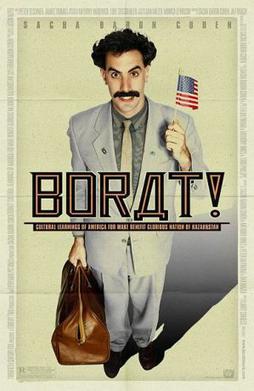
Borat arrives in America with a television crew's official assignment and a private appetite for chaos. Sacha Baron Cohen plays a fictional reporter whose enthusiasm is inseparable from his prejudice: he asks apparently innocent questions, announces appalling beliefs and waits for the person opposite him to respond. His homeland is an invented comic setting, so the opening village scenes establish a character's absurd worldview rather than describe Kazakhstan. The journey combines a scripted road movie with encounters presented in the style of documentary footage. That mixture is essential to understanding what happens. Borat can be following a ridiculous personal quest while the people he meets appear to be dealing with an unfamiliar visitor asking for advice.
The assignment is diverted when Borat sees Pamela Anderson on television and decides that she should become his wife. His producer Azamat expects a film about American society, but Borat turns the expedition toward California without initially revealing his motive. Their vehicle is an old ice-cream truck, an appropriately awkward home for a journey that keeps breaking the rules of ordinary travel. This romantic quest is already a joke about entitlement: Borat has fallen for a television image and assumes that reaching the actress will give him a claim on her. Anderson functions as a destination and a projection of his wishes long before she becomes someone who can answer him.
The interviews work by making everyday conversational rules unstable. Borat can ask about customs and then introduce an offensive assumption as though it needs only a practical explanation. A respondent must decide whether to correct him, accommodate him or end the conversation. The film edits those reactions into comic confrontations, and politeness sometimes prolongs an encounter that would otherwise stop immediately. A rodeo provides a larger version of the mechanism, with patriotic enthusiasm turning into hostility when his performance changes direction. The discomfort belongs partly to the character's conduct and partly to the uncertainty of watching others decide how much of it they will tolerate in public.
His fear of Jewish people gives another encounter an especially sharp reversal. Borat and Azamat receive hospitality at a bed-and-breakfast, then interpret their hosts through a fantasy of supernatural danger. Their fear tells us about the visitors, while the welcome itself contradicts what they claim to believe. The episode does not require the hosts to deliver a speech explaining the absurdity; the difference between ordinary kindness and Borat's interpretation is visible in the situation. Elsewhere, a formal dinner tests manners and inclusion. Borat brings Luenell into a room whose residents have been attempting to manage his behavior, and the evening breaks down around the arrival of someone he is willing to treat as a companion.
Azamat eventually discovers the deception behind the California trip, and their dispute destroys what remains of the expedition's professional appearance. Their hotel fight spills into public spaces, making other people's orderly events the setting for a feud that belongs to the two travelers. Once Azamat leaves, Borat loses the person who organizes his transport, money and paperwork. Hitchhiking exposes him to a different kind of conversation, including fraternity members whose remarks become part of the film's account of prejudice. Information about Anderson punctures his fantasy, but he responds as though her life has violated an agreement she never made with him. His disappointment continues the satire of a man confusing desire with ownership.
A religious gathering gives Borat a new route west, and he finds Azamat again in Los Angeles. Their reunion finally brings him to an Anderson book signing, where his proposed marriage becomes an attempted abduction and security stops him. The destination refuses to behave like the reward at the end of a romantic adventure. He later reunites with Luenell and returns to his village with her, carrying American habits into the same grotesque fictional community introduced at the start. The homecoming supplies an ending to the journey without converting Borat into a reliably enlightened person. New consumer goods and borrowed rituals can coexist with the prejudices he took abroad.
Larry Charles directs a comedy in which pauses and interruptions often do more than conventional punchlines. The camera can remain close enough to an exchange for us to notice somebody trying to preserve dignity, calculate a response or decide whether they have been insulted. Other scenes become deliberately enormous physical spectacles, using Borat's body and lack of restraint to overwhelm a hotel or public event. Cohen's unwavering performance holds those modes together: he can make the reporter sound sincerely curious even when the question is designed to be intolerable. Azamat offers a competing authority inside the traveling crew, frequently behaving as though Borat's worst assumptions are merely practical problems to be managed.
The documentary appearance does not make every sequence a transparent record of spontaneous life. The film has actors, planned narrative events and editing that shapes the encounters into a particular story. Its American journey is selective, assembled around moments of provocation rather than an attempt to represent everyone in the country. That construction leaves the viewer in an uncomfortable position as well: laughter can come from Borat's obvious stupidity, a respondent's prejudice or somebody's attempt to be gracious under pressure. These are different targets, and the film moves between them quickly. Understanding that shifting relationship helps explain why the comedy feels more abrasive than a straightforward collection of jokes delivered by a knowingly outrageous performer.